
How to Store Crypto Safely Long-Term (2026 Guide)
Complete guide to long-term crypto security, hardware wallets, and inheritance.
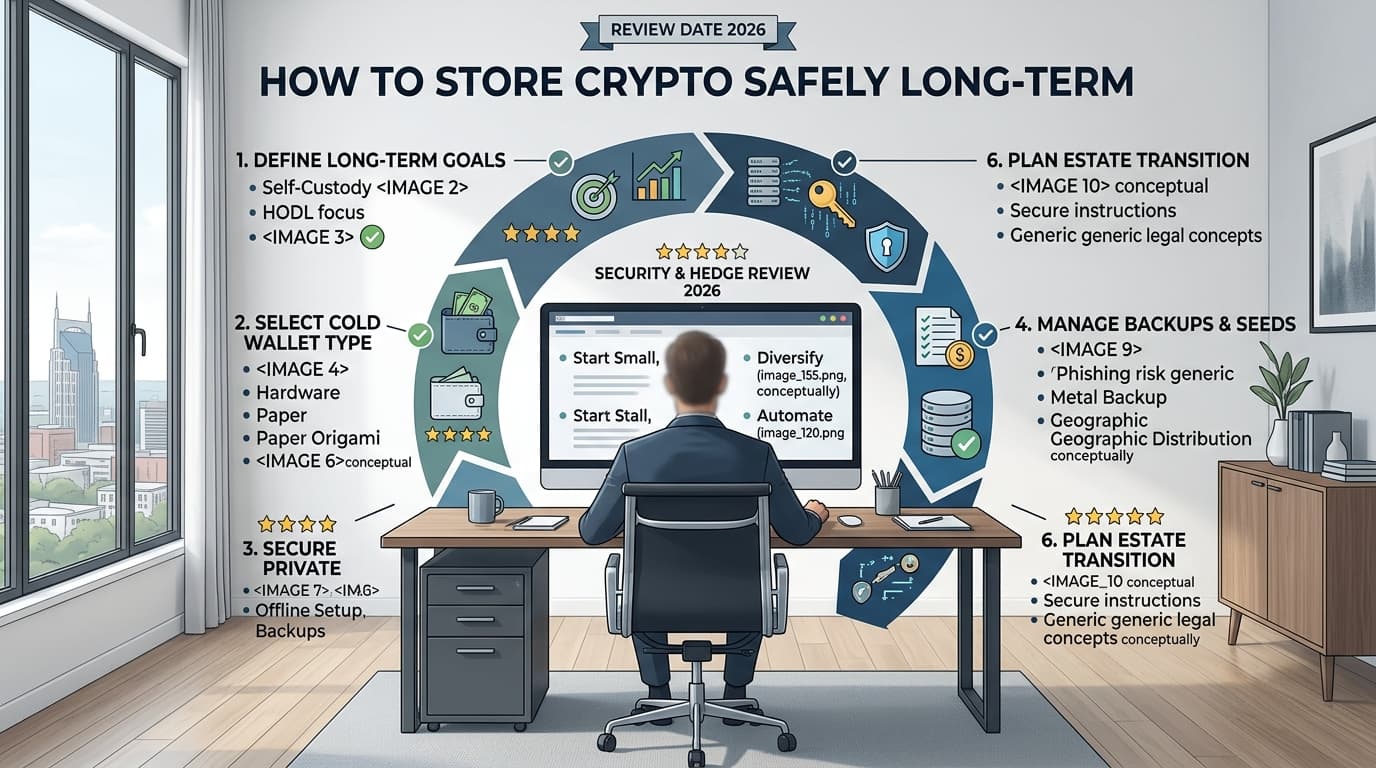
The Short Answer
Store crypto safely long-term using a hardware wallet, a metal seed phrase backup, a secure inheritance plan, and regular firmware updates — never rely solely on exchange storage for crypto you plan to hold for years.
How to Store Crypto Safely Long-Term (2026 Guide)
By DadAlt Investments | Category: Crypto | Last Updated: March 2026
Most people think the hard part of crypto investing is picking the right coins. It isn't. The hard part is keeping what you've accumulated. In 2025 alone, hackers stole a record-breaking $2.78 billion to $4.04 billion in cryptocurrency — the Bybit exchange hack in February 2025 drained $1.5 billion in a single attack, making it the largest crypto heist in history.1 And that's just theft. Billions more have been permanently lost simply because owners died, forgot a PIN, or stored a recovery phrase somewhere that couldn't survive a house fire. Long-term crypto security is not a single decision — it's a system with four interlocking layers: where you store it, how you protect device access, how you back up your recovery information, and what happens if you're no longer around to manage it. This guide walks through every layer in plain language, gives you the specific tools and habits that actually work in 2026, and explains the mistakes that cause permanent, irreversible loss.
The Four Layers of Crypto Security
Think of securing crypto like securing a physical safe. You need to choose the right safe (Layer 1), make sure only you can open it (Layer 2), keep a copy of the combination somewhere it can't be destroyed (Layer 3), and make sure your family can access it if something happens to you (Layer 4). Miss any layer and you have a plan with a hole in it.
| Layer | What It Protects Against | Primary Tool |
|---|---|---|
| Layer 1: Storage location | Exchange collapse, hack, account freeze | Hardware wallet (cold storage) |
| Layer 2: Device & account security | Unauthorized access, SIM swap, phishing | PIN, authenticator app 2FA, dedicated email |
| Layer 3: Seed phrase backup | Device loss, fire, flood, physical damage | Metal backup plate, geographic redundancy |
| Layer 4: Inheritance planning | Permanent loss on death or incapacity | Crypto will, Shamir's Secret Sharing |
Layer 1: move crypto to a personal wallet Is the Foundation
Why the Exchange Is Not Your Final Storage Solution
When your crypto sits on an exchange — even a reputable one — the exchange holds the private keys. You hold an account balance. That distinction becomes catastrophic when exchanges fail: FTX ($8B+), Celsius, Voyager, BlockFi, and Mt. Gox all collapsed while holding customer funds. In every case, users who couldn't withdraw their coins lost some or all of their holdings. Users with self-custody kept everything.
The safest way to store crypto in 2026 is using a hardware wallet combined with a metal seed phrase backup, keeping 90% of holdings in cold storage and only 10% on exchanges for trading.
Choosing Your Hardware Wallet
A hardware wallet is a dedicated physical device — roughly the size of a USB thumb drive — that generates and stores your private keys entirely offline. Because the keys never touch the internet, they are immune to remote hacking.
Top hardware wallets for U.S. investors in 2026:
- Ledger Nano X (~$149) — Supports 5,500+ coins and tokens. Bluetooth connectivity for mobile use with Ledger Live. CC EAL5+ certified secure element chip. Best all-around choice for most beginners and intermediate holders.
- Trezor Model T (~$219) — 100% open-source firmware, publicly auditable by security researchers. Touchscreen. Supports 1,800+ coins. No Bluetooth (which some security experts prefer). EAL6+ certified secure element on newer models.
- Trezor Safe 3 (~$79) — budget system-friendly Trezor entry point. Secure element chip. Open-source. Good starting option for holders under $5,000.
- Ledger Nano S Plus (~$79) — Budget Ledger option. USB-C. 5,500+ coin support. No Bluetooth.2
Related: Best Hardware Wallets for Long-Term Crypto Storage — our full comparison with detailed reviews of each device.
Important: Only purchase hardware wallets directly from the manufacturer's official website — never from Amazon third-party sellers, eBay, or any secondhand source. Counterfeit and pre-tampered hardware wallets are a real threat. A compromised device may have a pre-loaded seed phrase already known to the attacker, meaning the moment you fund the wallet, they can drain it.3
The Practical Threshold: When to Move to Hardware
| Amount in Crypto | Storage Recommendation |
|---|---|
| Under $500 | Reputable exchange is acceptable; low risk justifies convenience |
| $500 – $5,000 | Hardware wallet strongly recommended |
| $5,000+ | Hardware wallet is essential; no exceptions |
Layer 2: Device and Account Security
Owning a hardware wallet doesn't make you secure if your exchange account gets compromised or your hardware wallet is stolen with a guessable PIN. Layer 2 closes those gaps.
Hardware Wallet: Set a Strong, Unique PIN
Your hardware wallet's PIN is the first barrier if someone physically obtains your device. Without the correct PIN, the device wipes itself after a set number of failed attempts (typically 3 for Trezor, up to 8 for some Ledger configurations).
- Do: Choose a PIN of at least 6 digits that is random and unique
- Do not: Use your birthday, a repeating number (1111), or a sequential number (1234)
- Do not: Write the PIN on the same piece of paper or in the same location as your seed phrase
- Advanced: Some wallets support a passphrase (sometimes called the "25th word") — an additional secret added to your seed phrase that creates a completely separate, hidden wallet. Even if someone finds your seed phrase, they cannot access the passphrase-protected wallet. Store the passphrase separately from your seed phrase, never together.4
Exchange Accounts: Use an Authenticator App — Not SMS
All your exchange accounts should have two-factor authentication (2FA) enabled. But not all 2FA is equal:
- Authenticator app (Google Authenticator, Authy): Generates a time-based code on your phone. Even if someone steals your password, they cannot access your account without physical possession of your phone running the app. This is the minimum acceptable standard.
- SMS text message 2FA: Vulnerable to SIM-swapping — a social engineering attack where a criminal convinces your mobile carrier to transfer your phone number to their device. Once they control your number, they receive your SMS codes and can reset your exchange password. This has resulted in millions of dollars of crypto theft. Never use SMS 2FA for crypto accounts.
- Hardware security key (YubiKey): The strongest option. A physical USB or NFC device that must be physically present to complete login. Recommended for accounts with $10,000+ in holdings.5
Use a Dedicated Email Address for All Crypto Accounts
Create a separate email address — one that is not linked to your name, not used for any other purpose, and not publicized anywhere — specifically for your crypto exchanges accounts and wallet software. If your primary personal or work email is compromised, your crypto accounts remain isolated. Use a strong, unique password for this email and protect it with authenticator-app 2FA.
Never Access Wallets or Exchanges on Public Wi-Fi
Public networks — coffee shops, airports, hotels — are trivially monitored by anyone else on the same network. A sophisticated attacker can intercept traffic or deploy a fake access point. Only access exchanges and crypto wallets software on a trusted private network.6
Keep Operating Systems and Software Updated
- Enable automatic OS updates on any computer you use for crypto
- Update Ledger Live and Trezor Suite firmware promptly when updates are released — manufacturers release patches for discovered vulnerabilities, often quarterly4
- Run reputable antivirus/anti-malware software on any computer used to access crypto accounts
- Never download wallet software from any source other than the official manufacturer website
Layer 3: Seed Phrase Backup Strategy
Your seed phrase — typically 12 or 24 words generated by your hardware wallet during setup — is the master key to everything. It is the only way to recover your crypto if your hardware wallet is lost, stolen, damaged, or destroyed. It is more important than the wallet itself.
If someone else obtains your seed phrase, they can drain your entire wallet from anywhere in the world with no other information. If you lose your seed phrase and your wallet is destroyed, your crypto is gone permanently — no company, no government, no court order can recover it.3
The Non-Negotiables of Seed Phrase Security
Write it by hand, immediately, in order, in pen. The moment your hardware wallet generates the seed phrase, write each word down — carefully, in the exact order shown — on the recovery card that comes with the device. Use a ballpoint pen, not a pencil (which can fade or smear). Number each word.
Never:
- Photograph it with your phone
- Type it into a computer, notes app, or text file
- Email it or text it to yourself
- Store it in Google Drive, iCloud, Dropbox, or any cloud service
- Say the words aloud near smart speakers (Alexa, Google Home, Siri)
- Enter it into any website, even one claiming to be your wallet's official recovery portal
Always verify: After writing down your seed phrase, most hardware wallets prompt you to confirm it by selecting words in order. Complete this verification step without skipping. It is your only proof that you recorded it correctly.
Upgrade from Paper to Metal
Paper is vulnerable. It can burn in a house fire, disintegrate in a flood, fade over time, or simply get lost. For any holding over $1,000, upgrade your seed phrase backup to a metal plate.
Recommended metal seed phrase backup products:
- Billfodl — Marine-grade 316 stainless steel; tiles slide in; fire and flood resistant; widely considered one of the most durable options available7
- Cryptosteel Capsule — Sold by Ledger; compact capsule design; stainless steel; resists fire up to 1,400°C and extreme physical impact
- Trezor Keep Metal — Aerospace-grade stainless steel; supports 20-word SLIP39 Shamir backups; tamper-evident seals; made by Trezor for direct compatibility8
- Coinplate Alpha — German stainless steel; fire resistant to 1,400°C; straightforward stamping design
These devices store your seed phrase in a format that survives fires, floods, and decades of physical storage in ways paper simply cannot.
Geographic Redundancy: Two Locations
A single backup — even a metal one — is still a single point of failure. Your house could burn down. Your safe could be stolen. A second verified copy stored in a physically separate location eliminates that risk.
Recommended two-location strategy:
- Location 1: Home fireproof safe, or a hidden secure location inside your residence
- Location 2: Bank safety deposit box — a separate physical building that will almost certainly survive any disaster affecting your home
Users maintaining multiple geographically separated seed phrase copies report 80%+ successful asset recovery after device loss, damage, or theft.
Never store both copies in the same building. If the building is destroyed, both backups are gone.
Advanced: Shamir's Secret Sharing (SSS)
For holders managing five figures or more, Shamir's Secret Sharing is a cryptographic technique that splits your seed phrase into multiple "shares," where a defined threshold of shares is required to reconstruct the original seed.
For example, in a 3-of-5 Shamir backup: you create five shares, store each in a different location (or with a different trusted person), and any three of the five can recover your wallet. Even if one or two shares are lost, stolen, or destroyed, your funds remain safe. Critically, any single share by itself reveals nothing about the seed.9
Trezor's SLIP39 standard supports Shamir backup natively. It is the most secure seed backup method available for individual investors, though it adds complexity to setup and recovery. It is appropriate for large holdings and should be implemented with the assistance of detailed manufacturer documentation.
Layer 4: Inheritance and Estate Planning for Crypto
This is the layer most crypto holders skip entirely — and it is the layer that causes billions of dollars in permanent, intergenerational loss every year.
It is estimated that billions of dollars in Bitcoin and other cryptocurrencies have already been permanently lost simply because the owners passed away or became incapacitated without a viable succession plan. Unlike a bank account or a stock certificate, which is tied to your identity, the ownership of cryptocurrency is proven by one thing only: control of a secret private key.
Unlike a traditional bank account, there is no estate recovery mechanism for crypto. No executor can call a phone number. No death certificate unlocks a seed phrase. No court order reverses the blockchain. If your heirs cannot find and correctly use your seed phrase and hardware wallet PIN, the funds are gone forever.
Write a "Crypto Will"
This is not your actual legal will — it is a private, separate document that contains everything your trusted executor needs to access your crypto holdings. It should include:
- A list of all exchanges where you hold accounts, with account email addresses (not passwords in this document — see below)
- Location of each hardware wallet (which drawer, safe, or location)
- Location of each seed phrase backup (where the paper or metal backup is stored)
- Clear instructions on how to use the hardware wallet — or a pointer to a trusted guide
- Wallet balances or a note that values fluctuate — heirs should know what to expect
- Contact information for a crypto-literate attorney or advisor
Critical: Your crypto will should NOT contain the actual seed phrase or private keys. A legal will becomes a public document during probate — publishing your seed phrase to the public record would expose your funds to immediate theft. Instead, your will should be a pointer document — it tells your executor where to look and what to do, while the actual seed phrase is stored separately in secure physical locations.10
Split Access Between Two Trusted People
One approach that balances security with accessibility: give two trusted people separate pieces of information. Person A knows the location of the hardware wallet and the PIN. Person B knows the location of the seed phrase backup. Neither person alone can access the funds — but together, they can. Your crypto will explains that both people must be consulted together. This approach is described by Charles Fidelity, Vanguard, and Schwab as appropriate for serious individual investors.11
Consider a Crypto-Aware Attorney or Digital Inheritance Service
The Revised Uniform Fiduciary Access to Digital Assets Act (RUFADAA) has been adopted by 47 states, granting executors specific legal rights to access digital assets — but only if the estate documents are structured correctly to invoke that authority.12
Options to explore:
- Estate planning attorney with digital asset experience — can structure a revocable living trust that holds crypto and provides a step-up in cost basis for heirs (reducing capital gains tax), while granting trustee access rights under RUFADAA
- Vault12 Guard — a digital inheritance service that allows you to designate guardians who can help heirs recover access without ever seeing the seed phrase during your lifetime
- Casa or Unchained Capital — multi-signature wallet services with formal inheritance protocols built in13
The Tax Advantage Your Heirs Need to Know About
When heirs inherit crypto assets through a properly structured trust or will, they generally receive a step-up in cost basis to the market value on the date of death. If you bought Bitcoin at $10,000 and it is worth $60,000 when you die, your heirs' cost basis becomes $60,000 — significantly reducing their capital gains tax when they eventually sell.13
Without a proper estate plan, this advantage can be forfeited and the original cost basis documentation may be impossible to reconstruct.
Common Mistakes That Cause Permanent Crypto Loss
These are not rare edge cases — they are the most frequently occurring causes of permanent crypto loss among individual U.S. investors.
-
Storing the seed phrase digitally. Saving it in email drafts, Notes app, Google Drive, iCloud, a screenshot gallery, or a password manager. Any internet-connected storage is hackable. This is the single most common catastrophic mistake.
-
Purchasing a hardware wallet from a third-party seller. Hardware wallets bought from Amazon third-party sellers, eBay, or secondhand marketplaces may have been pre-tampered with. The attacker may have set up the device with a seed phrase they already know. The moment you transfer funds, the wallet is drained. Only buy directly from the manufacturer.3
-
Reusing passwords across exchange and email accounts. If one account in a data breach exposes your password and you've reused it on your crypto exchange or associated email, an attacker has everything they need. Use a password manager (Bitwarden, 1Password) to generate and store unique passwords for every account.
-
Not testing seed phrase recovery before storing large amounts. Write down your seed phrase, then actually verify you can restore your wallet using only those words — on a small test wallet first. Many people discover a transcription error only when it's too late. Hardware wallet manufacturers include a verification step during setup — do not skip it.4
-
Storing seed phrase and hardware wallet in the same location. If your house is robbed or burns down, both are gone simultaneously. The seed phrase backup must be stored in a geographically separate location from the device.
-
Using SMS text message 2FA on exchange accounts. As described above, this is vulnerable to SIM-swap attacks. Replace it with an authenticator app immediately.
-
Falling for seed phrase phishing. No legitimate service — not Ledger, not Trezor, not Coinbase, Kraken, and Gemini, not any tech support person — will ever ask you to enter your seed phrase online. If any website or "support agent" requests your seed phrase for any reason, it is a scam. Close the browser and do not comply.
Ongoing Security Maintenance
Crypto security is not a one-time setup — it is an ongoing practice. Perform the following review every 3–6 months:
- Update hardware wallet firmware from the official app (Ledger Live or Trezor Suite)
- Verify that your seed phrase backup is intact, legible, and still in its intended secure location
- Test that your 2FA apps and exchange login still work correctly
- Confirm your crypto will / inheritance instructions are current (wallet locations, exchange accounts, balances)
- Review whether your cold storage / hot wallet allocation still matches your holdings threshold
- Rotate passwords on exchange accounts if you have any reason to suspect compromise6
FAQ
What is the safest way to store Bitcoin for the long term?
The safest setup combines a hardware wallet (Ledger or Trezor) with a metal seed phrase backup (Billfodl, Cryptosteel, or similar) stored in two physically separate secure locations — one at home, one in a bank safety deposit box. Enable a strong, random PIN on the hardware wallet, and optionally add a passphrase (25th word) for an additional layer of security. Keep the hardware wallet and the seed phrase backup in different locations.4
Can a hardware wallet hold multiple different cryptocurrencies?
Yes. Modern hardware wallets support hundreds to thousands of different assets simultaneously. The Ledger Nano X supports 5,500+ coins and tokens. The Trezor Model T supports 1,800+. Each coin operates in its own separate "account" within the wallet, all secured by the same seed phrase. If you ever need to restore your wallet from the seed phrase, all coin accounts across all supported networks are recoverable from that one phrase.2
What happens to my crypto if I die without leaving instructions?
It is permanently lost. There is no customer service line for the blockchain. No court order can force a blockchain to release funds without a private key. If your heirs cannot locate your hardware wallet, know the PIN, and find the seed phrase backup — or if they don't understand how to use them — the funds are gone. This is why the "crypto will" described in Layer 4 is not optional for anyone holding a meaningful amount of crypto. The Revised Uniform Fiduciary Access to Digital Assets Act (RUFADAA), adopted in 47 states, provides a legal framework for executor access — but only if your estate documents are structured to invoke it.12
How do I test my seed phrase recovery without risking my actual funds?
The safest method: set up a second, separate test wallet on your hardware wallet. Send a small amount — $5 to $10 — into this test wallet. Then perform a full factory reset of the device and restore it using only the written seed phrase. If the $5–$10 test balance reappears after restoration, your seed phrase is correct and fully functional. Delete the test wallet afterward. This process gives you complete confidence that your backup works without ever risking your primary holdings. Never perform a seed phrase test on a wallet holding significant funds.4
Your Long-Term Storage Setup: Summary Checklist
Use this as a practical action plan:
Immediate (do today if you haven't):
- Move all holdings over $500 to a hardware wallet purchased directly from Ledger.com or Trezor.io
- Write down your seed phrase by hand and secure the paper in a fireproof location
- Replace SMS 2FA with an authenticator app on all exchange accounts
- Create a dedicated email address used only for crypto
Short-term (do within 30 days):
- Upgrade from paper to a metal seed phrase backup product
- Store a second verified seed phrase copy in a bank safety deposit box or second secure location
- Test seed phrase recovery on a small test wallet
Ongoing:
- Write or update your crypto inheritance document (your "crypto will")
- Review and update all four layers every 3–6 months
- Consult an estate planning attorney with digital asset experience if your holdings are significant
Sources and References
Disclaimer: This article is for informational and educational purposes only and does not constitute financial, legal, or tax advice. Cryptocurrency involves significant risk, including the potential for total loss. Estate planning and tax situations are highly individual — always consult a qualified attorney, CPA, or financial advisor before making decisions. DadAlt Investments may earn affiliate commissions from some links in this article at no cost to you.
Recommended Reading
- Best Hardware Wallets for Long-Term Crypto Storage
- 5 Crypto Wallets Every Dad Should Know
- How to Move Crypto Off an Exchange to a Wallet
Footnotes
-
Zipmex. "How to Store and Access Crypto Assets Safely: Complete 2026 Guide." January 14, 2026. https://zipmex.com/blog/how-to-store-and-access-crypto-assets-safely-complete-2026-guide/ ↩
-
StealthEX. "What Is a Cold Wallet? Best Crypto Cold Storage Guide 2026." https://stealthex.io/blog/what-is-cold-wallet-crypto-guide/ ↩ ↩2
-
Crypto Daily. "How to Store Cryptocurrency Securely in 2026." March 2026. https://cryptodaily.co.uk/2026/03/how-to-store-cryptocurrency-securely-in-2026/ ↩ ↩2 ↩3
-
ChangeHero. "Secure Crypto Wallet Strategies | Complete Crypto Security Guide 2026." January 13, 2026. https://changehero.io/blog/how-to-store-cryptocurrency-safely/ ↩ ↩2 ↩3 ↩4 ↩5
-
Charles Schwab. "How to Keep a Crypto Wallet and Keys Secure." https://www.schwab.com/learn/story/how-to-keep-crypto-wallet-secure ↩
-
ChangeHero. "Secure Crypto Wallet Strategies | Complete Crypto Security Guide 2026." January 13, 2026. https://changehero.io/blog/how-to-store-cryptocurrency-safely/ ↩ ↩2
-
CoinCodex. "16 Best Metal Crypto Wallets for Seed Phrase Storage in 2026." February 2026. https://coincodex.com/article/23147/best-metal-crypto-wallets-for-seed-phrase-storage/ ↩
-
Trezor. "Trezor Keep Metal — Protecting Your Bitcoin Inheritance with Shamir Backup." https://blog.trezor.io/protecting-your-bitcoin-inheritance-with-shamir-backup-77b5bc77ea5a ↩
-
Trezor Blog. "Protecting Your Bitcoin Inheritance with Shamir Backup." February 2024. https://blog.trezor.io/protecting-your-bitcoin-inheritance-with-shamir-backup-77b5bc77ea5a ↩
-
Blockchain Vest. "Crypto Inheritance Planning Guide | Secure Your Digital Legacy." November 2025. https://www.blockchainvest.org/crypto-inheritance-and-estate-planning/ ↩
-
Charles Schwab. "How to Keep a Crypto Wallet and Keys Secure." https://www.schwab.com/learn/story/how-to-keep-crypto-wallet-secure ↩
-
Ironclad Family. "Cryptocurrency and Estate Planning Guide for 2026." December 2025. https://www.ironcladfamily.com/blog/cryptocurrency-and-estate-planning ↩ ↩2
-
TokenTax. "Intro to Crypto Estate Planning." Updated March 5, 2026. https://tokentax.co/blog/intro-to-crypto-estate-planning ↩ ↩2
Frequently Asked Questions
What's the safest way to store cryptocurrency?
A hardware wallet (Ledger or Trezor) stored in a secure location, with your recovery phrase backed up on a metal plate in a separate location. This protects against hacking, exchange failures, and even house fires.
How do I make sure my family can access my crypto if something happens to me?
Create a detailed inheritance document explaining where your hardware wallet is, how to use the recovery phrase, and which assets you hold. Store this with your will or in a secure location your spouse knows about.
Should I use a metal seed phrase backup?
Yes — paper can burn, get wet, or fade. Metal seed phrase backups (like Cryptosteel or Billfodl) survive house fires and floods. At $50–$80, it's cheap insurance for potentially thousands in crypto assets.

About the Author
Jared DeValk
Founder, DadAlt Investments
Father, alternative investment researcher, and founder of DadAlt Investments. 14+ years turning hard lessons into honest guidance for dads building real wealth.