
Fidelity vs Vanguard vs Schwab: Which Is Best?
Head-to-head comparison of the big three brokerages.
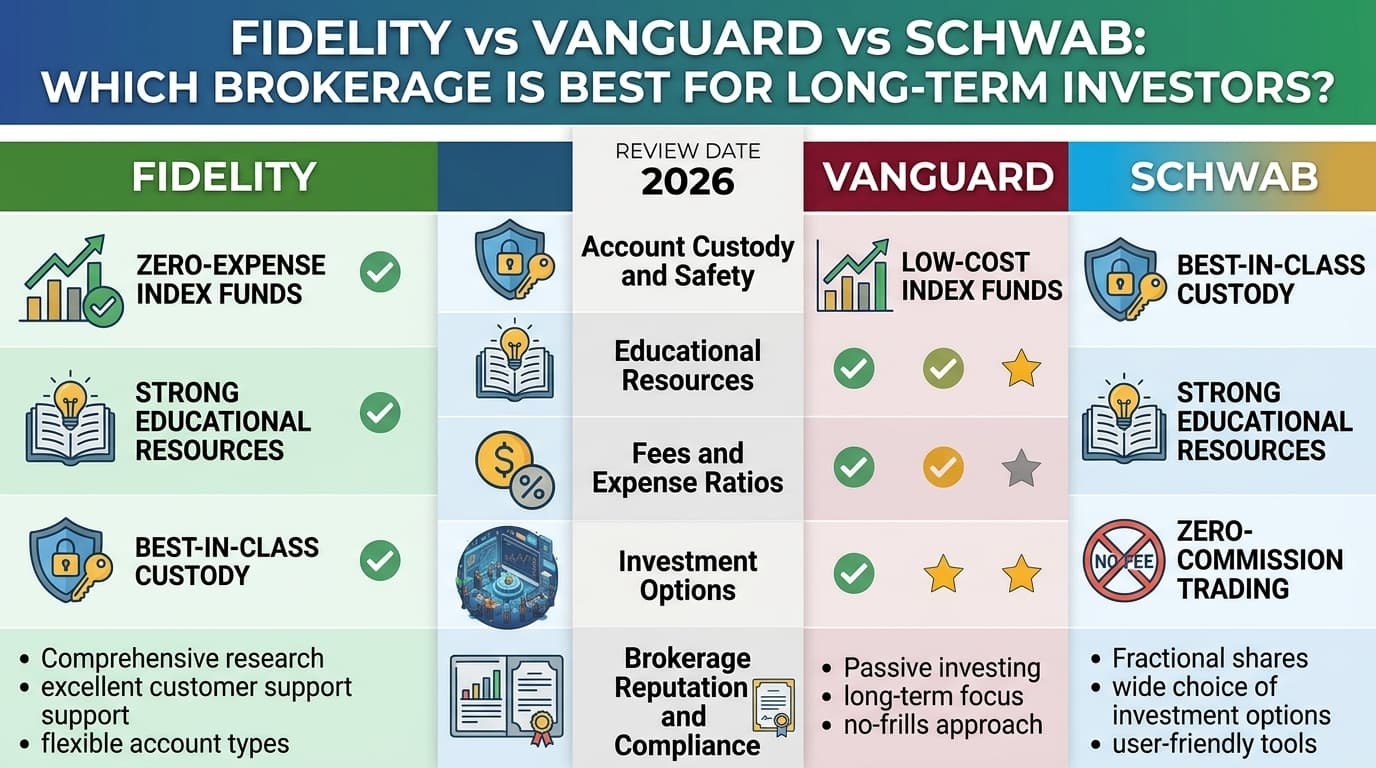
The Short Answer
Fidelity is best for most dads (zero-fee funds, best app), Vanguard is best for buy-and-hold simplicity, and Schwab is best for full-service banking and brokerage combined — you can't go wrong with any of the three.
Fidelity vs Vanguard vs Schwab: Which Brokerage Is Best for Long-Term Investors?
By DadAlt Investments | Category: Stocks & Brokerages | Last Updated: March 2026
Summary
Fidelity, Vanguard, and Charles Schwab are three of the most trusted names in U.S. investing — and for most long-term investors, the decision comes down to fit, not safety. All three are SIPC-insured, offer $0 commissions on stocks and passive income strategies, and provide access to the best platforms for index fundss that form the backbone of every serious wealth-building strategy. The real differences emerge when you look at expense ratios, platform usability, fractional share programs, retirement account features, and who each brokerage was originally built for. This article breaks all of that down clearly so you can choose the right home for your money — or understand why splitting between two of them might be the smartest move of all.
Why the Right Brokerage Actually Matters
It's tempting to assume all brokerages are essentially the same now that commissions have gone to zero. They are not.
The brokerage you choose determines:
- Which funds you can access at zero cost (some are exclusive to specific platforms)
- How easy it is to set up automatic investing and dividend reinvestment
- The quality of your tax reporting — especially important as your portfolio grows
- Whether you have fractional share access to invest any dollar amount
- How much ongoing support you get when something breaks or you have questions
Most importantly, expense ratios compound silently. A fund charging 0.50% per year versus 0.03% per year doesn't sound like much — but on a $200,000 portfolio held for 30 years at 7% average growth, that 0.47% difference in annual fees costs you approximately $96,000 in lost compound interest. The brokerage you open shapes which funds you'll actually use, which shapes your real lifetime return.
All three brokerages reviewed here are:
- Regulated by FINRA and the SEC
- Members of SIPC (Securities Investor Protection Corporation), which protects up to $500,000 per account ($250,000 cash) if the broker fails
- Safe, legitimate, and used by tens of millions of Americans
The question is purely about fit.
Quick Comparison Table (2026)
| Feature | Fidelity | Vanguard | Charles Schwab |
|---|---|---|---|
| Account minimum | $0 | $0 (ETFs); $3,000 for Admiral mutual funds | $0 |
| Best flagship fund | FZROX (0.00%) | VTI (0.03%) / VTSAX (0.04%) | SWTSX (0.03%) |
| Fractional shares | Yes — 7,000+ stocks & ETFs from $1 | Yes — ETFs from $1 | Yes — S&P 500 stocks only, $5 minimum |
| Branch locations | 200+ | None | 400+ |
| Roth IRA, Trad IRA, SEP-IRA | Yes | Yes | Yes |
| Robo-advisor | Fidelity Go (free under $25K) | Vanguard Digital Advisor | Schwab Intelligent Portfolios (free, $5K min) |
| 24/7 customer support | Yes | No | No |
| Proprietary platforms | Fidelity.com + Active Trader Pro | Vanguard.com | Schwab Mobile + thinkorswim |
| Overall StockBrokers.com 2026 rank | Top 5 | Unranked | #1 Overall |
Sources: Fidelity.com, Vanguard.com, Schwab.com, StockBrokers.com 2026 Annual Review (as of February 2026) 123
Fidelity — Best Overall for Most Long-Term Investors
Fidelity was founded in 1946 as a traditional asset manager. Over the past decade it has reinvented itself as arguably the most complete retail brokerage in the United States — combining institutional-quality research with genuinely beginner-friendly tools and the lowest-cost fund lineup in the industry.
The ZERO Fund Advantage
Fidelity's biggest differentiator is a lineup of four index mutual funds with a 0.00% expense ratio — the only funds of their kind available to retail investors anywhere:
- FZROX — Fidelity ZERO Total Market Index Fund (0.00%)
- FZILX — Fidelity ZERO International Index Fund (0.00%)
- FNILX — Fidelity ZERO Large Cap Index Fund (0.00%)
- FZIPX — Fidelity ZERO Extended Market Index Fund (0.00%)
Over the past year, FZROX returned 18.48%, outpacing both SPY (17.69%) and VTI (17.67%). Over five years, it returned 81.75% — ahead of VTI's 65.3% over the same comparable period. The zero fee structure has not come at the cost of performance. 4
There is one important caveat: FZROX and the other ZERO funds are exclusive to Fidelity accounts. They track proprietary indexes built to avoid licensing fees from S&P and CRSP, which is how Fidelity achieves the zero expense ratio. If you ever move your account to another brokerage, ZERO fund shares cannot transfer in-kind and would need to be sold first — a potential taxable event in a non-retirement account. For long-term investors who plan to stay at Fidelity, this is a non-issue. For everyone else, FXAIX (Fidelity's S&P 500 fund at 0.015%) is portable and just as competitive. 5
Other Fidelity Strengths
- Fractional shares on 7,000+ securities from $1. Fidelity's program, called Stocks by the Slice, covers far more stocks and ETFs than Schwab's and allows you to invest odd-dollar amounts including full dividend reinvestment into fractional shares. 6
- 25+ account types, including Youth Accounts for minors, Cash Management (checking) accounts, and Health best high-yield savings accountss (HSAs).
- 24/7 phone and live chat support — the only one of the three that offers round-the-clock human access.
- 200+ branch locations nationwide for in-person service.
- Fidelity Go robo-advisor manages up to $25,000 free of management fees (0.35% annually above $25,000).
- Active Trader Pro is available for free to investors who want advanced charting and real-time data as their portfolio grows.
Fidelity Limitations
- No IRA contribution match (Robinhood currently offers 1–3%)
- Limited direct crypto trading (primarily ETF access only)
- The Active Trader Pro platform has a steeper learning curve for absolute beginners
Bottom Line on Fidelity
Fidelity is the best all-around brokerage for most U.S. investors in 2026 — particularly those who prioritize the lowest possible long-term costs, need fractional share access across a wide range of securities, and value 24/7 support. It is the default recommendation for anyone starting a Roth IRA or taxable account from scratch.
Vanguard — Best for Passive Index Purists
Vanguard was founded in 1975 by Jack Bogle, who invented the index fund for retail investors. It is the only major brokerage structured as an investor-owned company — meaning the funds own the company, which in turn passes cost savings back to investors rather than distributing profits to outside shareholders. This structural alignment is genuinely unique in the industry.
The Vanguard Fund Lineup
Vanguard is home to some of the most widely held index funds in the world:
- VOO — Vanguard S&P 500 ETF (0.03%)
- VTI — Vanguard Total Stock Market ETF (0.03%)
- VT — Vanguard Total World Stock ETF (0.07%)
- BND — Vanguard Total Bond Market ETF (0.03%)
- VTSAX — Vanguard Total Stock Market Index Fund Admiral Shares (0.04%, $3,000 minimum)
Vanguard's average ETF expense ratio is 0.04%, compared to the industry average of 0.23% — an 83% difference. 7 VTSAX and VTI track the CRSP U.S. Total Market Index and have a 0.99 correlation with each other; over a 10-year period, both have delivered annualized returns near 15%. 8
One strategic point worth understanding: you do not need a Vanguard account to hold Vanguard ETFs. VOO, VTI, BND, and VT are all available commission-free at Fidelity and Schwab. The only things you cannot access elsewhere are Vanguard's Admiral Share mutual funds (like VTSAX), which require a Vanguard account and a $3,000 minimum investment.
Vanguard Strengths
- Investor-owned structure that structurally incentivizes low costs indefinitely
- The benchmark index funds that have defined passive investing for 50 years
- Automatic investing and DRIP (dividend reinvestment) available on all funds
- Multiple IRA account types including Roth, Traditional, SEP, and SIMPLE
- Vanguard Digital Advisor robo-advisor for hands-off management
Vanguard Limitations
- Weakest platform and mobile app of the three. Vanguard's Android app carries significantly lower ratings than Fidelity and Schwab. The web interface is functional but dated.
- No fractional shares on mutual funds. VTSAX has a $3,000 minimum to open.
- No 24/7 support. Customer service hours are limited compared to Fidelity.
- No physical branch locations.
- The platform is not designed to grow with you — investors who want to add options, bonds, or individual stocks will find Vanguard limiting.
Bottom Line on Vanguard
Vanguard is the right choice for investors who have already decided on their target allocation (for example: 80% VTI / 20% BND), don't need active platform features, and want to set it and forget it for decades. For everyone else, the best of Vanguard — its ETFs — is available at Fidelity and Schwab with a better experience.
Charles Schwab — Best for Full-Service Long-Term Investors
Schwab was founded in 1971 and has become the most complete full-service brokerage in the United States. It secured the #1 Overall ranking from StockBrokers.com in its 2026 Annual Review — the most comprehensive independent broker ranking in the industry — for "scaling its operations without sacrificing sophistication." 1
The thinkorswim Advantage
Schwab acquired TD Ameritrade in 2020, gaining access to the thinkorswim platform — widely considered the best free professional-grade trading and charting platform available to retail investors. This gives Schwab a unique position: beginner-friendly tools for new investors, and a seamless upgrade path to institutional-level analysis as your portfolio and knowledge grow. Two distinct apps serve these audiences without bloating either experience.
Schwab Strengths
- #1 Overall ranking, StockBrokers.com 2026
- 400+ branch locations — the most physical presence of any online brokerage
- thinkorswim: advanced charting, hundreds of technical indicators, paper trading (simulated investing), and futures access — all free
- Stock Slices fractional shares: invest in any S&P 500 company for as little as $5 per slice, up to 30 companies in a single transaction 9
- Schwab Intelligent Portfolios: free robo-advisor with no management fee (requires $5,000 minimum)
- Competitive index fund lineup: SWTSX (0.03%), SWPPX (0.02%)
- Full range of IRA account types: Roth, Traditional, SEP-IRA, SIMPLE IRA, rollover IRA
- 24/5 trading on hundreds of securities — extended market access outside standard hours
Schwab Limitations
- Fractional share program is narrower than Fidelity's. Stock Slices is limited to S&P 500 companies; you cannot buy fractional shares of ETFs or non-S&P 500 stocks through this program.
- Default interest on uninvested cash is very low (approximately 0.05%) — investors should opt into Schwab's money market fund or a higher-yield option rather than leaving cash in the default sweep.
- No spot crypto trading — limited to crypto ETFs and futures.
- The flagship Schwab Mobile app "feels like it comes from an old-school institution" relative to newer apps, per NerdWallet's 2026 review. 3
Bottom Line on Schwab
Schwab is the best choice for investors who want the most comprehensive ecosystem in a single brokerage — especially those who anticipate growing into options, futures, or advanced research over time, or who value having a physical branch nearby. It is also an outstanding platform for experienced investors who use thinkorswim as a research tool.
Head-to-Head: Retirement Accounts
All three brokerages offer the full suite of IRA account types:
- Roth IRA
- Traditional IRA
- SEP-IRA (for self-employed)
- SIMPLE IRA
- Rollover IRA (for 401(k) transfers)
2026 IRA Contribution Limits (IRS Official)
- Under age 50: $7,500 per year
- Age 50 and older: $8,600 per year (includes $1,100 catch-up contribution)
- Roth IRA income phase-out for single filers: $153,000–$168,000 MAGI
- Roth IRA income phase-out for married filing jointly: $242,000–$252,000 MAGI
Source: IRS Notice 2025-67; confirmed by Fidelity, Schwab, and Vanguard official contribution limit pages 101112
Expense Ratio Comparison for IRA Investments
The fund you hold inside your IRA matters as much as the account itself. Here is how the three platforms compare on their lowest-cost core index funds:
| Fund | Brokerage | Expense Ratio | Annual Cost on $100,000 |
|---|---|---|---|
| FZROX | Fidelity only | 0.00% | $0 |
| FXAIX | Fidelity | 0.015% | $15 |
| VTI / VTSAX | Vanguard (or any broker for VTI ETF) | 0.03% / 0.04% | $30 / $40 |
| SWTSX | Schwab | 0.03% | $30 |
| SWPPX | Schwab | 0.02% | $20 |
The difference between 0.00% and 0.04% on a $100,000 IRA is $40 per year — trivial in isolation. Over 30 years at 7% average growth, that $40 annual difference compounds to approximately $4,000 in lost returns. The real compounding danger is the difference between all three of these options and the actively managed funds or advisor-wrapped products many investors are still holding at higher-cost institutions.
IRA Contribution Match
One feature none of these three brokerages currently offers: a cash match on IRA contributions. Robinhood currently provides 1–3% depending on membership tier. If you are choosing a Roth IRA home purely for the match, see our Best Roth IRA Providers for Beginners review.
Head-to-Head: Platform and Mobile App
| Platform | Fidelity | Vanguard | Schwab |
|---|---|---|---|
| Primary app | Fidelity Investments app | Vanguard app | Schwab Mobile |
| Advanced platform | Active Trader Pro (free) | N/A | thinkorswim (free) |
| iOS App Store rating | ★★★★★ (4.8) | ★★★ (limited data) | ★★★★ (4.7) |
| Beginner-friendly UI | ✅ Excellent | ⚠️ Basic but dated | ✅ Good |
| Paper trading | No | No | ✅ Yes (thinkorswim) |
| Advanced charting | Active Trader Pro | No | ✅ thinkorswim |
For most long-term investors who check their account monthly and primarily add to existing positions, all three apps are sufficient. Where the gap matters is for investors who want to grow — Schwab's thinkorswim is in a different category from anything Fidelity or Vanguard offer on the advanced side, while Fidelity leads on day-to-day ease of use.
The Fee Math: Why This Decision Compounds
To illustrate how fund selection — influenced by your brokerage choice — affects outcomes, consider the following 30-year scenario:
- Starting portfolio: $50,000
- Monthly contribution: $500
- Assumed average annual return: 7% (before fees)
- Time horizon: 30 years
| Fund & Expense Ratio | Ending Portfolio Value |
|---|---|
| FZROX at 0.00% | ~$693,000 |
| VTI at 0.03% | ~$687,000 |
| Average actively managed fund at 0.75% | ~$608,000 |
| Advisor-wrapped account at 1.50% | ~$540,000 |
The gap between a zero-cost index fund and a 1.50% advisor-wrapped account — a common structure at traditional banks and insurance-based advisors — is approximately $153,000 on this modest starting scenario. The gap between FZROX and VTI is negligible. The message is clear: choosing any of these three brokerages over a high-fee alternative is the most important decision. The difference between Fidelity, Vanguard, and Schwab is secondary.
Which Should You Choose? A Decision Framework
Choose Fidelity if:
- You want the absolute lowest fund costs (FZROX at 0.00% is unmatched)
- You need fractional shares across the widest possible range of securities
- You want 24/7 customer support
- You're opening your first account and want the best beginner experience with room to grow
- You want a Youth Account or custodial account for your children
Choose Vanguard if:
- You are a committed passive investor who has already decided on your exact allocation
- You specifically want Vanguard mutual funds like VTSAX (not available elsewhere)
- You don't need platform features beyond basic buy/hold/reinvest
- You value the investor-owned cooperative structure on principle
Choose Schwab if:
- You want the #1-ranked full-service brokerage in 2026
- You value having 400+ physical branch locations for in-person service
- You plan to grow into advanced research tools, charting, or options over time
- You want thinkorswim — the best free professional stock brokerages available
- You value a robo-advisor option with no management fee (Schwab Intelligent Portfolios)
You Can Split — And It's Completely Valid
Many experienced investors use more than one:
- Roth IRA at Fidelity (FZROX for zero-cost retirement compounding) + Taxable brokerage at Schwab (thinkorswim access + branches)
- All accounts at Fidelity for simplicity + hold VTI/VOO inside those accounts if you prefer Vanguard ETFs (they're available commission-free at Fidelity)
- Vanguard for the Roth IRA (VTSAX purist approach) + Fidelity for taxable (better platform and cash management)
There is no wrong answer among these three. The biggest mistake would be staying in a high-fee alternative while debating between them.
Frequently Asked Questions
Can I hold Vanguard ETFs like VTI and VOO at Fidelity or Schwab? Yes. VTI, VOO, BND, VT, and all Vanguard ETFs trade commission-free at both Fidelity and Schwab. The only products exclusive to Vanguard are their Admiral Share mutual funds (like VTSAX, which requires a $3,000 minimum directly at Vanguard).
Which brokerage has the absolute lowest costs overall? Fidelity wins on expense ratios due to the ZERO fund lineup (0.00%). However, FZROX is only available at Fidelity. If portability matters to you, VTI at 0.03% (available anywhere) is effectively tied. The difference on $100,000 is $30 per year.
Can I transfer my account between these brokerages? Yes. ACAT (Automated Customer Account Transfer) allows you to transfer most securities in-kind without selling them. Standard ETFs like VTI and VOO transfer without issue. Fidelity ZERO funds (FZROX, FZILX) cannot transfer in-kind and would need to be sold first — a potentially taxable event outside a retirement account.
Is it OK to have accounts at multiple brokerages? Completely fine. SIPC insurance covers $500,000 per brokerage per account type, so spreading assets across multiple institutions can actually increase your total coverage. There are no tax or regulatory issues with holding accounts at all three simultaneously.
Do all three offer 401(k) rollovers? Yes. Fidelity, Vanguard, and Schwab all accept 401(k) rollovers into a Traditional or Roth IRA. The process takes approximately 1–2 weeks for a direct rollover.
Sources and References
Disclosure: This article is for informational purposes only and does not constitute financial advice. DadAlt Investments may receive compensation through affiliate relationships with the brokerages mentioned. All expense ratios and contribution limits cited reflect data available as of March 2026. Always verify current figures directly with the brokerage before opening an account.
Recommended Reading
- Top Stock Brokerages for New Investors
- Best Platforms to Buy Index Funds
- Best Brokerages for Dividend Investors
Footnotes
-
StockBrokers.com. Charles Schwab Review 2026. https://www.stockbrokers.com/review/charlesschwab — Schwab ranked #1 Overall in the 2026 Annual Review. ↩ ↩2
-
Fidelity Investments. No Minimum Investment Mutual Funds. https://www.fidelity.com/mutual-funds/investing-ideas/index-funds — FZROX and FZILX expense ratio confirmed at 0.00% as of February 1, 2026. ↩
-
NerdWallet. Charles Schwab Review: Our Honest Take for 2026. https://www.nerdwallet.com/investing/reviews/schwab-brokerage — Platform assessment and Stock Slices limitation details. ↩ ↩2
-
24/7 Wall St. Fidelity's Zero-Fee ETF Is Quietly Keeping Pace With the S&P 500. March 10, 2026. https://247wallst.com/investing/2026/03/10/fidelitys-zero-fee-etf-is-quietly-keeping-pace-with-the-sp-500-and-costs-absolutely-nothing/ — FZROX 1-year return 18.48% and 5-year return 81.75% vs comparable benchmarks. ↩
-
Rob Berger. Fidelity ZERO Funds — Are They Worth the Cost? Updated August 2025. https://robberger.com/fidelity-zero-funds-review/ — Analysis of ZERO fund portability limitations and proprietary index structure. ↩
-
Bankrate. Best Brokers for Buying Fractional Shares. January 23, 2026. https://www.bankrate.com/investing/best-brokers-fractional-share-investing/ — Fidelity 7,000+ securities from $1; Schwab S&P 500 stocks from $5. ↩
-
Vanguard. ETF Fees & Minimums. https://investor.vanguard.com/investment-products/etfs/etf-fees — Vanguard average ETF expense ratio 0.04% vs industry average 0.23%, as of December 31, 2025. ↩
-
PortfoliosLab. VTSAX vs VOO Comparison. https://portfolioslab.com/tools/stock-comparison/VTSAX/VOO — 10-year annualized returns: VTSAX 15.60%, VOO 15.80%; 0.99 correlation. ↩
-
Charles Schwab. Fractional Shares — Stock Slices. https://www.schwab.com/fractional-shares-stock-slices — S&P 500 companies, $5 minimum, up to 30 slices per transaction. ↩
-
IRS. 401(k) limit increases to $24,500 for 2026, IRA limit increases to $7,500. November 13, 2025. https://www.irs.gov/newsroom/401k-limit-increases-to-24500-for-2026-ira-limit-increases-to-7500 — Official IRS 2026 IRA limits: $7,500 standard; $8,600 age 50+. ↩
-
Vanguard. Roth IRA Income and Contribution Limits for 2026. https://investor.vanguard.com/investor-resources-education/iras/roth-ira-income-limits — Phase-out confirmed: $153K–$168K single; $242K–$252K married filing jointly. ↩
-
Fidelity. Roth IRA Contribution and Income Limits for 2025 and 2026. https://www.fidelity.com/learning-center/smart-money/roth-ira-contribution-limits — 2026 limit: $7,500 / $8,600 age 50+, consistent with IRS Notice 2025-67. ↩
Frequently Asked Questions
Which brokerage has the lowest fees?
All three offer zero-commission stock and ETF trading. Fidelity has zero-expense-ratio index funds. Vanguard and Schwab funds charge 0.03%. The fee differences between these three are negligible.
Can I switch brokerages without selling my investments?
Yes — you can do an in-kind transfer (ACAT) that moves your exact holdings to a new brokerage without selling. Most transfers complete in 5–7 business days and the receiving brokerage often covers transfer fees.
Which brokerage has the best mobile app?
Fidelity has the best mobile experience — clean interface, fractional shares, excellent research tools, and real-time alerts. Schwab's app is solid too. Vanguard's app is functional but more basic.

About the Author
Jared DeValk
Founder, DadAlt Investments
Father, alternative investment researcher, and founder of DadAlt Investments. 14+ years turning hard lessons into honest guidance for dads building real wealth.