
Simple Budget System for Busy Dads
Low-maintenance budgeting system.
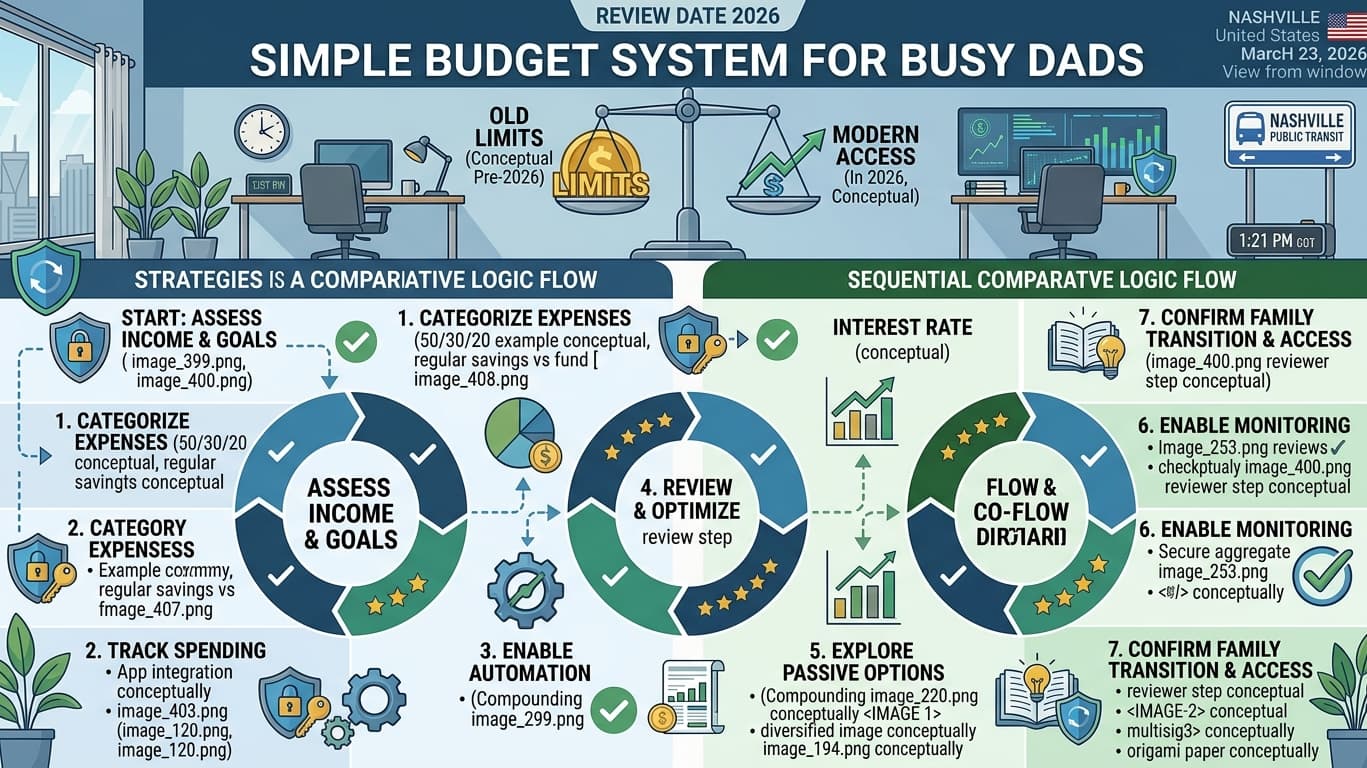
The Short Answer
The simplest budget system for busy dads is the 50/30/20 rule — 50% to needs, 30% to wants, 20% to savings and investing — automated through direct deposit splits so it runs without daily tracking.
Simple Budget System for Busy Dads
Category: Beginner Guides | Financial Independence | Guides & How-To's Target Keywords: family budgeting, personal finance, simple budget system Tags: Beginner Guides · Financial Independence · Guides & How-To's
Disclaimer: This article is for educational and informational purposes only and does not constitute financial, investment, tax, or legal advice. DadAlt Investments may receive affiliate compensation from best budgeting apps for familiess and financial companies referenced in this article. This never influences our editorial recommendations. Always consult a qualified financial advisor before making significant financial decisions.
Summary
Most budgets fail not because dads don't try — they fail because they're too complicated. Between work, kids, family obligations, and a schedule that barely leaves time to eat dinner sitting down, the last thing a busy dad needs is a 47-category Excel spreadsheet that takes two hours to update every week. The average American household spends $78,535 per year — about $6,545 per month — according to the U.S. Bureau of Labor Statistics' 2024 Consumer Expenditure Survey. Despite that spending, roughly 51% of Americans say they're living paycheck to paycheck as of late 2025, per Ramsey Solutions' State of Personal Finance report. The solution isn't more tracking or more complexity. It's a simpler system — one built for real life, with automation, flexibility, and enough breathing room that you'll actually stick with it. This guide introduces the DadAlt 3-Bucket Budget System: a three-part framework that covers every dollar you earn, takes about 30 minutes to set up, and requires only a monthly check-in to maintain. Whether you're a first-time budgeter or someone who has tried and quit a dozen times before, this system is designed to work for the life you actually have — not the one personal finance gurus assume you have.
Introduction: The Budget That Actually Works for Dads
Here's a scene most dads recognize: you sit down on a Sunday night, determined to finally get your finances sorted. You open a new spreadsheet or download a budgeting app. You spend an hour creating categories — groceries, dining out, gas, coffee, kids' activities, streaming services, Amazon purchases, haircuts. You feel productive.
Then life happens. A Wednesday night with unexpected overtime. A Saturday birthday party you forgot about. A car repair that wasn't in the budget. By month three, the spreadsheet is abandoned and the app sends daily notifications you've learned to ignore.
The problem isn't your discipline. The problem is the system.
A budget doesn't have to be perfect to work. It just has to be consistent. The most elaborate budget that gets abandoned in February is worthless. A simple system that runs on autopilot for 10 years builds real wealth.
This guide gives you exactly that: a framework built for dads who have jobs, kids, and approximately zero extra hours per week for financial micromanagement.
Why Most Budgets Fail
Before building a better system, it helps to understand why the old ones break down. Most budget failures come down to four predictable problems.
1. Too Much Detail
Tracking every $3 coffee, every gas station snack, every Amazon impulse purchase is exhausting. It requires daily effort and turns budgeting into a part-time job. Research consistently shows that the more categories a budget has, the less likely people are to maintain it. This isn't a willpower problem — it's a design problem. A budget with 40 line items is asking you to make 40 spending decisions every time you open your wallet. That level of friction is unsustainable for anyone with a full-time job and kids.
2. No Plan for Irregular Expenses
The most common budget-buster isn't overspending on groceries. It's the predictable expenses we treat like surprises: car registration, back-to-school supplies, holiday gifts, annual insurance premiums, and family vacations. These aren't emergencies — they're simply annual costs that most monthly budgets never account for. When they hit, they blow the budget, which triggers guilt, which triggers abandonment. A good system makes room for these costs upfront.
3. No Automation
A budget that requires manual effort every week will eventually fail. Life gets busy, and when the choice is between updating a spreadsheet and watching a movie with your kids, the spreadsheet loses every time. The best budgets automate transfers, savings, and bill payments on payday — before you ever have a chance to spend the money on something else.
4. Doesn't Fit Real Income Patterns
Many budgeting systems assume a clean, consistent paycheck every two weeks. The reality for many dads is messier: one partner works hourly with variable hours, someone does freelance on the side, bonuses or commissions create lumpy income months, or the household runs on two very different pay schedules. A rigid fixed-dollar budget breaks down the moment income varies. A percentage-based system adapts automatically.
The 3-Bucket DadAlt Budget System
Instead of dozens of categories, the DadAlt system uses three buckets. Every dollar you earn goes into one of them. The percentages flex with your income. The automation does the work. The monthly check-in takes 15 minutes.
Here's the overview:
| Bucket | Name | Percentage of Take-Home Income | Purpose |
|---|---|---|---|
| Bucket 1 | Non-Negotiables | 50–60% | Fixed, essential, automated |
| Bucket 2 | Life | 20–30% | Variable, discretionary, limited |
| Bucket 3 | Future Self | 10–20% | Investing, savings, debt payoff |
All percentages are based on take-home pay — your net income after taxes and any pre-tax deductions like 401(k) contributions.
Bucket 1: Non-Negotiables (50–60%)
These are the bills that keep your family housed, fed, insured, and moving. They don't change much month to month, and most can be automated completely.
What goes in Bucket 1:
- Mortgage or rent
- Utilities (electric, gas, water, internet)
- Groceries (weekly grocery bill, not restaurants)
- Insurance premiums (auto, home/renters, life, health if paid directly)
- Minimum payments on all debts (credit cards, student loans, car loans)
- Childcare or daycare
- Subscriptions tied to necessities (cell phone plan)
Benchmarks from the 2024 Consumer Expenditure Survey (U.S. Bureau of Labor Statistics):
| Category | Average Monthly Spend |
|---|---|
| Housing (mortgage/rent + utilities) | $2,189 |
| Transportation (car payment, gas, insurance) | $1,110 |
| Food (groceries + dining) | $660 |
| Healthcare | $516 |
| Total (major non-negotiables) | ~$4,475 |
The BLS survey reports that the average household income before taxes was $104,207 in 2024, with average annual expenditures of $78,535. For a household taking home approximately $75,000–$85,000 after taxes, Bucket 1 should fall between $37,500–$51,000 annually — about $3,125–$4,250/month — to hit the 50–60% target.
The key rule for Bucket 1: Every bill in this bucket should be on autopay. Bank account → bill paid. No manual steps, no risk of a missed payment, no late fees.
If your Non-Negotiables exceed 60% of take-home income, you have a structural budget problem that category adjustments can't solve. The solution is either increasing income or reducing a fixed cost — refinancing, moving, trading down a car, or renegotiating insurance rates.
Bucket 2: Life (20–30%)
This is the bucket where you actually live. Bucket 2 covers everything that makes life enjoyable and is variable enough to be controlled month to month.
What goes in Bucket 2:
- Dining out and takeout
- Entertainment (movies, concerts, sporting events)
- Kids' activities (sports leagues, lessons, camps)
- Clothing and shoes
- Personal care (haircuts, gym membership)
- Subscriptions you want but don't need (streaming services, hobby apps)
- Travel and vacations
- Gifts (birthdays, anniversaries, holidays)
- Miscellaneous cash spending
The Bucket 2 rule is simple: Calculate your monthly Bucket 2 dollar amount. Spend freely within it. Don't track individual categories. When it's gone, it's gone.
That last part is the key psychological shift that makes this system sustainable. You're not budgeting coffee — you're budgeting fun money. As long as you stay within the bucket, every purchase inside it is guilt-free. No more tracking a $12 lunch against a "dining out" line item. No more feeling bad about a $30 Amazon order. The Bucket 2 limit is your freedom boundary, not a cage.
For a household taking home $7,000/month: Bucket 2 at 25% = $1,750/month. That's real money for real life — more than enough for dining out, kids' activities, family entertainment, and still some left over.
Practical tip: Use a dedicated debit card or one credit card (paid in full monthly) exclusively for Bucket 2 purchases. When you check the card balance mid-month, you instantly know how much Life budget remains. No spreadsheet required.
Bucket 3: Future Self (10–20%)
Bucket 3 is where wealth gets built. It should be the first bucket funded — automatically, on payday — before you ever see the money.
What goes in Bucket 3:
- 401(k) contributions beyond the employer match (the match itself is typically deducted pre-tax before you see your paycheck)
- best Roth IRA providers contributions ($7,500/year for those under 50 in 2026; $8,600 for 50+, per IRS Notice 2025-67)
- best high-yield savings accounts account (Emergency Fund vs Investing: What Comes First? top-up, sinking funds)
- Extra debt payoff above minimum payments (for high-interest debt)
- Taxable brokerage contributions (after maxing tax-advantaged accounts)
The Bucket 3 non-negotiable: This bucket moves on payday, not at the end of the month. The single biggest reason Americans fail to save is that they try to save what's left over after spending. Nothing is ever left over. Automate Bucket 3 first — treat it like a bill that goes out the day your paycheck lands — and build your life around what remains.
This is sometimes called "pay yourself first," and the data backs it up. According to Ramsey Solutions' State of Personal Finance Q4 2025, saving money was the top New Year's resolution for 2026 — but only 45% of Americans said they were "very confident" they could handle a $1,000 emergency expense. The gap between intention and execution almost always comes down to automation.
Minimum target: The widely cited benchmark is saving at least 15% of gross income toward retirement, including employer 401(k) matches. If you're starting from zero, don't let that number be paralyzing — begin with 5% and increase it by 1–2% every time you get a raise until you hit 15%.
Setting Up Your Budget in 30 Minutes
You don't need a financial degree to implement this system. You need 30 minutes and access to your bank accounts.
Step 1: Calculate Your Monthly Take-Home Income
Add up all sources of monthly income after taxes. If your income varies (hourly, commission, freelance), use a conservative estimate — the average of your three lowest months, not your highest.
For couples: Add both take-home incomes together. The 3-Bucket system works the same for single-income and dual-income households.
Step 2: List All Fixed Monthly Expenses
Write down every bill that hits automatically each month: mortgage/rent, utilities, insurance, subscriptions, minimum debt payments, and childcare. Don't include dining, entertainment, or variable spending — those go in Bucket 2. Total these up. This is your baseline Bucket 1 number.
Step 3: Assign Bucket Percentages and Calculate Dollar Amounts
| Bucket | Target % | Your Monthly Take-Home | Monthly Dollar Amount |
|---|---|---|---|
| Non-Negotiables | 50–60% | $_______ | $_______ |
| Life | 20–30% | $_______ | $_______ |
| Future Self | 10–20% | $_______ | $_______ |
If your fixed expenses in Step 2 exceed your Bucket 1 target, you have a gap to close before moving forward. If they're well under 50%, you have room to direct more to Bucket 3.
Step 4: Set Up Automatic Transfers on Payday
- On payday, Bucket 3 transfers automatically to your investment accounts and high-yield savings
- Bills in Bucket 1 are on autopay from your main checking account
- Your Bucket 2 balance is whatever is left after Step 3 and Step 4 above
Most major banks allow you to schedule recurring transfers tied to your payday date. Set them up once and let them run.
Step 5: Review Once a Month — Adjust as Needed
Schedule a 15-minute "money date" with yourself (or your partner) at the end of each month. Check three things:
- Did Bucket 1 cover all fixed bills without overdraft?
- Did Bucket 2 stay within its limit?
- Did Bucket 3 transfer successfully?
That's it. Adjust percentages if your income or expenses changed significantly. Otherwise, the system runs itself.
Handling Irregular Expenses: The Sinking Fund System
The most budget-destroying expenses aren't the ones you forgot about — they're the ones you knew were coming and didn't plan for. Car registration. Holiday gifts. Annual insurance premiums. Back-to-school shopping. Family vacations. These are predictable, but most monthly budgets never account for them, which is why they feel like emergencies when they arrive.
The solution is sinking funds: dedicated savings pockets, funded monthly, that absorb irregular costs so your Bucket 2 never gets blown apart by a predictable expense.
The sinking fund formula is simple:
Total Annual Cost ÷ 12 = Monthly Sinking Fund Contribution
Common sinking fund examples:
| Irregular Expense | Estimated Annual Cost | Monthly Sinking Fund |
|---|---|---|
| Holiday gifts and travel | $1,200 | $100/month |
| Car maintenance and repairs | $1,000 | $83/month |
| Vehicle registration + tags | $300 | $25/month |
| Annual insurance premiums (paid lump sum) | $1,800 | $150/month |
| Back-to-school supplies | $600 | $50/month |
| Family vacation | $3,000 | $250/month |
| Home maintenance (1% of home value/year) | $3,000 (on $300K home) | $250/month |
| Total | ~$10,900 | ~$908/month |
That's nearly $11,000 per year in expenses that most families treat as emergencies — but which are entirely predictable. By saving $908/month into dedicated sinking fund buckets (this comes out of Bucket 3 or is baked into your Bucket 2 limit), you eliminate the financial panic that turns a $600 car repair into a debt spiral.
Where to keep sinking funds: High-yield savings accounts (HYSAs) are ideal. Top accounts in early 2026 offer 3.50–4.20% APY — your sinking funds earn interest while they wait. Ally Bank allows up to 30 "savings buckets" within a single account, making it easy to label and track individual sinking funds without opening multiple accounts.
The critical distinction: An emergency funds covers true unknowns — job loss, a medical crisis, a furnace that dies in January. A sinking fund covers predictable irregulars — the car registration you knew was coming in October. They serve different purposes and should be funded separately.
Best Budgeting Apps for Dads in 2026
The 3-Bucket system works with pen and paper, a spreadsheet, or a budgeting app. But for dads who want visibility into their spending without manually entering every transaction, a good app eliminates most of the friction. Here are the top options for 2026, with current pricing verified from each platform.
1. YNAB (You Need a Budget) — Best for Behavior Change
Price: $14.99/month or $109/year | 34-day free trial (no credit card required) | Free for college students for one year
What it does: YNAB is built on zero-based budgeting — every dollar you earn gets assigned a job before you spend it. When you get paid, you allocate every dollar to a category (rent, groceries, sinking funds, investments) until you reach zero unassigned dollars. It's proactive, not reactive.
YNAB's four core rules:
- Give every dollar a job — allocate before spending
- Embrace your true expenses — break large irregular costs into monthly chunks (this is essentially the sinking fund system built into the app)
- Roll with the punches — when life happens, adjust the budget, not the guilt
- Age your money — work toward using last month's income to pay this month's bills
YNAB's reported results (per YNAB's own user data): Users save an average of $600 in their first two months and $6,000 in their first year.
Best for: Dads who want hands-on control, are motivated by zero-based discipline, and don't mind a learning curve of several hours upfront. YNAB's 34-day free trial is one of the longest in the industry — long enough to complete a full budget cycle before paying.
Limitation: YNAB is manually oriented. It auto-categorizes some transactions, but the philosophy is hands-on. If you want a set-it-and-forget-it dashboard, Monarch may be a better fit.
2. Monarch Money — Best All-in-One for Couples and Wealth Builders
Price: $14.99/month or $99.99/year | 7-day free trial
What it does: Monarch is a comprehensive financial dashboard — not just a budgeting app. It connects checking, savings, credit cards, loans, and investment accounts into one visual platform. You get real-time spending tracking, Best Tools for Tracking Net Worth monitoring, goal tracking, cash flow forecasting, and AI-powered financial insights in one place.
Key features:
- Automatic transaction categorization (with easy one-click corrections)
- Budget categories including Fixed, Flexible, and Non-Monthly expenses (which mirrors the 3-Bucket approach)
- Investment portfolio tracking across all accounts
- Collaborative access for couples — fully transparent shared view
- Automatic subscription detection and upcoming bill alerts
- Net worth tracking over time
Best for: Dads who want a clean visual overview of their entire financial picture — spending, savings, investments, and net worth — without managing multiple apps. Monarch is particularly strong for couples because it provides a fully shared financial dashboard with no hidden accounts. It's also ideal for dads who are past the "getting out of debt" phase and actively building wealth, because it tracks investments alongside spending.
Limitation: Monarch doesn't negotiate your bills or cancel subscriptions for you. It tracks and alerts on subscriptions but requires you to take action yourself. Also note the 7-day trial is shorter than YNAB's 34-day offer.
3. Rocket Money — Best Free Option with Bill Management Tools
Price: Free (basic) | $6–$12/month (Premium, you choose the price) | 7-day trial for Premium features
What it does: Rocket Money's headline feature is automatic subscription tracking and cancellation. Connect your accounts and Rocket Money identifies every recurring charge — streaming services, gym memberships, forgotten trial subscriptions — and flags ones you may want to cancel. It will even cancel subscriptions on your behalf with one tap.
Key features:
- Automatic subscription identification and cancellation
- Spending tracking and basic budgeting tools
- Smart Savings: automatically moves small amounts to savings based on your spending habits
- Bill negotiation service (Premium; charges 35–60% of first-year savings as a fee)
- Unlimited budgets (Premium)
- Credit score monitoring
Best for: Dads who suspect they're bleeding money on forgotten subscriptions and want a free tool that can find and kill those charges quickly. If you haven't audited your recurring charges in the past year, Rocket Money frequently finds $50–$200/month in subscriptions most people didn't know were still running.
Limitation: Rocket Money is primarily a bill management and spending tracker. Its budgeting tools are functional but not as robust as YNAB's zero-based system or Monarch's comprehensive dashboard. Per Motley Fool's January 2026 review, Rocket Money's free plan is limited — subscription cancellation, Smart Savings, and unlimited budgets all require a Premium upgrade.
Quick Comparison
| App | Best For | Price/Month | Free Trial | Couples Support | Investment Tracking |
|---|---|---|---|---|---|
| YNAB | Behavior change & zero-based budgeting | $14.99 (or $109/yr) | 34 days | ✅ (up to 6 users) | ❌ (budgeting only) |
| Monarch Money | All-in-one wealth management | $14.99 (or $99.99/yr) | 7 days | ✅ (collaborative) | ✅ (robust) |
| Rocket Money | Subscription hunting & bill management | Free / $6–12 (Premium) | 7 days | Limited | ❌ |
DadAlt recommendation: Start with YNAB's 34-day free trial if you need to break bad spending habits and you've never used zero-based budgeting. Use Monarch if you're already reasonably disciplined and want one app that shows your entire financial picture — spending, savings, debt, and investments — in a clean dashboard. Use Rocket Money for a free audit of your subscriptions, then decide if you want to upgrade.
Budgeting with Your Partner
A budget that only one person understands or cares about is a budget waiting to fail. Financial disagreements are consistently cited as one of the leading causes of marital tension in the United States. In fact, just over half of married couples (56%) report they never had a serious money conversation before getting married, per Ramsey Solutions' State of Personal Finance Q4 2025.
The 3-Bucket system is built to be transparent and collaborative. Here's how to make it work with a partner:
1. Schedule a Monthly Money Date
Block 15 minutes at the end of each month — same time, same place, every month. This isn't a confrontation; it's a quarterly checkup for your family's financial health. Review your three buckets: did Bucket 1 cover everything? Did Bucket 2 stay in range? Did Bucket 3 transfer automatically as planned?
Keep it short, keep it factual, and keep it solution-focused. If you went over in Bucket 2, discuss why and whether next month's limit needs adjusting — not whose fault it was.
2. Agree on Bucket 2 Limits Before the Month Starts
The most common budget fight between partners isn't about the mortgage — it's about the $60 Amazon order or the spontaneous dinner reservation. Eliminate those fights by agreeing on the total Bucket 2 amount at the start of each month. Once you've agreed on the number, both partners spend freely within it without requiring approval for individual purchases.
If you want individual discretionary money, split Bucket 2 into a joint portion (family activities, dining, groceries above the Bucket 1 minimum) and individual "no-questions-asked" allowances for each partner.
3. Use One Shared View
Monarch Money is the best app for couples because it shows both partners the same dashboard simultaneously. No one person carries the mental load of tracking all the finances — the app does it for both of you, automatically.
4. Separate Financial Values from Financial Facts
Numbers are not judgments. If your partner spends $80 on a hobby you don't share, that's a Bucket 2 decision to make together — not evidence of irresponsibility. Approach money conversations as two people managing a shared resource, not as an auditor and a defendant.
The 50/30/20 Rule vs. the 3-Bucket System
You may have heard of the 50/30/20 rule: 50% needs, 30% wants, 20% savings. This is a widely cited framework (popularized by Senator Elizabeth Warren in All Your Worth, published in 2005) and it shares real DNA with the 3-Bucket system.
The core idea is the same — divide your income into structured categories and automate where possible. The 3-Bucket system differs in a few meaningful ways:
| Feature | 50/30/20 Rule | 3-Bucket DadAlt System |
|---|---|---|
| Savings target | 20% | 10–20% (flexible) |
| "Wants" percentage | 30% | 20–30% (flexible) |
| Irregular expenses | Not explicitly addressed | Built into Bucket 3 / sinking funds |
| Automation emphasis | Varies by implementation | Explicit — transfer on payday first |
| Couples usage | Individual-focused | Designed for shared use |
| Starting point | Fixed percentages | Percentage ranges that adapt to income |
Both systems work. Use whichever resonates. The best budget is the one you'll actually maintain.
Building Your Budget Over Time
The 3-Bucket system is designed to evolve as your financial situation improves. Here's how it typically develops across three stages:
Stage 1: Stabilization (First 3–6 Months)
- Get Bucket 1 fully automated
- Build the $1,000 starter emergency fund (part of Bucket 3)
- Establish your Bucket 2 limit and stick to it
- Open sinking funds for the two or three biggest irregular expenses coming in the next 6 months
Stage 2: Acceleration (6–24 Months)
- Expand the emergency fund to 3–6 months of expenses
- Maximize the employer 401(k) match
- Open a Roth IRA and begin monthly contributions
- Identify and eliminate high-interest debt using the avalanche or snowball method
- Set up sinking funds for all major annual irregular expenses
Stage 3: Wealth Building (2+ Years)
- 401(k) contributions at or approaching the $24,500 annual limit (2026)
- Roth IRA fully funded at $7,500/year ($8,600 if 50+)
- Emergency fund fully established
- No high-interest debt
- Begin taxable brokerage investing for goals beyond retirement (real estate down payment, college funding, financial independence)
Conclusion: A Budget Is a Plan — Not a Prison
A budget doesn't restrict your freedom. Done right, it creates it. The dads who feel financially free aren't the ones with the highest incomes — they're the ones who know exactly where their money is going and why, have automated savings that grow without their involvement, and have eliminated the financial anxiety that comes from not knowing if next month's bills will clear.
The 3-Bucket system is built for exactly that: three categories, automated transfers, a monthly 15-minute check-in, and the flexibility to live your actual life in the middle of it.
Start today. Open a spreadsheet or download YNAB's free 34-day trial. List your fixed expenses, calculate your three bucket amounts, and set up one automatic transfer to your savings or investment account for next payday. That one move — automating Bucket 3 before spending begins — is the highest-leverage financial habit a busy dad can build.
The rest follows from there.
→ Related: paying off debt | The Dad's Guide to Emergency Funds | The Ultimate DadAlt Investment Playbook
Sources and References
-
U.S. Bureau of Labor Statistics — "Consumer Expenditures–2024" (December 19, 2025, USDL-25-1586) — Average annual expenditures for all consumer units in 2024: $78,535; average annual expenditures in 2023: $77,158; average income before taxes in 2024: $104,207. The only statistically significant increase among major expenditure components was housing. bls.gov/news.release/cesan.nr0.htm
-
Motley Fool Money — "American Households' Average Monthly Expenses" — Average American household spends $6,545 per month (citing 2024 Consumer Expenditure Survey, BLS); housing largest average expense at $2,189/month (33% of spending); transportation second at $1,110/month (17%); food: $660/month; healthcare: $516/month; entertainment: $301/month. Average spending up $105/month from 2023 and $2,286/month from 2013. fool.com/money/research/average-monthly-expenses
-
Ramsey Solutions — "The State of Personal Finance in America Q4 2025" — 51% of Americans living paycheck to paycheck; 63% of Millennials and 67% of Gen Z living paycheck to paycheck; 45% of Americans "very confident" they could handle a $1,000 emergency expense; saving money was the top 2026 New Year's resolution; 56% of married couples never had a serious money conversation before getting married. ramseysolutions.com/budgeting/state-of-personal-finance
-
LendEDU — "2025 Personal Finance Survey" (conducted January 13, 2025) — 53% of Americans report living paycheck to paycheck; 40.1% could not cover a $1,000 emergency in cash; among paycheck-to-paycheck respondents, 32.5% cited "income is too low" as biggest challenge; debt management discussion exceeds budgeting strategy awareness among respondents; 34% of those who can't cover $1,000 emergency would turn to credit cards; 39% cite paying off debt as primary financial goal. lendedu.com/blog/2025-personal-finance-survey
-
Bank of America Institute — "Paycheck to Paycheck: Slowing but Growing" (November 2025) — An estimated 24% of U.S. households spent more than 95% of income on necessities in 2025; lower-income household paycheck-to-paycheck rate: 29% (up from 27.1% in 2023); inflation grew faster than middle- and lower-income wages since January 2025; wage growth gap between high- and low-income Americans highest since 2016. institute.bankofamerica.com
-
CNN Business — "Things Are Pretty Crappy: 1 in 4 US Households Are Living Paycheck to Paycheck" (November 13, 2025) — Bank of America Institute data; 24% of households spending 95%+ of income on necessities; low-income Millennial wages up 1% vs. high-income Millennial wages up 6% year-over-year; data drawn from Bank of America's tens of millions of consumer accounts; economist Joe Wadford quoted on K-shaped economy. cnn.com/2025/11/13/economy/job-prices-debt-economy
-
Motley Fool Money — "Monarch Money vs. YNAB: Which Budgeting App Will Actually Stick With You?" (updated January 5, 2026) — YNAB: $14.99/month or $109/year, 34-day free trial, zero-based budgeting, hands-on control, up to 6 shared users; Monarch Money: $14.99/month or $99.99/year, 7-day trial, visual all-in-one dashboard, AI insights, collaborative couples features; YNAB best for building spending discipline; Monarch best for comprehensive financial management beyond budgeting. fool.com/money/personal-finance/monarch-money-vs-ynab
-
Motley Fool Money — "Monarch Money vs. Rocket Money: Which Is Better?" (updated January 5, 2026) — Rocket Money Premium: $6–$12/month (user-chosen price); subscription cancellation, Smart Savings, bill negotiation; Monarch: $14.99/month or $99.99/year; Rocket Money cancels subscriptions with one tap (not available on Monarch); bill negotiation costs 35–60% of first-year savings; Rocket Money free plan limited — key features require Premium upgrade. fool.com/money/personal-finance/monarch-money-vs-rocket-money
-
YNAB.com — "YNAB vs. Monarch" (updated November 12, 2025) — YNAB pricing confirmed: $14.99/month or $109/year USD, 34-day free trial; Monarch: $14.99/month or $99.99/year, 7-day trial; YNAB philosophy: assign every dollar before spending; Monarch philosophy: passive financial management and observation. ynab.com/blog/ynab-vs-monarch
-
NerdWallet — "The Best Budget Apps for 2026" (updated regularly, accessed March 2026) — YNAB: $14.99/month or $109/year, free for college students for 1 year, 34-day free trial; Monarch: $99.99/year or $14.99/month, 7-day trial and money-back guarantee; apps reviewed on criteria including account sync, forward-looking planning, spending categorization, bill tracking, partner sharing, and credit score display. nerdwallet.com/finance/learn/best-budget-apps
-
Rob Berger — "YNAB vs Monarch Money" (October 19, 2025) — YNAB users save average of $600 in first two months and $6,000 in first year per YNAB data; YNAB has steeper learning curve (several hours to learn); Monarch Money superior for couples and investment tracking; YNAB recommended for transforming spending habits; Monarch recommended for holistic wealth management; longer free trial makes YNAB more accessible for testing. robberger.com/ynab-vs-monarch-money
-
YNAB Blog — "What Is a Sinking Fund?" (updated November 12, 2025) — Sinking fund definition: fixed amount saved monthly for non-monthly expenses; reduces financial stress by planning predictable costs in advance; sinking funds are built into YNAB's Rule 2 (Embrace Your True Expenses); examples: car repairs, home maintenance, twice-yearly insurance payments; calculation: total cost ÷ months until due = monthly contribution. ynab.com/blog/what-is-a-sinking-fund
-
FinancialAha! — "Sinking Funds Explained: Budget for Big Expenses" — Sinking fund formula examples: car insurance $1,200/year = $100/month; holiday gifts $600 with 11 months = $55/month; home maintenance guideline: 1% of home value annually (2–4% for older homes); three types of sinking fund expenses: fixed annual, predictable irregular, and planned purchases; Ally Bank cited as option for up to 30 savings buckets. financialaha.com/articles/sinking-funds-explained
-
Yahoo Finance / GOBankingRates — "This Money Hack Keeps One-Off Expenses From Wrecking Your Budget" (December 14, 2025) — Sinking fund expert quote from Thomas Kopelman, co-founder AllStreet Wealth: "The best way to plan and prepare is to set up separate high-yield savings accounts for each irregular expense, then put money toward it monthly"; property tax example: $5,000 annually = $417/month in dedicated sinking fund; starting small ($25–$50/month) recommended for paycheck-to-paycheck households. finance.yahoo.com
-
Bankrate — "The Average American Household Budget" — BLS Consumer Expenditure Survey cited: housing and transportation comprise 32.9% and 17% of total expenditures respectively; food: 12.9% of spending; only 16% of U.S. adults have enough emergency savings to cover 3–5 months of living expenses; 27% have no emergency savings (Bankrate 2024 Emergency Savings Report); 63% say inflation caused them to save less for unexpected expenses. bankrate.com/personal-finance/average-household-budget
-
IRS.gov — "401(k) limit increases to $24,500 for 2026, IRA limit increases to $7,500" (IRS Notice 2025-67, November 13, 2025) — 2026 401(k) employee contribution limit: $24,500; catch-up for age 50+: $8,000 additional (total $32,500); Roth IRA contribution limit: $7,500 (under 50), $8,600 (50+); phase-out for Roth IRA (married filing jointly) begins at $242,000. irs.gov/newsroom/401k-limit-increases-to-24500-for-2026-ira-limit-increases-to-7500
Disclaimer: This article is for educational and informational purposes only and does not constitute financial, investment, tax, or legal advice. DadAlt Investments may receive affiliate compensation from YNAB, Monarch Money, Rocket Money, Ally Bank, and other financial companies referenced in this article. This never influences our editorial recommendations. Pricing and features for budgeting apps may change; verify current details on each platform's website before subscribing. Always consult a qualified fee-only fiduciary financial advisor before making significant financial decisions.
Recommended Reading
Frequently Asked Questions
What's the easiest budgeting method for families?
The 50/30/20 rule is the easiest — allocate 50% of take-home pay to needs, 30% to wants, and 20% to savings/investing. Automate the splits with your paycheck and you barely have to think about it.
How much should a family of four save each month?
Aim for 20% of take-home pay. For a family earning $80K, that's about $1,000/month split between emergency savings, retirement, and investment accounts. Start where you can and increase gradually.
Do I really need a budget if I'm not in debt?
Yes — a budget isn't just about avoiding debt. It's about intentionally directing money toward wealth-building goals. Without one, lifestyle creep silently absorbs income that could be building your family's future.

About the Author
Jared DeValk
Founder, DadAlt Investments
Father, alternative investment researcher, and founder of DadAlt Investments. 14+ years turning hard lessons into honest guidance for dads building real wealth.