
How to Buy Bitcoin and Cryptocurrency Safely (Without Getting Scammed)
Guide to safely buying and storing Bitcoin & Cryptocurrency
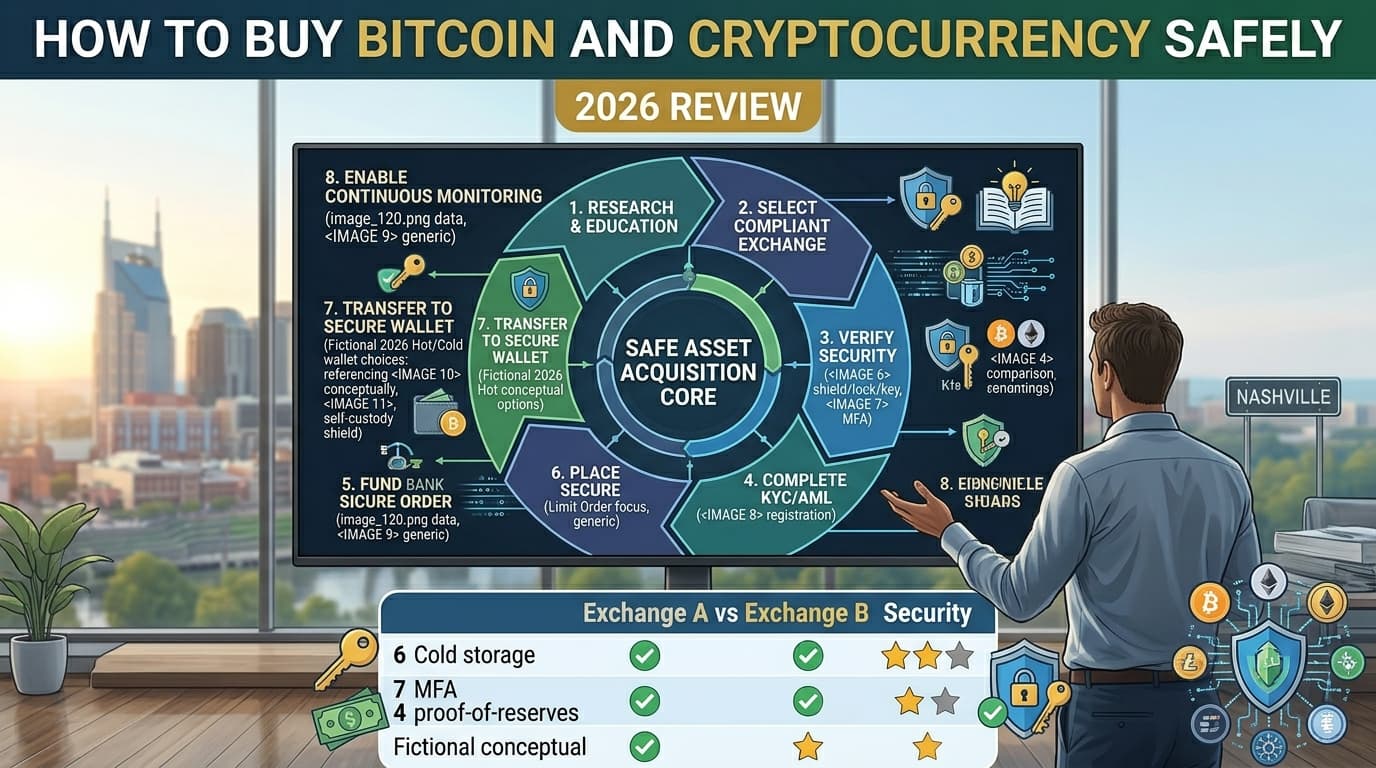
The Short Answer
The safest way to buy Bitcoin is through a regulated U.S. exchange like Coinbase or Kraken, using bank transfer funding, enabling two-factor authentication, and moving your coins to a personal hardware wallet.
How to Buy Bitcoin and Cryptocurrency Safely (Without Getting Scammed)
Category: Crypto & Digital Assets | Tags: Beginner Guides · Tools & Platforms · Guides & How-To's
Target Keywords: buy bitcoin safely, avoid crypto scams, how to buy cryptocurrency, best crypto exchange USA, hardware wallet, crypto scams 2025
Summary
Buying Bitcoin and cryptocurrency has never been more accessible — but it has also never been more dangerous for the uninformed. In 2024 alone, Americans reported losing $5.7 billion to investment scams, the majority of which involved cryptocurrency, according to the Federal Trade Commission. Crypto fraud wallets received an estimated $9.9 billion in 2024 according to blockchain analytics firm Chainalysis — with that figure expected to be revised higher as more scam wallets are identified. The good news: nearly every major crypto scam follows a predictable pattern, and every major category of theft is preventable with basic knowledge and the right setup. This guide covers the five things you need to know to buy Bitcoin and cryptocurrency safely as a US investor in 2025: how to choose a legitimate, regulated exchange; how the most dangerous scams work; how to secure your accounts; how to properly store your crypto; and whether a Bitcoin passive income strategies might be a safer alternative to owning coins directly. If you already own crypto or are thinking about buying your first $100 of Bitcoin, this is the article that could save you from a very expensive mistake.
The Crypto Scam Landscape in 2025: What You're Up Against
Before buying a single dollar of Bitcoin, it's worth understanding the threat environment. The numbers are stark.
According to the FTC's 2024 Consumer Sentinel Network Data Report:
- Consumers reported losing $12.5 billion to fraud in 2024 — a 25% increase over 2023
- Investment scams accounted for $5.7 billion — the single largest fraud category, and a $1 billion increase from the prior year
- Cryptocurrency was the second-highest payment method for fraud losses, behind only bank transfers
- The median loss for crypto fraud victims was $5,400 — more than 12 times the $447 median for general fraud
The FBI's Internet Crime Complaint Center (IC3) reported that losses from crypto-asset-related investment frauds alone reached $5.8 billion in 2024 — with a significant portion driven by a type of scam called "pig butchering" (more on this in a moment).
Bitcoin ATM scams are also accelerating. The FBI reported that from January through November 2025, scammers collected $333.5 million through Bitcoin ATM fraud — up from roughly $250 million for all of 2024, which was itself more than double the prior year's figure. In the first half of 2024 alone, the FTC documented over $65 million in Bitcoin ATM fraud losses, with adults over 60 accounting for a disproportionate share of victims.
The critical context for all of this: crypto transactions are largely irreversible. Once you send cryptocurrency to a scammer's wallet, there is no credit card dispute, no bank reversal, and no FDIC protection. This is why crypto is the preferred payment method for every category of scammer — and why knowing the rules before you start is so important.
The 5 Most Dangerous Crypto Scams (and How to Spot Them)
Understanding how scams work is the single most effective preventative measure available. Every major crypto scam follows one of these five structures.
1. Pig Butchering (Romance Baiting)
Pig butchering is currently the most costly and fastest-growing crypto scam in the United States. The CFTC describes it as "a sophisticated online confidence scam operated by international criminal gangs." Chainalysis estimated that pig butchering revenue grew nearly 40% year-over-year in 2024, with the number of deposits to these schemes growing approximately 210% — indicating a dramatic expansion of the victim pool.
The mechanics are consistent:
- Initial contact — You receive a "wrong number" text, a dating app match, a LinkedIn connection, or an Instagram message from an attractive stranger
- Relationship building — The scammer spends weeks or months building emotional connection, often using "love bombing" (quick affection and pet names) and sharing stories that mirror your own life
- The investment mention — The new "friend" casually mentions they've made significant money on a crypto investment platform. They seem reluctant to share at first, which makes it feel exclusive
- The small win — You invest a small amount. The platform shows you making money. You can even withdraw a small amount to prove it's real. This is designed to build trust
- The slaughter — You invest more. The platform shows increasingly large returns. When you try to withdraw, you're told you owe "taxes" or "fees" that must be paid first. You pay them. The platform disappears along with your money
The term "pig butchering" comes from a Chinese organized crime phrase — the idea of fattening a pig before slaughter. The FBI, CFTC, and AARP now commonly refer to these as "romance baiting" or "financial grooming" scams. Individual victims typically lose an average of $130,000, according to WalletWhitePages analysis, with some losing millions.
Warning signs to watch for:
- Met online and refuses to meet in person or video chat, despite ongoing "romantic" communication
- Mentions cryptocurrency investments casually or unprompted early in a relationship
- Shows screenshots of trading profits or claims insider access to a platform
- Recommends a specific exchange you've never heard of
- Creates urgency around investing now
- Asks you to move conversation from a dating app to WhatsApp or Telegram
- The platform is not listed on CoinGecko or CoinMarketCap
- Early withdrawals succeed, but later ones suddenly require "fees" or "taxes"
Bottom line: Anyone you have only met online who introduces you to a crypto investment opportunity is almost certainly running a pig butchering scam. The CFTC states explicitly: "Do not send money to people you have only met online."
2. Bitcoin ATM Scams
There are now more than 45,000 Bitcoin ATMs across the United States — often found in convenience stores, gas stations, and grocery stores. While legitimate uses exist, the FBI has identified them as a favorite tool for scammers because transactions are immediate and nearly impossible to reverse.
The typical Bitcoin ATM scam involves an impersonator — someone claiming to be from the government (IRS, Social Security Administration), a bank, or tech support (Microsoft, Apple) — who creates a sense of crisis. They tell you your account has been compromised, your Social Security number is linked to criminal activity, or there's a warrant for your arrest. The "solution" is always to withdraw cash and deposit it into a Bitcoin ATM to "protect" your funds or resolve the issue. Real government agencies, banks, and tech companies never ask you to pay via Bitcoin ATM.
The FTC reports that adults over 60 are more than three times as likely as younger adults to report losing money to Bitcoin ATM scams, with a median individual loss of $10,000 in the first half of 2024.
3. Fake Crypto Exchanges and Platforms
Scammers build websites and apps that look exactly like legitimate exchanges — sometimes using domain names with a single letter changed from a real exchange (e.g., "Coinbaise.com" instead of "Coinbase.com"). These fake platforms often allow small initial "test" withdrawals to build credibility before freezing accounts when users try to access larger amounts.
How to avoid:
- Always navigate directly to exchange URLs — never click links from emails, texts, or social media
- Verify the exact URL before entering any credentials or financial information
- Only use exchanges listed on reputable review sites and that are registered with US regulators
- Search the exchange name plus "scam" or "review" before depositing money
4. Rug Pulls and Fake Tokens
A rug pull is a scam specific to new cryptocurrency projects. Developers launch a new token, generate buzz through social media, attract investor money — then drain the liquidity and disappear, leaving token holders with worthless assets. According to Yellow.com's 2025 crypto fraud analysis, rug pulls have become increasingly common in the decentralized finance (DeFi) ecosystem.
The safest rule for beginners: stick to established cryptocurrencies — Bitcoin, Ethereum, and major tokens listed on regulated US exchanges. Avoid any new token promoted through social media, Discord, or Telegram, especially if the promotion uses language like "100x guaranteed" or "early investor opportunity."
5. Giveaway Scams and Impersonation
Social media giveaway scams involve fake accounts impersonating celebrities, executives, or major companies (Elon Musk is the most impersonated figure — comprising an estimated 32% of social media scam attempts, according to crypto fraud trend data). The scam: send us 0.1 Bitcoin and we'll send back 0.2. You will never receive anything back.
AI-enabled deepfake versions of these scams surged in 2025. According to blockchain analytics firm TRM Labs, AI-enabled scam reports increased 456% between mid-2024 and mid-2025. Fraudulent YouTube livestreams mimicking Bitcoin giveaways defrauded viewers of approximately $120 million.
Rule: No legitimate person or organization ever asks you to send them cryptocurrency in exchange for a larger return. Period.
How to Choose a Safe, Regulated Crypto Exchange
For US-based investors, the most important security decision you'll make is choosing a regulated, reputable exchange. The exchange is where your dollars turn into crypto, and a bad choice at this step can expose you to platform insolvency, regulatory uncertainty, and inadequate security.
What to Look for in a US Crypto Exchange
- US regulatory compliance — The exchange should be registered with relevant US regulators and licensed in your state. In the US, exchanges must register with FinCEN as a Money Services Business and comply with state-level money transmitter regulations. Some states (New York, in particular) have the most rigorous requirements via the BitLicense
- Two-factor authentication (2FA) — Any legitimate exchange requires this for login and withdrawals. This means a scammer who knows your password still cannot access your account without also having your phone
- Cold storage for user funds — Reputable exchanges hold the majority of user funds offline in "cold storage" — hardware wallets not connected to the internet — so that even a successful hack of the exchange's online systems cannot drain user accounts
- Proof-of-reserves audits — The best exchanges publish regular third-party audits proving they hold sufficient assets to cover all user balances
- Insurance on USD balances — Coinbase, for example, provides FDIC insurance on USD balances (not crypto) up to $250,000. Some platforms carry additional private insurance policies for custodial crypto assets
- No major hack history — Research the exchange's security track record
The Best Regulated US Crypto Exchanges (2025)
These are the most consistently recommended regulated exchanges for US investors based on security track record, compliance posture, and user reviews:
Coinbase
- Founded 2012; publicly traded on Nasdaq (COIN); largest US-based exchange
- Supports 250+ cryptocurrencies
- FDIC insurance on USD balances; CFTC-regulated BTC and ETH derivatives
- Available in all US states
- Higher fees than most competitors (0.50% trading + 1.49% transaction on standard interface; lower on Coinbase Advanced Trade)
- Best for: beginners, first-time buyers, anyone who wants the most regulated and transparent option
Kraken
- Founded 2011; never suffered a major hack in its history — a claim very few exchanges of its size can make
- Supports 400+ cryptocurrencies
- Holds ISO 27001, SOC 1 & SOC 2 certifications; active bug bounty program
- Proof-of-reserves audits published regularly
- Maker/taker fees starting at 0.25%/0.40% — lower than Coinbase
- Not available in New York or Maine
- Best for: security-conscious investors, experienced traders, those who prioritize security track record above all else
Gemini
- Founded 2015 by the Winklevoss twins; licensed by the New York Department of Financial Services (NYDFS)
- One of the most tightly regulated exchanges in the US
- Supports 80+ cryptocurrencies
- Higher fees than Kraken; comparable to Coinbase
- Available in all US states
- Best for: New York residents, security-conscious investors who want maximum regulatory oversight
What to Avoid
- Exchanges you discovered through a social media post, a stranger's recommendation, or an unsolicited message
- Any platform promising guaranteed returns or "exclusive" access
- Platforms not listed in major crypto review publications (CoinBureau, Money.com, Koinly)
- Bitcoin ATMs for investment purposes (fees of 5–15% and no account-level security protections)
Step-by-Step: How to Buy Bitcoin on a Regulated Exchange
Once you've chosen an exchange, here is the standard process for purchasing Bitcoin safely:
Step 1: Create Your Account
- Go directly to the exchange's official URL (bookmark it immediately; never navigate via search)
- Create an account with your email address and a strong, unique password
- Use a password manager to generate and store a complex password
Step 2: Enable Two-Factor Authentication (2FA)
Before depositing any money, enable 2FA. Use an authenticator app (Google Authenticator, Authy) rather than SMS text message-based 2FA — SIM-swapping attacks can intercept SMS codes. This single step dramatically reduces your exposure to account takeover.
Step 3: Complete KYC Verification
Know Your Customer (KYC) verification is a legal requirement on all regulated US exchanges. You'll need to provide:
- Full legal name, date of birth, and residential address
- A government-issued photo ID (driver's license or passport)
- A selfie or live photo for facial verification
KYC typically takes anywhere from a few minutes to 24 hours depending on the platform. While it may feel intrusive, KYC protects you: regulated exchanges with KYC are far less likely to be scam operations, and the verification process creates an audit trail if fraud ever occurs.
Step 4: Fund Your Account
- ACH bank transfer — Free or near-free; takes 1–5 business days to settle; lower buying limits initially
- Wire transfer — Typically 1% fee; faster settlement; higher limits
- Debit card — Instant; usually carries an additional 1.5%–3.5% fee
- Credit card — Available on some platforms; higher fees and treated as a cash advance by most card issuers (not recommended)
Tip: ACH transfers are the most cost-effective option for most buyers. The small delay in settlement is worth the fee savings, especially for larger purchases.
Step 5: Place Your First Purchase
- Search for Bitcoin (BTC) on the platform
- Enter the dollar amount you want to spend (you can buy a fraction of a Bitcoin — there's no minimum of 1 BTC)
- Review the fees before confirming
- Use a limit order if available (on Coinbase Advanced Trade or Kraken Pro) to specify the price you're willing to pay rather than accepting the current market price; this typically reduces fees
Step 6: Decide Where to Store It
After purchasing, you have two options:
- Leave it on the exchange (custodial storage) — Convenient but carries risk if the exchange is hacked or becomes insolvent
- Transfer to a personal wallet (self-custody) — More secure for significant holdings; requires understanding of wallet management
For small amounts or frequent trading, leaving funds on a well-regulated exchange is acceptable. For any meaningful investment — a general rule of thumb is anything you wouldn't want to lose to an exchange failure — consider moving it to a hardware wallet (covered in the next section).
How to Store Your Crypto Safely: Hot Wallets vs. Cold Wallets
The phrase in crypto that you will hear repeatedly is: "Not your keys, not your coins." When your Bitcoin is on an exchange, the exchange holds the private keys — not you. If the exchange is hacked, goes bankrupt, or freezes withdrawals, your funds may be inaccessible or gone. The FTX collapse in 2022 is the most prominent example: billions in customer funds became inaccessible when the exchange imploded.
Understanding Crypto Wallets
A crypto wallet doesn't actually "hold" your cryptocurrency — it holds the private key that proves ownership and authorizes transactions on the blockchain. Whoever controls the private key controls the coins.
Hot Wallets (Software Wallets)
- Connected to the internet via your phone or computer
- Convenient for frequent transactions or small amounts
- More vulnerable to hacking, malware, and phishing attacks
- Examples: Coinbase Wallet, MetaMask, Trust Wallet
- Best for: small amounts you use actively; think of it like your checking account
Cold Wallets (Hardware Wallets)
- Physical devices that store private keys completely offline
- Immune to online hacking — a hacker cannot access a key that has never touched the internet
- Best for: significant holdings you plan to hold long-term; think of it like a safe
- Examples: Ledger, Trezor
The most important rule in crypto security: never enter your seed phrase (the 12–24 word recovery phrase that controls your wallet) on a computer, website, or app. This phrase should be written on paper, stored physically in a secure location, and never photographed, emailed, or saved digitally.
The Two Leading Hardware Wallets: Ledger vs. Trezor
Ledger
- Founded 2014; based in France; most widely used hardware wallet globally
- Uses a proprietary Secure Element (SE) chip — the same hardware protection used in bank cards — for maximum physical tamper resistance
- Supports 5,500+ cryptocurrencies
- Models: Nano S Plus ($79), Nano X ($149, includes Bluetooth), Flex ($249), Stax ($399)
- Managed via Ledger Live app
- Firmware is closed-source (cannot be independently verified by the public)
- In 2023, Ledger launched a controversial seed recovery service that prompted security concerns among some users
- Best for: investors who want the broadest coin support and most polished user experience
Trezor
- Founded 2013 by SatoshiLabs; first-ever commercial hardware wallet
- 100% open-source firmware — independently auditable by the public and security researchers
- Supports 1,500+ cryptocurrencies (fewer than Ledger, but covers all major assets)
- Models: Trezor One ($59), Safe 3 ($79), Model T ($169), Safe 5 (premium)
- Managed via Trezor Suite app
- Does not use a secure element chip (relies on open-source security model instead)
- Best for: investors who prioritize transparency and prefer open-source software
How to Choose
- If you hold multiple altcoins and want maximum coin support with a polished interface: Ledger
- If you hold primarily Bitcoin and Ethereum and value software transparency: Trezor
- Either device is a massive security upgrade over leaving significant funds on an exchange
Hardware Wallet Setup Best Practices
- Buy only from the manufacturer's official website — Never purchase from Amazon, eBay, or third-party sellers; pre-compromised devices are a known attack vector
- Verify the packaging is intact — Check for factory seals; a device that has been opened is potentially compromised
- Generate your seed phrase on the device itself — Never accept a pre-generated phrase or enter a phrase sent to you
- Write your seed phrase on paper — Use the paper card included with your device; consider a metal backup (Cryptosteel, Bilodal) for fire and water resistance
- Store the seed phrase physically in a secure location separate from the device — A fireproof safe or safety deposit box
- Never share your seed phrase with anyone — Legitimate support staff will never ask for it
Bitcoin ETFs: A Safer Alternative for Some Investors
In January 2024, the US Securities and Exchange Commission (SEC) approved 11 spot Bitcoin ETFs — a landmark moment that changed how Americans can access Bitcoin exposure. Previously, investing in Bitcoin required navigating crypto exchanges, managing wallets, and handling private keys. Now, investors can buy Bitcoin exposure through a standard brokerage account, with the same process used to buy a stock or mutual fund.
What Is a Spot Bitcoin ETF?
A spot Bitcoin ETF is a fund that:
- Holds actual Bitcoin (not futures contracts) in institutional custody
- Trades on traditional stock exchanges like the NYSE and Nasdaq
- Can be purchased through any standard brokerage account — Fidelity, Vanguard, and Schwab, Charles Schwab, Vanguard (some platforms), TD Ameritrade, and others
- Can be held in an IRA or Roth IRA providers, providing tax advantages not available when buying Bitcoin directly
The ETF structure means you get Bitcoin price exposure without managing wallets, seed phrases, or exchange accounts. The tradeoff: you don't own the underlying Bitcoin itself, and you pay an annual expense ratio (management fee).
The Major US Bitcoin ETFs (2025)
| ETF | Ticker | Issuer | Expense Ratio | AUM (approx.) | Custodian |
|---|---|---|---|---|---|
| iShares Bitcoin Trust | IBIT | BlackRock | 0.25% | $76B+ | Coinbase Custody |
| Fidelity Wise Origin Bitcoin Fund | FBTC | Fidelity | 0.25% | $20.6B | Fidelity Digital Assets |
| ARK 21Shares Bitcoin ETF | ARKB | ARK Invest / 21Shares | 0.21% | ~$4.9B | Coinbase Custody |
| Bitwise Bitcoin ETF | BITB | Bitwise | 0.20% | ~$3.9B | Coinbase Custody |
| Grayscale Bitcoin Mini Trust | BTC | Grayscale | 0.15% | Varies | Coinbase Custody |
Source: Benzinga, Motley Fool, LevelFields (mid-2025 data; AUM subject to change)
BlackRock's IBIT has emerged as the largest Bitcoin ETF by a significant margin, with over $76 billion in assets under management — reflecting BlackRock's institutional credibility and distribution network.
Fidelity's FBTC is notable because Fidelity uses its own custodial service (Fidelity Digital Assets) rather than Coinbase Custody — giving it an edge in custodial independence.
Should You Buy a Bitcoin ETF or Bitcoin Directly?
This comes down to a few personal factors:
A Bitcoin ETF might be better if:
- You want the simplest possible path to Bitcoin exposure
- You already have a brokerage account and want to keep everything in one place
- You want to hold Bitcoin in a tax-advantaged account (IRA, Roth IRA, 401k if offered)
- You're not comfortable managing wallets, seed phrases, and exchange security
- You have a financial advisor who needs to manage the position on your behalf
Buying Bitcoin directly might be better if:
- You want to own actual Bitcoin with direct self-custody
- You plan to use Bitcoin for transactions, not just investment
- You believe in the philosophy of holding your own keys
- You're willing to invest the time to understand wallet security
For most first-time investors just getting started, a Bitcoin ETF is a legitimately good starting point — it eliminates the security complexity and the scam exposure that comes with managing a crypto exchange account, and it's available through the same brokerage account you might use for stocks and best platforms for index fundss.
10 Essential Security Rules for All Crypto Investors
Whether you buy Bitcoin on an exchange or through an ETF, these rules apply to everyone interacting with the crypto ecosystem:
- Use a dedicated email address for crypto accounts — Don't use your main personal or work email; a separate address reduces phishing exposure and limits the blast radius if your email is compromised
- Enable 2FA on every crypto account — Use an authenticator app, not SMS
- Never click links in emails, texts, or DMs that claim to be from your exchange — Always navigate directly to the exchange URL
- Never share your seed phrase with anyone — Not support staff, not a forum user, not a friend. No legitimate entity will ever ask for it
- Double-check wallet addresses before sending — Malware called "clipboard hijackers" can silently replace a wallet address you've copied with a scammer's address. Always verify the first and last several characters manually
- Be deeply suspicious of anyone online who mentions crypto investments — Especially new acquaintances on dating apps, social media, or messaging platforms
- Research any exchange, platform, or investment before depositing money — Search the platform name + "scam" + "review" + the current year
- Don't use public Wi-Fi when accessing crypto accounts — If necessary, use a VPN
- Ignore any "giveaway" that asks you to send crypto first — These are always scams, no exceptions
- If something sounds too good to be true, it is — Guaranteed returns, insider access, exclusive platforms, limited-time offers: these are scam hallmarks, not investment opportunities
What to Do If You've Been Scammed
If you've already sent money to a scammer, act immediately:
- Stop sending money — Do not send additional funds to "recover" earlier losses; this is a known secondary scam tactic used against previous victims
- Report to the FBI's Internet Crime Complaint Center (IC3): ic3.gov
- Report to the FTC: reportfraud.ftc.gov
- Report to your state Attorney General's office
- Contact your bank or credit card company if any traditional payment method was involved
- Be wary of "crypto recovery" services — Many are scams that target people who have already lost money; no legitimate service can reliably recover stolen crypto. Be especially skeptical of anyone who contacts you claiming to be law enforcement or a recovery specialist via Telegram or WhatsApp
Recovery of stolen cryptocurrency is difficult and often impossible — but reporting it creates data that helps law enforcement identify and disrupt scam networks and may help other potential victims.
Key Takeaways
- Crypto scams are at record levels. Americans lost $5.7 billion to investment scams in 2024, the majority involving crypto. Bitcoin ATM fraud hit $333 million in just the first 11 months of 2025 (FBI data)
- The most dangerous scam is pig butchering (romance baiting) — a long-con scheme that generated an estimated $9.9 billion globally in 2024. Anyone you meet online who introduces you to a crypto investment platform is almost certainly running this scam
- Use only regulated US exchanges — Coinbase (best for beginners), Kraken (best security track record), and Gemini (most regulated) are the top three
- The five-step safe buying process: choose a regulated exchange → enable 2FA with an authenticator app → complete KYC verification → fund via ACH bank transfer → research storage options before depositing significant funds
- "Not your keys, not your coins" — For any significant holding, move funds off the exchange to a hardware wallet (Ledger or Trezor). Buy only from official manufacturer websites
- Bitcoin ETFs are a legitimate alternative — The SEC approved 11 spot Bitcoin ETFs in January 2024. BlackRock's IBIT and Fidelity's FBTC are the two largest and most liquid options, available through standard brokerage accounts
- The non-negotiable security rules: never share your seed phrase, never click links in crypto-related messages, always double-check wallet addresses before sending, and treat any online acquaintance who mentions crypto investments as a potential scammer until proven otherwise
Related Articles on DadAlt Investments
- 5 Crypto Wallets Every Dad Should Know — Deeper breakdown of hot and cold wallet options for secure storage
- Top 5 Crypto ETFs — Comparison of the best crypto-based ETFs for US investors in 2025
- Should I Buy Crypto? The Case for Crypto in a Family Portfolio — The investment thesis for holding crypto alongside traditional assets
- Gold vs. Crypto: Which Is the Better Hedge? — Comparing inflation protection between Bitcoin and precious metals
- 5 Side Business Ideas You Can Start This Weekend — Building alternative income to fuel your investment accounts
Sources and References
-
Federal Trade Commission — New FTC Data Show a Big Jump in Reported Losses to Fraud to $12.5 Billion in 2024 — Consumers reported $12.5 billion in fraud losses in 2024 (25% increase over 2023); investment scams accounted for $5.7 billion; cryptocurrency was the second-highest payment category for fraud losses. ftc.gov
-
Federal Trade Commission — New FTC Data Shows Massive Increase in Losses to Bitcoin ATM Scams — Bitcoin ATM fraud losses topped $65 million in just the first six months of 2024; median individual loss of $10,000; adults over 60 more than three times as likely as younger adults to report losses. ftc.gov
-
ABC News / FBI — Scammers Notched $333 Million from Bitcoin ATM Scams in 2025, FBI Says — From January through November 2025, Bitcoin ATM fraud totaled $333.5 million; in 2024, losses were approximately $250 million, more than double the prior year's figure. AARP Director Amy Nofziger: "Requesting crypto is now the No. 1 preferred method of criminals." abcnews.go.com
-
Motley Fool — Crypto and Investment Scam Statistics for 2025 — Americans lost $1.5 billion to crypto scams through Q3 2025; investment scams accounted for 48% of all scams involving cryptocurrency; the number of investment scam victims who cited social media as initial contact grew from 4,889 in 2020 to 26,569 in 2024. fool.com
-
CNBC / Chainalysis — Crypto Scams Likely Hit a New Record in 2024, Driven by 'Pig Butchering' and AI — Crypto fraud wallets received an estimated $9.9 billion in 2024; pig butchering revenue grew nearly 40% year-over-year; the number of deposits to pig butchering scams grew nearly 210%; generative AI use in scam infrastructure grew 1,900% year-over-year among top vendors on the Huione platform. cnbc.com
-
CFTC — Romance Frauds — In 2024, the FBI reported losses from crypto-asset-related investment frauds rose to $5.8 billion; pig butchering operates through wrong-number texts, dating apps, and social media; "Do not send money to people you have only met online." cftc.gov
-
AARP — 'Pig Butchering' Scams Lure Victims Into Fake Investments — Detailed description of pig butchering mechanics; warning signs including love bombing within days; criminals have used deepfake software to conduct live video calls; advice on moving conversations to WhatsApp or Telegram as a red flag. aarp.org
-
WalletWhitePages — Pig Butchering Crypto Scams Explained: Complete Protection Guide 2025 — Victims typically lose an average of $130,000; scam contact methods include dating apps, wrong-number texts, LinkedIn, and gaming platforms; red flag list including fake profit screenshots and platforms not listed on CoinGecko. walletwhitepages.com
-
Yellow.com — Crypto Fraud in 2025 Hits Record Highs — TRM Labs reports AI-enabled scam reports increased 456% between mid-2024 and mid-2025; deepfake endorsements impersonating Elon Musk comprised 32% of social media scam attempts; fraudulent YouTube livestreams defrauded viewers of approximately $120 million. yellow.com
-
Coinlaw.io — Cryptocurrency Fraud Trends Statistics 2025 — Global cryptocurrency theft reached $3.4 billion in 2025; AI-generated deepfake scams rose by 700%; social media fraud channels contributed to 56% of all crypto scam cases; phishing campaigns extracted $2.4 billion worldwide. coinlaw.io
-
Money.com — 6 Best Crypto Exchanges of October 2025 — Kraken has never suffered a large-scale hack since going online in 2011; Gemini is well-funded with strong security practices and NYDFS licensing; Coinbase recommended for its high reputation for security and transparency. money.com
-
Tangem Blog — Best Crypto Exchanges in the USA (2025 Guide) — Kraken and Gemini stand out for security and compliance; Coinbase provides FDIC protection for USD balances; Binance.US charges the lowest maker/taker fees at 0.1%; exchanges are for trading, not permanent storage. tangem.com
-
Koinly — 10 Best Crypto Exchanges USA January 2026 — Comprehensive exchange comparison including fee structures, security certifications (ISO 27001, SOC 1 & 2), state availability, and regulatory status. Kraken maker/taker fees start at 0.25%/0.40%; Coinbase maker/taker fees start at 0.40%/0.60%. koinly.io
-
Kraken — Most Secure Crypto Exchange in 2026 — Kraken founded 2011; Kraken Security Labs team identifies and discloses vulnerabilities in third-party products; supports 500+ cryptocurrencies in 190+ countries; named Best Crypto stock brokerages in the 2025 Finder Awards. kraken.com
-
CoinBureau — Trezor vs. Ledger: Which Hardware Wallet Is Better in 2026? — Hardware wallets are "widely regarded as the most secure option" for crypto storage; Trezor launched the first-ever commercial hardware wallet in 2013; Ledger followed in 2014; Ledger supports 5,500+ cryptocurrencies vs. Trezor's approximately 1,500. coinbureau.com
-
CoinTracker — Hardware Wallet Heavyweights: Trezor vs. Ledger — Cold hardware wallets store private keys offline and are "immune to online hacks"; Trezor is open-source with community-auditable code; Ledger uses a Secure Element chip for physical tamper resistance; both require seed phrase backup. cointracker.io
-
CoinLedger — Ledger vs. Trezor: Investor's Guide 2026 — Trezor software is 100% open-source; Ledger's firmware is closed-source; Trezor models start at $59 (Trezor One); Ledger models start at $79 (Nano S Plus); both generate seed phrases on-device. coinledger.io
-
StealthEX — What Is a Cold Wallet? Best Crypto Cold Storage Guide 2026 — Hardware wallet setup best practice: generate 12- or 24-word seed phrase on device; never enter seed phrase on a computer or website; write seed phrase on recovery sheet or store in metal backup. stealthex.io
-
Benzinga — 10 Best Bitcoin ETFs of 2025 — BlackRock IBIT: $76B+ AUM, 0.25% fee, Coinbase Custody; Fidelity FBTC: $20.6B AUM, 0.25% fee, Fidelity Digital Assets custody; ARK 21Shares ARKB: ~$4.9B AUM, 0.21% fee; Bitwise BITB: ~$3.9B AUM, 0.20% fee. benzinga.com
-
Motley Fool — 5 Best Bitcoin ETFs to Buy in 2026 — The SEC approved spot Bitcoin ETFs in January 2024; BlackRock's IBIT emerged as the largest Bitcoin fund; Fidelity FBTC uses Fidelity's own custodial service (Fidelity Digital Assets); Grayscale Bitcoin Mini Trust has the lowest expense ratio at 0.15%. fool.com
-
Winston & Strawn — Road to Bitcoin Investment Cleared with SEC's Approval of 11 Spot Bitcoin ETFs — January 10, 2024: SEC declared effective the applications for 11 spot Bitcoin ETPs; issuers include BlackRock (
$9T AUM), Fidelity ($11.5T AUM), Franklin Templeton, and WisdomTree; JP Morgan, Jane Street, and Virtu serve as authorized participants. winston.com -
US News & World Report — Spot Bitcoin ETFs: How to Invest After Their SEC Approval — Bitcoin ETFs allow investment through regulated environment; spot ETFs follow Bitcoin price directly rather than tracking businesses with Bitcoin exposure; ETF structure keeps investors away from fraudulent crypto firms. money.usnews.com
-
Fraud.org — Five Fraud Stats From 2025 — Among those who invested in cryptocurrency, approximately 15% found the investment to be a scam; median reported loss to cryptocurrency and investment schemes reached $30,000; consumers reported $12.5 billion in total scam losses in 2024; only 2%–6.7% of victims report their losses. fraud.org
-
FTC — Imposter Data Spotlight (August 2025) — In 2024, 33% of older adults who reported losing $10,000 or more to a business or government imposter scam indicated cryptocurrency was the payment method; government imposter scam losses increased $171 million from 2023 to a total of $789 million in 2024. ftc.gov
-
Switchere — A Step-by-Step Guide to Safely Buy Bitcoin in 2025 — KYC is a mandatory legal requirement on regulated exchanges; using an authenticator app for 2FA rather than SMS is recommended; reputable exchanges enforce cold storage for user funds; seed phrases should never be entered on a computer or website. switchere.com
Disclaimer: This article is for educational and informational purposes only and does not constitute financial, investment, or legal advice. Cryptocurrency is a highly volatile and speculative asset class. All investment decisions involve risk, and past performance does not guarantee future results. DadAlt Investments may receive compensation from affiliate partners referenced in this article. See our Affiliate Disclaimer for full details. Always consult a qualified financial advisor before making investment decisions.
Recommended Reading
Frequently Asked Questions
What's the safest exchange to buy Bitcoin in the U.S.?
Coinbase, Kraken, and Gemini are the three safest U.S. exchanges. All are regulated, insured, and offer strong security features including two-factor authentication and cold storage.
How much Bitcoin should a beginner buy?
Start with an amount you're comfortable losing — $100 to $500 is a reasonable starting point. You can buy fractional Bitcoin, so you don't need thousands to get started.
Should I keep my Bitcoin on an exchange or move it to a wallet?
For long-term holdings, move your Bitcoin to a hardware wallet you control. Exchanges can be hacked or freeze accounts. Self-custody gives you full ownership of your assets.

About the Author
Jared DeValk
Founder, DadAlt Investments
Father, alternative investment researcher, and founder of DadAlt Investments. 14+ years turning hard lessons into honest guidance for dads building real wealth.