
Top Stock Brokerages for New Investors [2025 Review]
Review of beginner-friendly trading platforms.
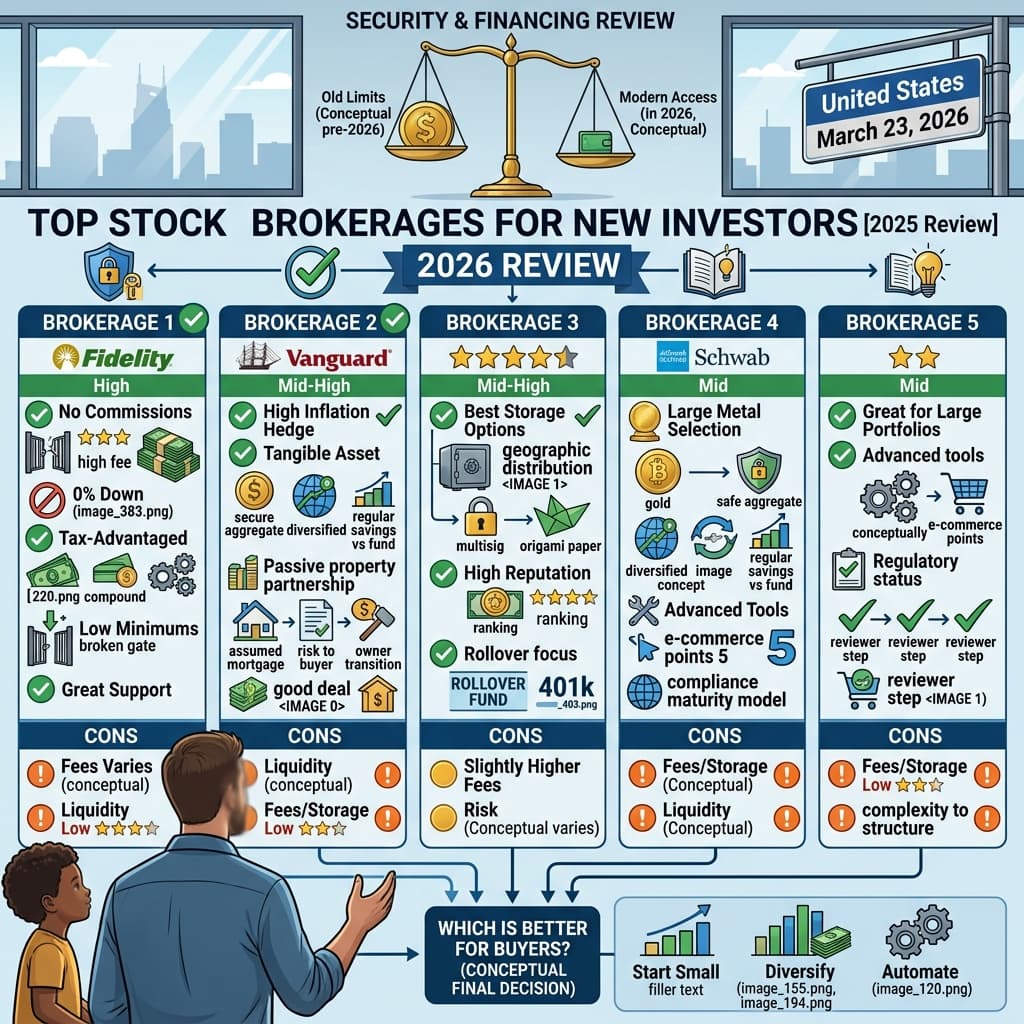
The Short Answer
The best stock brokerages for new investors in 2026 are Fidelity (best overall), Charles Schwab (best for retirement), and M1 Finance (best for automated investing) — all offer zero-commission trades and no account minimums.
Top Stock Brokerages for New Investors [2026 Review]
Category: Stocks & passive income strategies | DadAlt Investments
Opening a brokerage account is the most important step you'll take on your investing journey — and in 2026, it has never been easier or cheaper to get started. The good news: virtually every major brokerage has eliminated trading commissions and account minimums, so the competition has shifted to who offers the best tools, education, automation, and perks for new investors. The bad news: with dozens of options, it can feel overwhelming to pick the right one. This guide cuts through the noise and reviews the six best stock brokerages for new investors in 2026, covering their features, fees, pros and cons, and who each platform is best suited for. Whether you're opening your first Roth IRA providers, setting up automatic investments, or simply trying to buy your first ETF, there's a brokerage on this list that fits your goals — and your schedule.
Why Choosing the Right Brokerage Matters
Your brokerage is the financial foundation you'll use for decades. Unlike picking the wrong stock — which you can sell — switching brokerages later means paperwork, potential transfer fees, and the hassle of updating automatic investment schedules.
Key factors to weigh when choosing a brokerage as a new investor:
- Account minimums: Can you start with $0, $1, or $1,000?
- Trading fees and commissions: Are stock and ETF trades free?
- Investment selection: Can you access the best platforms for index fundss, ETFs, and IRAs you need?
- Educational resources: Does the platform teach you how to invest?
- Automation: Can you set up automatic recurring investments?
- Mobile app quality: Will you use it primarily from your phone?
- Customer service: Can you reach a human being when you need one?
- Retirement account features: Does the platform support IRAs, Roth IRAs, or offer contribution matches?
The brokerages reviewed here were selected based on overall beginner-friendliness, industry awards, verified 2026 ratings from independent review organizations (NerdWallet, StockBrokers.com, Bankrate, Motley Fool), and their suitability for long-term, passive investors.
Quick Comparison: Top 6 Brokerages at a Glance
| Brokerage | Account Minimum | Stock/ETF Trades | Best For | IRA Match |
|---|---|---|---|---|
| Fidelity, Vanguard, and Schwab | $0 | $0 | Overall best beginner platform | None |
| Charles Schwab | $0 | $0 | Full-service + thinkorswim power users | None |
| Robinhood | $0 | $0 | Mobile-first + IRA match seekers | 1%–3% |
| Vanguard | $0 | $0 | Buy-and-hold index fund investors | None |
| Merrill Edge | $0 | $0 | Bank of America customers | None |
| M1 Finance | $0 | $0 | Automated portfolio investors | None |
1. Fidelity — Best Overall for New Investors
Account minimum: $0 Stock & ETF trades: $0 Options: $0.65/contract Mobile app: 4.8/5 (App Store), 4.6/5 (Google Play) Awards: StockBrokers.com #1 Beginners 2026, Motley Fool Best Overall Stock Broker 2026
Overview
Fidelity is the gold standard for new investors in 2026. It has won more independent industry awards than any other broker reviewed here, and for good reason: it combines zero-fee accounts, fractional share investing from $1, an enormous educational library, and 24/7 customer support — all on a platform that's approachable without being dumbed down.1
Founded in 1946, Fidelity manages trillions in assets and serves tens of millions of customers. If you already have a 401(k) through your employer at Fidelity (which roughly 25 million Americans do), adding a brokerage or Roth IRA account means everything appears in one dashboard.2
Key Features
- $0 account minimum and no monthly maintenance fees for all brokerage and retirement accounts
- Fractional shares ("Stocks by the Slice") starting at $1 for more than 7,000 U.S. stocks and ETFs — one of the largest fractional share programs of any broker
- FZROX and Fidelity ZERO funds: Fidelity offers its own family of index mutual funds with a 0.00% expense ratio — no management fee whatsoever, and no investment minimum. Funds include FZROX (Total Market), FZILX (International), and others.3
- Over 10,000 mutual funds with no transaction fees, including funds from Vanguard, Schwab, and others
- 25+ IRA account types, including Roth IRA, Traditional IRA, SEP IRA, SIMPLE IRA, self-employed 401(k), and custodial IRAs for minors
- Fidelity Youth Account: For teens ages 13–17, this is a financial first for any brokerage. It won StockBrokers.com's #1 Youth Investor award in 2026.1
- Fidelity Go robo-advisor: Automated, low-cost portfolio management starting at $10
- Active Trader Pro: Professional-grade trading platform for when you're ready to go deeper
- Cash Management Account: Earns interest on uninvested cash and reimburses ATM fees globally
Pros
- Consistently ranked #1 for beginners, retirement accounts, and research
- Zero-fee index funds that no competitor can match
- Excellent mobile app with goal-tracking and educational tools built in
- Comprehensive retirement account selection
- Robust customer support — phone, chat, and physical branches
Cons
- No IRA contribution match (unlike Robinhood)
- No futures trading
- Options still carry a $0.65/contract fee
- Fractional share trades may not be as instant as some platforms
Best For
New investors who want the most complete, trustworthy platform with the lowest possible costs. Especially ideal for anyone already enrolled in a Fidelity 401(k) who wants to consolidate their investing life in one place.
2. Charles Schwab — Best for Full-Service Investing + thinkorswim Access
Account minimum: $0 Stock & ETF trades: $0 Options: $0.65/contract Mobile app: 4.8/5 (App Store) Awards: StockBrokers.com #1 Overall 2026, #1 Mobile Trading Apps 2026, NerdWallet Best for IRA Investors 2026
Overview
Charles Schwab is the largest broker in the United States and manages nearly $12 trillion in client assets.4 After acquiring TD Ameritrade in 2020, it inherited one of the most powerful retail trading platforms ever built — thinkorswim — and made it available to all clients at no additional charge.
What makes Schwab exceptional for new investors is its dual-platform approach: the standard Schwab Mobile app is clean, approachable, and feature-rich for everyday investors, while thinkorswim sits on the side whenever you're ready to graduate to advanced analysis and trading.5
Key Features
- thinkorswim platform suite: Desktop, mobile, and web versions — each free with any Schwab account. Includes paper trading (practice accounts), 90+ technical indicators, and customizable layouts.6
- paperMoney virtual trading: Practice investing with fake money in a live market environment before risking real dollars — excellent for learning without consequences
- Nearly 400 physical branch locations nationwide for in-person help
- Schwab Intelligent Portfolios: No-fee robo-advisor with automatic rebalancing (requires $5,000 minimum)
- "Stock Slices" fractional shares: Available for S&P 500 companies with a $5 minimum
- No-transaction-fee mutual funds: Thousands of funds available without trading commissions
- 24/7 customer support via phone and chat
- Schwab Checking Account integration: Banking and investing under one roof
- "$50 First Investment" promo: New investors can get their first $50 to invest7
Pros
- Unmatched breadth of investment offerings (stocks, ETFs, mutual funds, bonds, options, futures, forex)
- thinkorswim is among the most powerful free trading platforms available anywhere
- Outstanding customer service — consistently rated best in class by independent reviewers
- Physical branches give you a human to talk to if needed
- Well-rounded educational content for all experience levels
Cons
- Fractional share program limited to S&P 500 companies ($5 minimum vs. Fidelity's $1 on 7,000+ stocks)
- Schwab Intelligent Portfolios robo-advisor requires $5,000 (vs. Fidelity Go's $10)
- The mobile app is excellent but slightly less intuitive than Robinhood or Fidelity for absolute beginners
- Very low interest rate (0.15% APY) on uninvested cash in standard sweep accounts
Best For
Investors who want a single platform that can grow with them from their first $100 purchase to managing a $500,000 portfolio. Particularly good for those who want access to in-person branches or plan to eventually explore options and futures trading.
3. Robinhood — Best Mobile Experience + Best IRA Contribution Match
Account minimum: $0 Stock & ETF trades: $0 Options: $0 per contract (Gold: $0.35 per index option contract) Mobile app: Highly rated — known as one of the cleanest investing UIs available Awards: Known for pioneering commission-free trading across the industry
Overview
Robinhood launched in 2013 with a simple, revolutionary idea: make investing free and accessible to everyone. It worked so well that within a few years, Fidelity, Schwab, and virtually every major broker had eliminated commissions entirely just to remain competitive — that is the lasting impact Robinhood has had on the industry.
In 2025 and 2026, Robinhood has matured dramatically. It's no longer just a simple stock trading app. It now includes a desktop trading platform (Robinhood Legend), a robo-advisor (Robinhood Strategies managing $1.3 billion across 200,000+ funded accounts), AI-powered market research (Cortex Digests), banking, a credit card, futures trading on 40+ CME Group products, and 24/7 customer support.8
The single most compelling feature for new investors: Robinhood's IRA contribution match is the best in the industry.
The Robinhood IRA Match: Breaking It Down
- Non-Gold members: 1% match on all IRA contributions, plus 1% on IRA transfers and 401(k) rollovers
- Robinhood Gold members ($5/month or $50/year): 3% match on annual IRA contributions
- 2026 IRA contribution limits: $7,500 (under age 50), $8,600 (age 50+)
- Gold IRA companies match example: Max out your 2026 IRA at $7,500 → Robinhood adds $225 to your account. Subtract the $50 annual Gold fee = $175 in free money just for contributing to your IRA9
- Match does NOT count toward your annual IRA contribution limit — it's truly additional money
- Catch: You must hold the matched funds for at least 5 years to keep the match, or Robinhood will claw back the corresponding amount9
This 1–3% IRA contribution match is extraordinary. No other major brokerage offers anything comparable on a permanent basis — only employers typically match retirement contributions at this level.
Key Features
- Fractional shares from $1, including hundreds of stocks and ETFs
- 24/5 extended hours trading (8pm–8am market, 5 days/week)
- 24/7 phone and chat support
- Robinhood Legend: Desktop platform with 90+ technical indicators, futures trading, and advanced charts
- Robinhood Strategies: Robo-advisor with auto-rebalancing; first $100,000 managed free for Gold members
- Gold Card: Credit card earning 3%–5% cash back across all categories (600,000+ active users)
- Cortex Digests: AI-powered summaries explaining what's moving your portfolio and why
- Morningstar premium research: Available to Gold members
- No mutual funds (significant limitation vs. Fidelity/Schwab)
- Cryptocurrency trading: Access to a wide range of crypto assets (not available in IRAs)
Pros
- Best IRA contribution match in the industry (1% free, 3% with $5/month Gold)
- Cleanest, most intuitive mobile interface of any broker
- Zero per-contract options fees (vs. $0.65 at Fidelity and Schwab)
- Rapid product innovation — Robinhood ships new features faster than any legacy broker
- Good for investors who want crypto alongside stocks and ETFs in one app
Cons
- No mutual funds — a major gap for investors who want Vanguard or Fidelity index funds
- No bonds or individual fixed-income securities
- No custodial accounts, trusts, or joint accounts
- $100 fee to transfer your account to another brokerage (industry's highest ACAT fee)
- Research tools lag behind Fidelity and Schwab for deep fundamental analysis
- Gold IRA match requires 5-year hold period; withdraw early and Robinhood claws back the match
Best For
Mobile-first investors, those prioritizing an IRA contribution match, and anyone who appreciates a modern, streamlined UI over deep research tools. Especially compelling for investors contributing $2,000+ per year to an IRA (at which point the 3% Gold match easily offsets the $50 annual subscription fee).
4. Vanguard — Best for Passive, Buy-and-Hold Index Fund Investors
Account minimum: $0 Stock & ETF trades: $0 for Vanguard ETFs and stocks Options: $1/contract Mobile app: 4.7/5 (App Store), 3.5/5 (Google Play — notably weaker) Founded: 1975 by John "Jack" Bogle, inventor of the index fund
Overview
Vanguard has a unique ownership structure that sets it apart from every competitor: the company is owned by its own funds, which are in turn owned by the investors who use them. There are no outside shareholders to pay. This structure means that Vanguard's incentives are literally aligned with keeping costs as low as possible for its investors — and it shows.10
Founded by Jack Bogle — the man who invented the index fund — Vanguard has been the philosophical home of passive, low-cost investing for 50 years. It manages over $7.7 trillion in assets globally.11
If you want VOO (Vanguard S&P 500 ETF, 0.03% expense ratio) or VTI (Vanguard Total Stock Market ETF, 0.03% expense ratio), you can buy these at any broker. But Vanguard remains the spiritual home of buy-and-hold index investing, and its research and education lean heavily into that philosophy.
Key Features
- Lowest expense ratios on its own ETFs and funds: Vanguard ETF expense ratios average 82% lower than the industry average12
- 3,600+ no-transaction-fee mutual funds, including Vanguard's own legendary lineup
- Vanguard Digital Advisor: Low-cost automated investment management starting at $3,000 (~$15 per $10,000 annually)
- Vanguard Personal Advisor Services: Hybrid human/robo advisory with a $50,000 minimum (0.30% fee)
- Automatic contributions: Easy to set up recurring investment schedules
- $0 account minimum to open a brokerage account (Vanguard Admiral Shares mutual funds still require $3,000 minimums, though their ETF equivalents can be bought for the price of a single share)
- Investor-owned structure: Profits reinvested to lower costs rather than distributed to shareholders
Pros
- The original home of low-cost index investing — 50-year track record
- Investor-owned structure keeps fees perpetually low with no shareholder pressure
- Exceptional fund lineup including VOO, VTI, VYM, VXUS, BND
- Strong reputation and trust in the Financial Independence (FIRE) community
- No account fees if you opt for e-delivery of statements
Cons
- Weakest mobile app of any broker on this list — Android app in particular receives poor reviews
- Platform interface is dated and less intuitive than Fidelity, Schwab, or Robinhood
- No fractional shares for individual stocks (only Vanguard ETFs)
- $25 annual service fee (waived with e-delivery) — small but worth noting
- Limited research and screening tools vs. competitors
- No cryptocurrency trading
- Vanguard's own funds are available at every other broker; you don't need to bank at Vanguard to buy VOO
Best For
Long-term, hands-off investors who want to buy a handful of low-cost Vanguard index funds and leave them alone for decades. Ideal for investors already committed to a passive strategy who prioritize fund quality over platform features. Note: if you want Vanguard's excellent funds (VOO, VTI, BND) but also want a better platform, you can buy these at Fidelity or Schwab — you're not required to use Vanguard's own brokerage.
5. Merrill Edge — Best for Bank of America Customers
Account minimum: $0 Stock & ETF trades: $0 Options: $0.65/contract Account types: Individual, joint, IRAs, 529, business Awards: StockBrokers.com #1 Bank Brokerage 2026
Overview
Merrill Edge is the retail brokerage arm of Merrill Lynch, which was acquired by Bank of America in 2008. If you already have a Bank of America checking or savings account, Merrill Edge is worth a serious look — the integration between banking and investing is seamless, and Bank of America's Preferred Rewards program can deliver real benefits to investors who maintain qualifying account balances.13
Merrill Edge is particularly strong in research — it regularly ranks at the top of industry surveys for the strength of its research resources, drawing on both proprietary tools and major third-party research providers.14
Key Features
- Seamless Bank of America integration: View all your accounts — checking, savings, and investments — in a single login. Transfers between BofA and Merrill accounts are instant.
- Preferred Rewards program: BofA customers who maintain qualifying balances across their accounts can receive benefits like fee waivers, interest rate boosts, and investing discounts based on their Preferred Rewards tier
- Access to 2,500+ Bank of America branches for in-person investment support — more locations than any broker on this list
- Top-rated research tools: Portfolio analysis, stock screeners, ETF screeners, third-party analyst reports, and a "Stock Story" tool that translates complex institutional data into clear narratives13
- MarketPro trading platform: Browser-based, professional-grade charting and analysis
- $0 minimums on self-directed brokerage and IRA accounts
- Merrill Guided Investing: Robo-advisor option with a $1,000 minimum and professional portfolio management
Pros
- Best-in-class integration for existing Bank of America customers
- Outstanding research tools — particularly strong for fundamental stock analysis
- Access to 2,500+ physical branches
- Commission-free stock, ETF, and options trades
- Strong customer service infrastructure backed by Bank of America
Cons
- No fractional shares — a significant gap for investors trying to buy partial shares of expensive stocks like Amazon or Berkshire Hathaway
- No cryptocurrency trading
- Low interest rate on uninvested cash
- Mobile app is less polished than Robinhood or Fidelity for pure mobile trading
- Limited product selection for advanced traders (no futures, no forex)
- $49.95 full account transfer-out fee
Best For
Existing Bank of America customers who want to add investing to their existing banking relationship without opening accounts at a separate institution. Also good for investors who value strong research tools and don't need fractional shares.
6. M1 Finance — Best for Automated Portfolio Investing
Account minimum: $0 (IRAs require $500 minimum to start) Stock & ETF trades: $0 Options: Not available Mutual funds: Not available Trading style: Two fixed daily windows (not real-time)
Overview
M1 Finance occupies a unique niche: it's not quite a traditional brokerage, and it's not quite a robo-advisor. It's a self-directed automated investing platform built around the concept of "Pies" — portfolio templates where each stock or ETF is a "slice" representing its target allocation percentage.15
You build your portfolio (or select a pre-built Model Portfolio) and then M1 handles all the mechanical work: automatically buying the right amounts when you deposit money, dynamically rebalancing as needed, and reinvesting dividends. You get control without the constant attention — ideal for busy parents who want to invest on autopilot.
M1 charges zero commissions and zero advisory fees, though there is a premium M1 Premium subscription ($3/month) for additional features.
Key Features
- "Pie" portfolio visualization: See your portfolio as a visual pie chart where each slice is a holding. Add new money and M1 automatically directs it to underweight positions to maintain your target allocation without triggering selling (and thus avoiding capital gains taxes in taxable accounts)
- Dynamic rebalancing with new deposits: When you deposit money, M1 buys the most underweight positions first — this means you can rebalance a taxable account without selling, avoiding capital gains
- Custom and pre-built portfolios: Choose from dozens of pre-built Model Portfolios (Target Date, Value, Income, Responsible Investing, etc.) or build completely custom
- Fractional shares: Automatically handled — you invest a dollar amount, not a share count
- Low margin rates: One of the best margin rates available to retail investors
- M1 Checking account: FDIC-insured checking with debit card and competitive interest rates
- IRA accounts: Traditional, Roth, SEP, and rollover IRAs with a $500 minimum to open
Pros
- Exceptional for automated, set-and-forget investing without paying advisory fees
- Dynamic rebalancing with deposits avoids tax-triggering sells in taxable accounts
- Fractional share investing handled seamlessly at any dollar amount
- Low margin rates for investors who use leverage
- Good hybrid between robo-advisor automation and self-directed control
Cons
- No real-time trading — orders execute in fixed morning and afternoon windows only (approximately 9:30 AM and 3:00 PM Eastern). This is intentional to reduce costs, but means you can't buy/sell at specific prices
- No mutual funds — you can only invest in stocks and ETFs
- No options trading
- Limited research tools — only one third-party data source (Quotemedia), far behind Fidelity and Schwab
- Customer support is slower than legacy brokers
- The $500 IRA minimum may be a barrier for first-time investors
- M1 is not ideal for active traders or investors who want manual control over trade timing
Best For
Investors who want to set up a portfolio and automate contributions without paying an advisor. Particularly good for investors building a long-term portfolio with regular monthly contributions who want the system to handle rebalancing automatically.
How to Choose the Right Brokerage
Still not sure which one to pick? Here's a simple decision framework:
Go with Fidelity if:
- You want the safest, most full-featured option with the best track record
- You have an employer 401(k) through Fidelity
- You want zero-expense-ratio index funds (FZROX, FZILX)
- You want the largest fractional share program ($1 minimum, 7,000+ stocks and ETFs)
Go with Charles Schwab if:
- You want a complete financial ecosystem (investing + banking + checking)
- You want access to in-person branches in major cities
- You eventually want to try options, futures, or advanced charting
- Customer service quality is your top priority
Go with Robinhood if:
- You primarily invest through your phone and want the cleanest mobile experience
- You're contributing regularly to an IRA and want to earn a 1%–3% contribution match
- You don't need mutual funds (index ETFs like VOO and VTI are available, but not their mutual fund equivalents)
- You're comfortable with a fintech company vs. a legacy institution
Go with Vanguard if:
- You're a dedicated buy-and-hold investor committed to Vanguard's own funds
- You're OK with a clunky platform in exchange for the original low-cost fund leader
- You already know you want VOO, VTI, BND, or VYM and plan to hold forever
- (Note: you can buy all Vanguard ETFs at Fidelity or Schwab with better platforms)
Go with Merrill Edge if:
- You already bank with Bank of America and want everything in one place
- You qualify for Preferred Rewards benefits based on existing BofA balances
- Research tools are important to you and you appreciate institutional-grade analysis
Go with M1 Finance if:
- You want automated portfolio management without paying an advisor's fee
- You'll make regular contributions and want automatic rebalancing handled for you
- You're comfortable with delayed trade execution (not real-time) in exchange for automation
SIPC Protection: Is Your Money Safe?
All brokerages reviewed here are members of SIPC (Securities Investor Protection Corporation), which protects customer accounts up to $500,000 in securities (including $250,000 in cash) in the event a brokerage fails. This is not protection against market losses — it protects your assets if the brokerage itself becomes insolvent.
Fidelity and Schwab go further, providing excess SIPC coverage through Lloyd's of London and other insurers, covering amounts beyond the SIPC limits. For the amounts most new investors will hold, standard SIPC coverage is more than sufficient.
Your investments are not federally insured by the FDIC the way bank deposits are. However, cash management accounts at most brokerages (Fidelity Cash Management, Schwab Checking) sweep uninvested cash to FDIC-insured banks.
Common Mistakes New Investors Make When Choosing a Brokerage
-
Picking a brokerage because of a bonus offer — Limited-time cash bonuses are fine, but don't let a $200 promo drive you to an inferior platform for decades. Evaluate long-term fit.
-
Opening too many accounts — Having accounts at six brokerages dilutes your focus. Pick one or two (one for retirement, one for taxable investing) and stick with them.
-
Waiting for the "perfect" time to open an account — Every month you wait to open and fund an account is a month of compounding you'll never get back. The best brokerage is the one you actually use.
-
Confusing the brokerage with the investment — You can buy Vanguard's VOO ETF at Fidelity or Schwab. The brokerage is just the account; the investments inside it matter more.
-
Ignoring the retirement account features — Many new investors open a taxable brokerage account before maxing out an IRA. Open a Roth IRA first. The $7,500/year (2026) tax-free compounding is worth far more than any brokerage cash bonus.
The Recommended Priority Order for New Investors
Regardless of which brokerage you choose, invest in this order to optimize your tax situation:
- Contribute enough to your 401(k) to capture your employer match — This is an immediate 50%–100% return on your money. Never leave this on the table.
- Open and max your Roth IRA ($7,500 in 2026 if under 50; $8,600 if 50+) — Fidelity or Schwab for the best platform; Robinhood if you want a 3% match contribution
- Go back and increase 401(k) contributions if you have more money to invest
- Open a taxable brokerage account for additional investing beyond retirement account limits
Frequently Asked Questions
Can I have accounts at multiple brokerages? Yes. Many investors use one brokerage for their Roth IRA (Fidelity or Robinhood for the match) and another for their taxable account. Having two is fine; having six creates unnecessary complexity.
How long does it take to open an account? Most accounts can be opened online in 10–15 minutes. Funding via ACH bank transfer typically takes 1–3 business days, though Robinhood and Fidelity offer instant buying power on verified deposits.
What's the difference between a brokerage account and an IRA? A brokerage account (taxable) has no contribution limits and no tax advantages. An IRA (Roth or Traditional) has annual contribution limits but provides significant tax advantages: a Roth IRA grows tax-free and withdrawals in retirement are tax-free.
Can I move my investments from one brokerage to another? Yes, through an ACAT transfer. Most brokers charge a $0–$75 fee to transfer out. Robinhood charges $100, the highest on this list. Most receiving brokers will reimburse transfer fees as a new-account incentive.
Is it safe to put all my investments at one brokerage? For most people, yes. SIPC protection covers $500,000 in securities, which exceeds most new investors' balances for many years. If you accumulate more, consider spreading across two brokerages.
Should I use the brokerage's robo-advisor? If you genuinely won't manage your investments manually, a robo-advisor is better than doing nothing. Schwab Intelligent Portfolios and Fidelity Go are both excellent. However, you can build an equivalent diversified portfolio yourself with 2–3 low-cost ETFs for free — and many experienced investors prefer that approach.
Summary: Our Top Picks
- 🏆 Best Overall: Fidelity — most complete platform, best education, ZERO expense ratio index funds
- 🖥️ Best Full-Service: Charles Schwab — thinkorswim power + 400 branches + $12T in client assets
- 📱 Best Mobile + IRA Match: Robinhood — cleanest UI + 3% IRA match for Gold members
- 📈 Best for Index Fund Purists: Vanguard — investor-owned, lowest fund costs, 50-year passive investing legacy
- 🏦 Best for BofA Customers: Merrill Edge — seamless bank integration + Preferred Rewards + 2,500 branches
- 🤖 Best for Automation: M1 Finance — set-and-forget pie portfolios with dynamic rebalancing
The honest truth: in 2026, any of these six brokerages will serve you well. The biggest mistake isn't picking the "wrong" brokerage — it's waiting to start. Open an account this week, set up a recurring automatic investment, and let compound growth do the heavy lifting.
Disclaimer
This article is for informational purposes only and does not constitute financial, legal, or tax advice. All investing involves risk including the potential loss of principal. Past performance does not guarantee future results. Brokerage features, fees, and promotions change frequently — verify current offerings directly with each brokerage before opening an account.
References and Sources
Recommended Reading
- Fidelity vs Vanguard vs Schwab: Which Is Best?
- How to Open a Brokerage Account
- Best Brokerages for Dividend Investors
Footnotes
-
StockBrokers.com — Fidelity Review 2026, StockBrokers.com 2026 Annual Awards (January 27, 2026). https://www.stockbrokers.com/review/fidelityinvestments ↩ ↩2
-
NerdWallet — Fidelity Review: Why It's One of Our Favorite Brokers (February 10, 2026). https://www.nerdwallet.com/investing/reviews/fidelity ↩
-
StockBrokers.com — Fidelity IRA Review 2026 (January 26, 2026). https://www.stockbrokers.com/review/fidelityinvestments/ira ↩
-
U.S. News & World Report — Charles Schwab Review 2026 (January 21, 2026). https://money.usnews.com/investing/best-brokers/charles-schwab ↩
-
StockBrokers.com — Charles Schwab Review 2026: #1 Overall (January 27, 2026). https://www.stockbrokers.com/review/charlesschwab ↩
-
Charles Schwab — thinkorswim Platform Overview. https://www.schwab.com/trading/thinkorswim ↩
-
NerdWallet — Charles Schwab Review 2026 (December 17, 2025). https://www.nerdwallet.com/investing/reviews/schwab-brokerage ↩
-
StockBrokers.com — Robinhood Review 2026 (January 27, 2026). https://www.stockbrokers.com/review/robinhood ↩
-
Robinhood — IRA Match FAQ. https://robinhood.com/us/en/support/articles/ira-match-faq/ ↩ ↩2
-
NerdWallet — Vanguard Review 2026: Pros, Cons and How It Compares (December 18, 2025). https://www.nerdwallet.com/investing/reviews/vanguard ↩
-
Unbiased.com — Vanguard Financial Advisor Review 2026 (January 13, 2026). https://www.unbiased.com/discover/financial-advice/vanguard-financial-advisor ↩
-
Unbiased.com — Vanguard vs. Fidelity vs. Schwab Comparison. https://www.unbiased.com/discover/financial-advice/vanguard-vs-fidelity-vs-schwab ↩
-
StockBrokers.com — Merrill Edge Review 2026: #1 Bank Brokerage (January 2026). https://www.stockbrokers.com/review/merrilledge ↩ ↩2
-
MoneyRates — Merrill Edge Online Discount Brokerage Review 2026 (January 8, 2026). https://www.moneyrates.com/reviews/online-broker-review-merrill-edge.htm ↩
-
NerdWallet — M1 Finance Review 2026: Pros, Cons and How It Compares (December 22, 2025). https://www.nerdwallet.com/investing/reviews/m1-finance ↩
Frequently Asked Questions
Which stock brokerage is best for beginners?
Fidelity is the best all-around choice — zero commissions, no minimums, fractional shares, excellent research tools, and a mobile app that's powerful without being overwhelming.
Are online brokerages safe?
Yes — major brokerages are regulated by FINRA and the SEC, and accounts are SIPC-insured up to $500,000. Fidelity, Schwab, and Vanguard have never had a customer lose money due to a security breach.
Can I have accounts at multiple brokerages?
Yes, and many investors do. A common setup is one brokerage for retirement accounts and another for taxable investing. Just keep track of your overall asset allocation across all accounts.

About the Author
Jared DeValk
Founder, DadAlt Investments
Father, alternative investment researcher, and founder of DadAlt Investments. 14+ years turning hard lessons into honest guidance for dads building real wealth.