
How to Open a Brokerage Account (Step-by-Step)
Complete beginner guide to opening your first brokerage account.
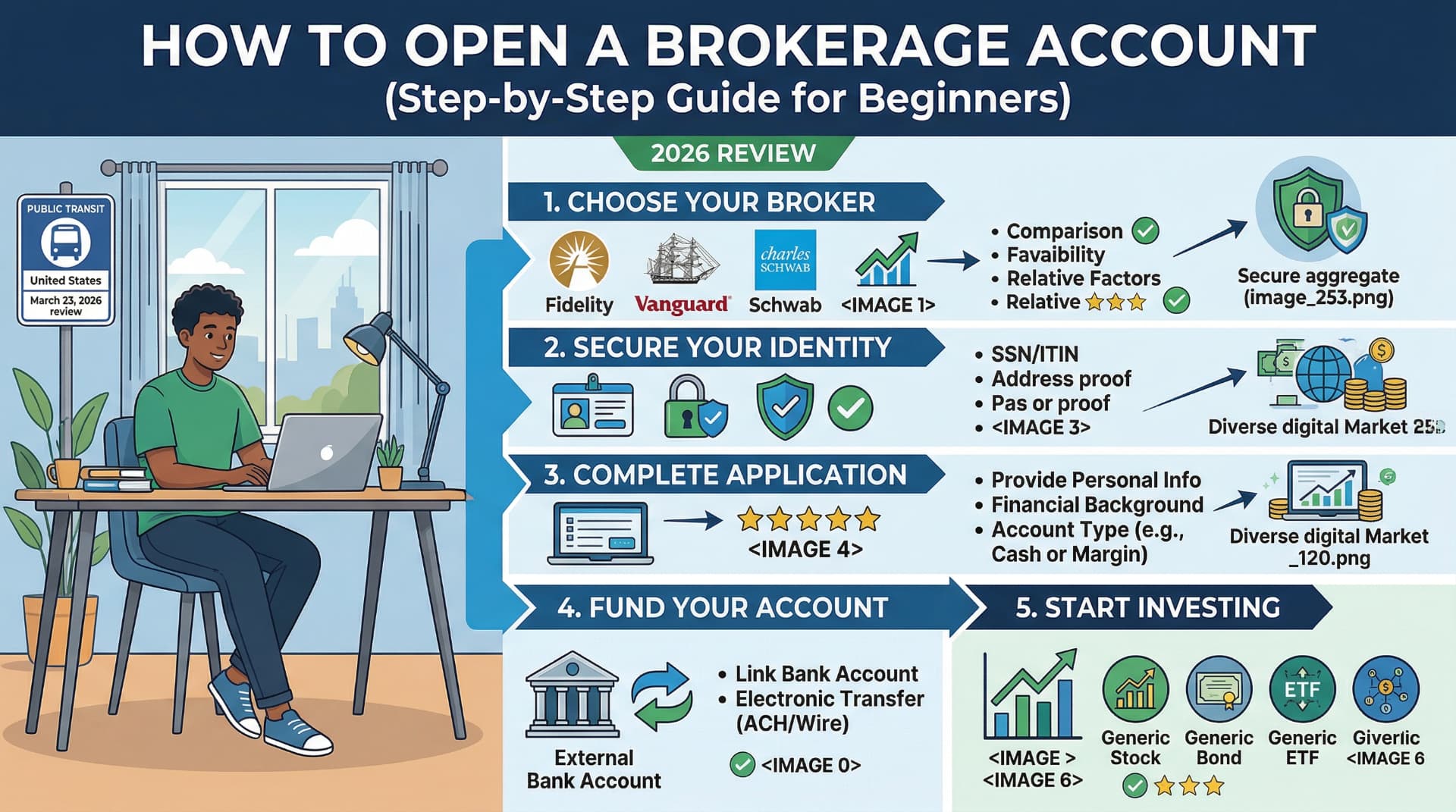
The Short Answer
Opening a brokerage account takes 10–15 minutes — choose a broker like Fidelity or Schwab, provide your Social Security number, link your bank account, and fund with as little as $1 to start investing.
How to Open a Brokerage Account (Step-by-Step Guide for Beginners)
By DadAlt Investments | Category: Stocks & Brokerages | Last Updated: March 2026
Summary
Opening a brokerage account in 2026 takes about 10 to 15 minutes online and costs nothing to start — no minimums, no commissions at the major platforms. But most beginners make the same two mistakes: they open the wrong account type first, or they fund the account and then leave their money sitting in cash. This guide walks you through every step clearly — from choosing the right account type to placing your first trade and setting up automation — so you beginner investing the right way from day one. If you have been putting this off, this is the article that ends that.
What Is a Brokerage Account — and Why Do You Need One?
A brokerage account is an investment account that lets you buy and sell securities: stocks, passive income strategies, mutual funds, bonds, and more. You deposit money, the brokerage holds and executes your trades, and you own the investments directly in your name.
It is fundamentally different from a high-yield savings accounts. Money in a savings account earns a fixed interest rate set by the bank — typically 0.45–5.00% depending on the account type. Money in a brokerage account is put to work in the market, where the U.S. stock market has returned an average of approximately 10% annually over the past century before inflation, or roughly 7% after inflation. 1
Three Account Types You Need to Understand
Before you open anything, it helps to know the landscape:
| Account Type | Tax Treatment | Contribution Limit | Withdrawal Rules |
|---|---|---|---|
| Taxable Brokerage | Pay taxes on dividends and capital gains each year | No limit | Withdraw anytime, no penalty |
| Roth IRA | Contribute after-tax; growth and withdrawals are tax-free | $7,500/yr (2026); $8,600 age 50+ | Contributions anytime; earnings penalty-free at 59½ |
| 401(k) | Pre-tax contributions; pay taxes on withdrawal | $24,500/yr (2026); up to $32,500 age 50+ | Penalty-free at 59½ |
Sources: IRS Notice 2025-67; IRS.gov retirement contribution limits 23
The taxable brokerage is the most flexible — no limits, no age restrictions, no penalties. But it is the last account you should open, not the first.
Brokerage Account vs. Roth IRA: Which Should You Open First?
Open the Roth IRA first.
This is the most important decision in this entire guide and the one most beginners get backwards. Here is why:
- Tax-free compound interest is permanent. Every dollar that grows inside a Roth IRA — and every dollar you withdraw in retirement — is completely tax-free. A taxable brokerage account taxes you on dividends every year and on capital gains when you sell.
- The 2026 contribution limit is $7,500 (or $8,600 if you are 50 or older). This is a use-it-or-lose-it annual limit. You cannot go back and fill prior years.
- The income phase-out for a Roth IRA in 2026 starts at $153,000 MAGI for single filers ($242,000 for married filing jointly). If your income is below those thresholds, you are eligible to contribute. 2
The correct order for most investors:
- Contribute enough to your 401(k) to capture the full employer match (this is a guaranteed 50–100% return on that money)
- Open and max a Roth IRA ($7,500 in 2026)
- Then open a taxable brokerage account for any additional investing beyond the IRA limit
A taxable brokerage is still worth having — especially once you have maxed tax-advantaged accounts, or if you need liquidity before retirement age. But if you have limited capital and can only do one thing, the Roth IRA wins.
See also: Best Roth IRA Providers for Beginners — a full comparison of Fidelity, Vanguard, and Schwab, Schwab, Robinhood, and M1 Finance for 2026.
What You Will Need Before You Apply
The application process is fast — but having everything ready before you start makes it seamless. Here is the complete checklist:
Required for every applicant:
- ✅ Social Security Number (SSN) — Required for tax reporting under the USA PATRIOT Act. Brokerages are legally required to collect this under their Customer Identification Program (CIP) mandated by FINRA Rule 2090 and the Bank Secrecy Act. 4
- ✅ Government-issued photo ID — Driver's license, state ID, or passport. You will upload a photo through the app or website.
- ✅ Bank account number and routing number — For linking your checking or savings account to fund your brokerage account via ACH transfer.
- ✅ Current mailing address — Must match your ID or you may need to provide proof of address (utility bill or bank statement).
- ✅ Basic employment information — Employer name, address, and employment status. Required under FINRA's Know Your Customer (KYC) suitability rules. 5
- ✅ Email address and phone number — For account verification and security alerts.
Optional but useful to have ready:
- Beneficiary information (full name, date of birth, SSN of the person who inherits the account)
- Your existing 401(k) statement if you plan to open a rollover IRA
If you do not have an SSN: U.S. residents without an SSN can apply for an Individual Taxpayer Identification Number (ITIN) from the IRS using Form W-7. Several major brokerages — including Charles Schwab — accept ITINs for account opening. 6
Time required: The application itself takes 10–15 minutes. Account approval is usually instant or within 1–2 business days via electronic verification. 7
Step 1 — Choose Your Brokerage
The most important criteria for a beginner's first brokerage account in 2026:
- $0 account minimum — You should never need to deposit a set amount just to open an account
- $0 commissions on stocks and ETFs — All major online brokerages now offer this
- Fractional shares available — So you can invest any dollar amount regardless of share price
- Strong mobile app — You will use this more than the website
- IRA account types — If you are opening a Roth IRA, confirm the brokerage supports it
Best brokerages for beginners in 2026:
| Brokerage | Account Minimum | Fractional Shares | IRA Available | Best For |
|---|---|---|---|---|
| Fidelity | $0 | Yes — 7,000+ securities from $1 | Yes | Best all-around; ZERO expense ratio funds |
| Charles Schwab | $0 | Yes — S&P 500 stocks, $5 min | Yes | Full-service; 400+ branches; thinkorswim |
| Robinhood | $0 | Yes — from $1 | Yes (with IRA match) | Simplest app; 1–3% IRA match (Gold) |
For most beginners, Fidelity is the default recommendation: no account minimum, no commissions, fractional shares on over 7,000 securities, 24/7 customer support, 200+ branch locations, and access to FZROX — the only 0.00% expense ratio total market fund available to retail investors. 8
See also: Top Stock Brokerages for New Investors 2026 — a full breakdown of every major platform with ratings, pros, and cons.
What to avoid:
- Brokerages with account minimums or annual maintenance fees
- Platforms that charge commissions per trade
- Choosing a brokerage purely because of a referral bonus — the bonus is temporary, the platform is long-term
Step 2 — Start the Application
Go to your chosen brokerage's website or download their app. Look for "Open an Account" or "Get Started." The application will walk you through several screens.
Choose Your Account Type
This is the first decision the application will ask you to make. Your options typically include:
- Individual brokerage account — Taxable account owned by one person. Most flexible, no contribution limits, taxable on gains and dividends.
- Joint brokerage account — Taxable account owned by two people (e.g., spouses). Same tax treatment as individual.
- Roth IRA — Post-tax contributions; tax-free growth; $7,500 limit in 2026. Best first account for most investors.
- Traditional IRA — Pre-tax contributions (may be deductible depending on income); taxable on withdrawal. Good if you expect lower taxes in retirement.
- Rollover IRA — For moving an old 401(k) or 403(b) into an IRA.
If you are starting from zero: open a Roth IRA. If your income is above the Roth phase-out ($153,000 single / $242,000 married in 2026), open a Traditional IRA or taxable brokerage. 2
Fill In Your Personal Information
The application will ask for:
- Full legal name (exactly as it appears on your ID)
- Date of birth
- Social Security Number
- Home address and mailing address
- Email address and phone number
- Citizenship status
Enter everything accurately. Discrepancies between your application and your ID are the most common reason for delays.
Answer the Investment Experience Questionnaire
Every brokerage is legally required to ask about your financial situation under FINRA Rule 2111 (Suitability). 5 You will be asked questions like:
- What is your annual income?
- What is your approximate net worth?
- How many years of investing experience do you have?
- What is your investment objective? (growth, income, capital preservation, speculation)
- What is your risk tolerance? (conservative, moderate, aggressive)
Answer honestly. These answers do not lock you into anything — you can update them later. But if you call yourself an aggressive trader and then call customer service because a stock went down 10%, they will reference what you told them. For most beginners, "moderate" risk tolerance and "long-term growth" as your objective is accurate and appropriate.
Step 3 — Verify Your Identity
After submitting your personal information, the brokerage will verify your identity. This is required by federal law under the USA PATRIOT Act and FINRA's Customer Identification Program. 4
How Verification Works
Most brokerages use electronic verification first — they run your name, SSN, date of birth, and address against credit bureau and government databases. For the majority of applicants, this happens in seconds and the account is approved instantly.
If electronic verification cannot confirm your identity, you will be asked to upload a photo of your government-issued ID:
- On mobile: Use your phone camera to photograph the front and back of your driver's license or passport. Most apps guide you through this.
- On desktop: Upload a clear image file (JPEG or PDF) of your ID. Make sure all four corners are visible and the image is in focus.
If Verification Takes Extra Time
Delays happen for a few reasons:
- Your name or address has changed recently (e.g., recent move or marriage)
- The address on your ID does not match your current address
- The image of your ID was unclear or cut off
If your account is pending review, the brokerage will email you instructions. In most cases, uploading a clear ID photo resolves the issue within 1–2 business days. You can call customer service to check status — Fidelity's 24/7 phone line is particularly helpful here.
Step 4 — Link Your Bank and Fund the Account
Once your account is approved, you need to fund it before you can invest. There are two primary methods:
Method 1: ACH Transfer (Most Common)
An ACH (Automated Clearing House) transfer moves money electronically from your bank account to your brokerage using your bank's routing number and account number.
- Settlement time: Typically 1–3 business days for the full transfer to settle
- Instant buying power: Fidelity, Schwab, and Robinhood all provide a portion of your deposited funds as instant buying power before the ACH fully clears — typically up to $1,000–$25,000 depending on your account history 9
- Cost: Free at all major brokerages
- Best practice: Initiate the transfer as a "push" from your bank's website (you send the money out) rather than a "pull" initiated at the brokerage. Push transfers are typically credited faster. 10
Method 2: Wire Transfer
A wire transfer is the fastest funding method — funds are available the same day if the wire is received before 4:00 PM ET.
- Settlement time: Same day
- Cost: Your bank typically charges $15–$35 to send a wire. The receiving brokerage does not charge.
- When to use: When you need to invest immediately and the amount is large enough to justify the wire fee
How Much Should You Start With?
You can start with as little as $1 — fractional shares allow you to invest any dollar amount in any security. There is no minimum at Fidelity, Schwab, or Robinhood.
A practical starting point for most beginners:
- $100–$500: Enough to buy a fractional share of one or two index ETFs and get comfortable with the platform
- $500–$2,000: Enough to build a simple two-fund portfolio (e.g., VTI + BND)
- $2,000+: Enough to begin building a diversified starting allocation
The most important thing is not how much you start with. It is that you start, and that you set up automatic recurring contributions so you add money consistently over time.
Step 5 — Place Your First Trade
With your account funded and some buying power available, you are ready to invest. Here is how to do it clearly and simply.
What to Buy First
For a brand new investor, the simplest and most research-backed starting point is a broad-market index ETF. Three solid choices that are available at every major brokerage:
- VTI — Vanguard Total Stock Market ETF. Tracks the entire U.S. stock market (4,000+ companies). Expense ratio: 0.03%.
- VOO — Vanguard S&P 500 ETF. Tracks the 500 largest U.S. companies. Expense ratio: 0.03%.
- SCHD — Schwab U.S. Dividend Equity ETF. Dividend-focused; 100 high-quality dividend-paying companies. Expense ratio: 0.06%.
If you are at Fidelity and want the absolute lowest cost, FZROX (Fidelity ZERO Total Market platforms for index funds, 0.00% expense ratio) is the equivalent of VTI — but only available at Fidelity.
Market Order vs. Limit Order — Explained Simply
When you place a trade, you will be asked to choose an order type:
- Market order: Buy immediately at whatever the current price is. The trade executes within seconds during market hours (9:30 AM–4:00 PM ET, Monday–Friday). Slight risk of getting a slightly different price than what you see on screen, but for large index ETFs with high trading volume, this difference is usually pennies.
- Limit order: You set the maximum price you are willing to pay. The trade only executes if the price is at or below your limit. More control, but the trade may not fill if the price never reaches your limit.
For index ETFs, a market order is fine. Limit orders matter more for individual stocks with low trading volume or during volatile market conditions.
How to Place the Trade (Step by Step)
- Log into your brokerage account
- Search for the ticker symbol (e.g., "VTI" or "VOO")
- Click "Buy" or "Trade"
- Choose "Market" as the order type
- Enter either the number of shares you want, or the dollar amount (if fractional shares are available)
- Review the order preview — confirm the ticker, quantity, estimated price, and total cost
- Click "Confirm" or "Submit"
- Check your "Holdings" or "Positions" tab to see your new investment
That is it. You are now an investor.
Step 6 — Set Up Automation
Placing one trade is a good start. What builds real wealth over time is consistent, automatic investing — removing emotion and decision fatigue from the equation entirely.
Enable DRIP (Automatic Dividend Reinvestment)
DRIP stands for Dividend Reinvestment Plan. When a stock or ETF pays a dividend, instead of depositing the cash into your account, the brokerage automatically uses it to buy more shares — including fractional shares.
- Fidelity offers fractional DRIP on all eligible securities 8
- Schwab offers DRIP on all eligible securities in standard accounts 11
- Robinhood offers DRIP on eligible securities
How to enable it: In your brokerage account settings, look for "Dividend Reinvestment" and turn it on. At Fidelity, it is under Account Features → Dividends and Capital Gains → Update. At Schwab, look for "Dividend Reinvestment" in account settings.
Set Up Recurring Automatic Investments
Every major brokerage allows you to schedule automatic investments — you choose the amount and frequency (weekly, biweekly, or monthly), and the brokerage buys shares automatically.
- At Fidelity: Go to Accounts → Transact → Automatic Investments. Select your fund, dollar amount, and schedule.
- At Schwab: Go to Accounts → Automatic Investment Plan.
- At Robinhood: Use the "Recurring Investment" feature within any stock or ETF page.
Even $50 or $100 per month invested automatically in a low-cost index ETF will compound significantly over 20–30 years. A $200/month recurring investment in VTI over 30 years at 7% average return grows to approximately $227,000.
Notification Settings
Set these up correctly from the start:
Turn ON:
- Security alerts (login from new device, password change, large withdrawal)
- Trade confirmations
- Tax document availability notices
Turn OFF (or limit):
- Daily market summary notifications
- Push notifications for every price movement in your holdings
The investors who check their accounts the most tend to perform the worst — they buy and sell based on short-term noise. Set it up, automate it, and check it monthly at most.
Common Mistakes First-Time Investors Make
1. Opening a Taxable Account Before Maxing Tax-Advantaged Options
The single most common and most expensive mistake. If you have not yet opened and maxed a Roth IRA ($7,500 in 2026), that should happen before you put a dollar into a taxable brokerage account. Tax-free compounding is worth tens of thousands of dollars over a career.
2. Leaving Cash Uninvested After Funding
You fund your account, the money sits there, and you wait for "the right moment" to invest. This is called cash drag, and it costs you real money. The default cash sweep at Schwab pays approximately 0.05% interest — while the market averages 10% annually over time. 11 Invest your cash the day it arrives. For index fund investors, time in the market beats timing the market.
3. Over-Checking the Account in the First Weeks
The S&P 500 has positive returns in approximately 73% of calendar years since 1928. 1 But on any given day, week, or month, it may be down — and it will feel like your money is disappearing. Checking daily is normal at first and almost always counterproductive. Set a monthly check-in on your calendar and step away.
4. Choosing a Brokerage Purely for the Referral Bonus
A $50 or $100 sign-up bonus sounds appealing, but it is meaningless if the platform has a weaker user experience, narrower fractional share program, or poorer tax reporting tools. Choose the platform you will use for the next 20 years, then look for any current promotions as a secondary consideration.
5. Confusing a Brokerage Account With an Investment
Opening the account and depositing money is not investing. Your money must be put into a security — a stock, ETF, or mutual fund — before it is working for you. Many first-time investors fund an account, assume they are now "invested," and discover months later that their cash has just been sitting uninvested.
Frequently Asked Questions
How long does it take to open a brokerage account? The application takes 10–15 minutes. Account approval via electronic verification is typically instant or within 1–2 business days. Funding via ACH transfer usually provides some instant buying power the same day, with the full transfer settling in 1–3 business days. 7
Can I open a brokerage account if I am under 18? No — you must be at least 18 years old to open a standard brokerage account in the United States. However, parents can open a custodial account (such as a UGMA/UTMA account) for a minor. Fidelity also offers a Youth Account for teens ages 13–17 with parental oversight. At age 18, the account converts to a standard individual account. 12
Is there a minimum balance to start investing? No, at Fidelity, Schwab, and Robinhood. You can open an account with $0 and begin investing with as little as $1 using fractional shares.
What happens if I deposit money and do not invest it? Your cash will sit in a default "cash sweep" or money market position. At Schwab, the default sweep account earns approximately 0.05% — essentially nothing. 11 At Fidelity, uninvested cash in a brokerage account goes into FDIC-insured cash or a money market fund, earning more. Either way, uninvested cash does not participate in market returns. Always invest your cash the same week you fund the account.
What taxes will I owe on a taxable brokerage account? You may receive three types of tax forms from a taxable brokerage account: a 1099-B (if you sold any investments at a gain or loss), a 1099-DIV (if you earned more than $10 in dividends), and a 1099-INT (if you earned more than $10 in interest income). Capital gains held longer than one year are taxed at the long-term capital gains rate (0%, 15%, or 20% depending on your income). Gains held one year or less are taxed as ordinary income. In a Roth IRA, none of this applies — no taxes on dividends, gains, or withdrawals in retirement. 12
Can I have a Roth IRA and a taxable brokerage account at the same time? Yes, absolutely. Most serious long-term investors maintain both. The Roth IRA is your primary retirement vehicle (tax-free growth). The taxable brokerage handles investments beyond the annual IRA limit, shorter-term goals, or assets you may need to access before retirement age.
Sources and References
Disclosure: This article is for informational purposes only and does not constitute financial or tax advice. DadAlt Investments may receive compensation through affiliate relationships with the brokerages and platforms mentioned. Always verify account features, minimums, and contribution limits directly with the brokerage before opening an account. Consult a qualified tax professional regarding your specific tax situation.
Recommended Reading
- Top Stock Brokerages for New Investors
- The Ultimate Beginner's Guide to Investing for Dads
- Best Platforms to Buy Index Funds
Footnotes
-
Investopedia. S&P 500 Historical Annual Returns. Long-term average annual return approximately 10% nominal, 7% inflation-adjusted. https://www.investopedia.com/ask/answers/042415/what-average-annual-return-sp-500.asp ↩ ↩2
-
IRS. 401(k) limit increases to $24,500 for 2026, IRA limit increases to $7,500. IRS Notice 2025-67, November 13, 2025. https://www.irs.gov/newsroom/401k-limit-increases-to-24500-for-2026-ira-limit-increases-to-7500 — IRA contribution limits: $7,500 standard / $8,600 age 50+. Roth IRA phase-out: $153,000–$168,000 single; $242,000–$252,000 married filing jointly. ↩ ↩2 ↩3
-
IRS. Retirement Topics — IRA Contribution Limits. https://www.irs.gov/retirement-plans/plan-participant-employee/retirement-topics-ira-contribution-limits ↩
-
FINRA. Anti-Money Laundering (AML) — Customer Identification Program. https://www.finra.org/rules-guidance/key-topics/aml — Brokerages required to collect and verify SSN, name, DOB, and address under the USA PATRIOT Act and Bank Secrecy Act. ↩ ↩2
-
FINRA. Rule 2090 — Know Your Customer. https://www.finra.org/rules-guidance/rulebooks/finra-rules/2090 — Requires member firms to use reasonable diligence to know and retain essential facts about every customer. ↩ ↩2
-
TopRatedFirms. How to Invest Without SSN (with ITIN) in 2026. Updated January 2026. https://topratedfirms.com/articles/ssn/brokerage-account-without-ssn.aspx — Charles Schwab accepts ITINs; ITIN application via IRS Form W-7. ↩
-
Chase. What Do You Need to Open a Brokerage Account? https://www.chase.com/personal/investments/learning-and-insights/article/what-do-you-need-to-open-brokerage-account — Application process overview; typical 10–15 minutes; approval usually same day or 1–2 business days. ↩ ↩2
-
Fidelity. How to Open a Brokerage Account. https://www.fidelity.com/learning-center/smart-money/how-to-open-a-brokerage-account — $0 minimums, fractional shares, Youth Account for ages 13–17, DRIP details. ↩ ↩2
-
Fidelity. EFT or a Bank Wire — Fund Transfers, Fees, and Eligibility. https://www.fidelity.com/customer-service/choose-eft-or-bank-wire — ACH transfer times; wire available same day if received before 4 PM ET; instant buying power details. ↩
-
The Finance Buff. ACH Push or Pull: The Right Way to Transfer Money. Updated February 2025. https://thefinancebuff.com/ach-transfer-push-pull.html — ACH push transfers typically credited faster than pull transfers; internal bank transfers are instant. ↩
-
NerdWallet. Charles Schwab Review: Our Honest Take for 2026. https://www.nerdwallet.com/investing/reviews/schwab-brokerage — Default sweep account interest approximately 0.05%; DRIP availability; account features. ↩ ↩2 ↩3
-
Fidelity. IRA Contribution Limits for 2025 and 2026. https://www.fidelity.com/learning-center/smart-money/ira-contribution-limits — Tax treatment of brokerage vs. IRA accounts; 1099 forms explained; Youth Account age requirements. ↩ ↩2
Frequently Asked Questions
What do I need to open a brokerage account?
You'll need your Social Security number, a government-issued ID, your employer's name and address, and a linked bank account for funding. The entire process is done online in about 15 minutes.
Is there a minimum deposit to open a brokerage account?
Most major brokerages (Fidelity, Schwab, Vanguard) have no minimum deposit requirement. You can open an account with $0 and fund it when you're ready. Some specialty accounts may require $1,000+.
Should I open a taxable brokerage account or a Roth IRA first?
If you're eligible, start with a Roth IRA for tax-free growth. Once you max that out ($7,000/year), open a taxable brokerage account for additional investing. Both are important for a complete strategy.

About the Author
Jared DeValk
Founder, DadAlt Investments
Father, alternative investment researcher, and founder of DadAlt Investments. 14+ years turning hard lessons into honest guidance for dads building real wealth.