
Crypto Staking Explained for Beginners
Earn passive income with staking safely.
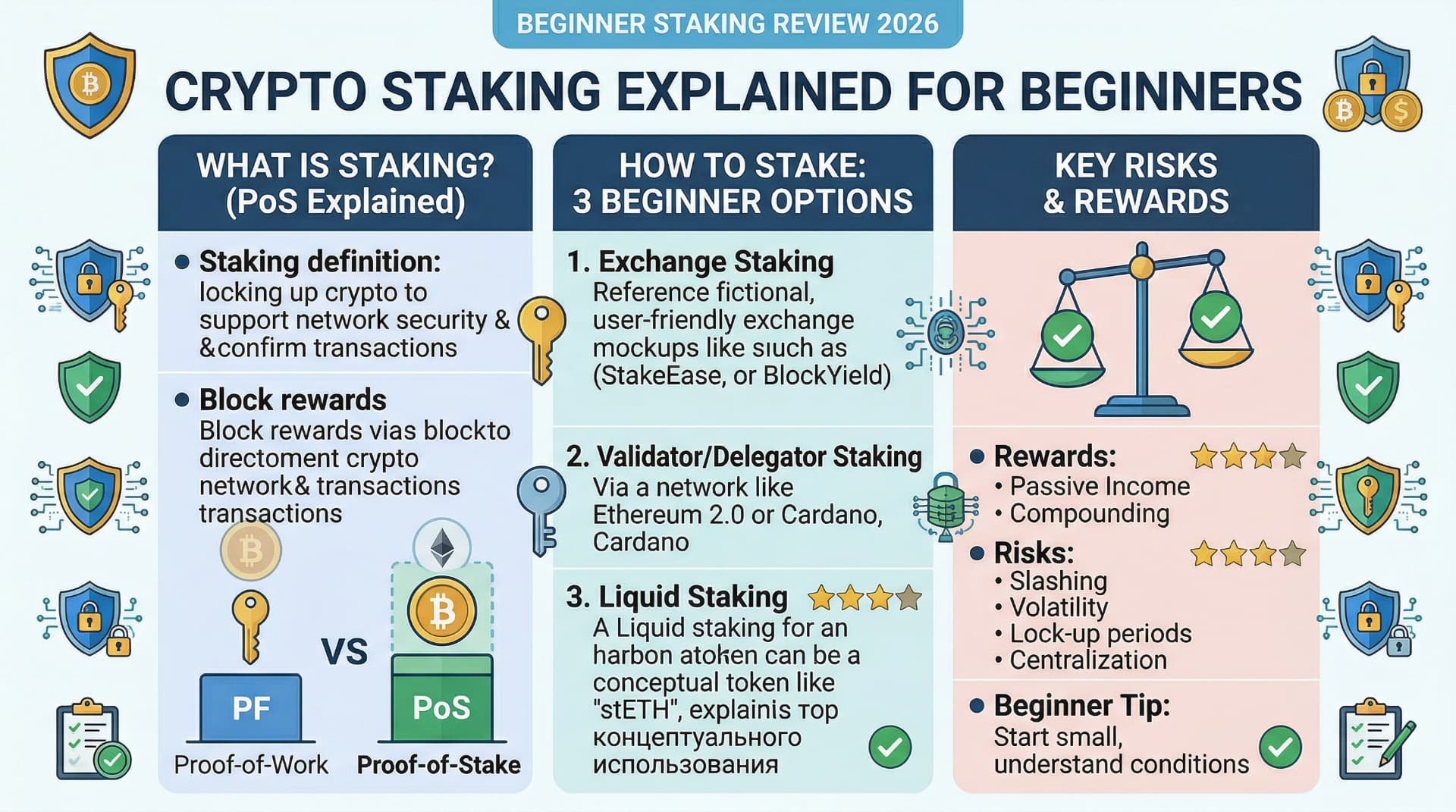
The Short Answer
Crypto staking lets you earn 3–12% annual yields by locking up coins to help secure a blockchain network — it's essentially passive income from crypto without trading or timing the market.
Crypto Staking Explained for Beginners: How to Earn Passive Income With Your Crypto
Category: Crypto & Digital Assets | Tags: Passive Income · Beginner Guides · Guides & How-To's
Target Keywords: crypto staking, passive crypto income, how does staking work, staking rewards, best coins to stake
Summary
If you own Ethereum, Solana, Cardano, or another proof-of-stake cryptocurrency and you're just letting it sit in a wallet, you may be leaving real money on the table. Crypto staking is the process of locking up your digital assets on a blockchain network to help validate transactions — and earning rewards in return. Think of it like putting your money in a high-yield savings account, except instead of a bank paying you interest for using your deposit, a blockchain network pays you newly minted crypto for helping keep it secure and operational. As of early 2026, more than 35.8 million ETH — nearly 29% of Ethereum's total supply — is actively staked, per Datawallet, with the total value of staked Ethereum exceeding $112 billion. Staking has grown from a niche technical activity into one of the most accessible forms of passive income in the crypto world, with everyday investors earning between 3% and 15% annually depending on the coin and method they choose. This guide explains exactly how staking works, which cryptocurrencies support it, what the risks are, how much you can realistically earn, how to get started safely as a beginner — and critically, how the IRS expects you to handle it on your taxes.
What Is Crypto Staking? The Simple Version
Crypto staking is the practice of locking your digital tokens onto a blockchain network in order to earn rewards — typically a percentage of the tokens you staked, paid out periodically in the same cryptocurrency.
Here's the plainest possible explanation: You lock up some of your crypto. The network uses it to help validate transactions and maintain security. In return, you earn more crypto — similar to how a savings account pays you interest for keeping your money on deposit.
According to Britannica Money, a basic example looks like this: if a blockchain offers a 5% reward for staking and you lock up 100 tokens for a month, you can expect to receive 5 additional tokens as your reward at the end of that period, in addition to getting your original 100 tokens back.
Unlike Bitcoin — which uses an energy-intensive process called "proof of work" that requires miners to compete by solving complex math problems using expensive computing hardware — many modern blockchains use "proof of stake," where the validator is selected based on how much crypto they have staked. The result is a system that is dramatically more energy-efficient (Ethereum's 2022 switch to proof of stake reduced its energy consumption by approximately 99.95%, per Ethereum.org), more accessible to everyday participants, and capable of generating meaningful passive income for token holders.
The most important thing to understand before we go further:
Not all cryptocurrencies can be staked. Bitcoin cannot be staked — it uses proof of work. Only cryptocurrencies that run on proof-of-stake blockchains support staking. The major stakeable coins include Ethereum (ETH), Solana (SOL), Cardano (ADA), Polkadot (DOT), Cosmos (ATOM), and others covered below.
How Crypto Staking Actually Works: The Mechanics
To understand staking, you need to understand the problem it solves: how does a decentralized network of computers that doesn't have a central authority agree on which transactions are valid?
In traditional finance, banks and clearinghouses serve as trusted intermediaries. In crypto, blockchains need a different mechanism. Two dominant approaches have emerged:
Proof of Work vs. Proof of Stake
| Proof of Work (PoW) | Proof of Stake (PoS) | |
|---|---|---|
| How validators are chosen | Compete to solve math puzzles | Selected based on amount staked + randomness |
| What participants do | Mining with specialized hardware | Lock up ("stake") their tokens |
| Energy requirement | Enormous — Bitcoin uses as much electricity as some small countries | Minimal — ~99.95% less than PoW |
| Main example | Bitcoin (BTC) | Ethereum (ETH), Solana (SOL), Cardano (ADA) |
| Reward mechanism | Block rewards for successful miners | Staking rewards for selected validators |
| Can regular investors participate? | Only with expensive mining hardware | Yes — through staking pools, exchanges, or direct staking |
Sources: Fidelity Learning Center, Gemini Cryptopedia, Ethereum.org
The Staking Process Step by Step
Here is how proof-of-stake blockchain validation works, as explained by Fidelity's Learning Center and corroborated by Kraken's educational resources:
-
Token holders ("stakers") lock their tokens into the network. This is called "staking." The network requires a minimum amount of tokens to be considered for validator selection on most protocols (32 ETH for solo Ethereum validation, for example, per SoFi). Staking pools and exchange-based staking allow participation with much smaller amounts.
-
A validator is randomly selected from the pool of stakers to propose the next block of transactions. The randomness is not purely proportional to stake size — protocols incorporate additional randomization so that smaller stakers still have a chance to be chosen, preventing the richest participants from dominating entirely, per Kraken's staking guide.
-
The selected validator proposes a new block. They compile a set of pending transactions, verify them, and submit the new block to the network for the record.
-
Other validators review the block and attest to its validity. This cross-checking mechanism ensures accountability — validators that try to cheat or submit invalid transactions can be identified and penalized.
-
The block is added to the blockchain. The proposing validator receives staking rewards in the form of newly minted cryptocurrency, plus any transaction fees from that block.
-
The process repeats for every new block, which happens every few seconds on most modern blockchains.
What Is Slashing?
Slashing is the penalty for bad behavior in a proof-of-stake system. If a validator tries to cheat — proposing invalid blocks, double-signing transactions, or going offline for extended periods — the blockchain protocol can automatically confiscate ("slash") a portion of their staked tokens.
As explained by Kraken's staking guide and confirmed by the Lido Finance documentation, slashing can result in the partial or complete loss of a validator's staked tokens. This financial penalty is what makes the system trustworthy: validators have real "skin in the game" and will lose money if they act dishonestly.
For individual investors staking through exchanges or liquid staking platforms, slashing risk is generally managed by the platform's professional validator operators and is considered a low-probability event — but it is not zero, and it is one of the risks you accept when staking.
The 4 Ways to Stake Crypto
Staking is not one-size-fits-all. There are four main methods, each with different tradeoffs in terms of control, minimum amounts, yield, and complexity. Here's how they compare:
Method 1: Solo Staking (Running Your Own Validator Node)
What it is: You operate your own validator node — a computer that runs continuously, stays online, and participates in block validation directly on the blockchain.
How it works: You lock up the required minimum amount (32 ETH for Ethereum), run dedicated hardware, and handle all technical operations yourself. If your node misbehaves or goes offline excessively, you risk slashing.
Best for: Technical users with significant capital and the expertise to run server infrastructure reliably.
Pros:
- Maximum yield — no middleman taking a fee cut
- Full control of your assets at all times (non-custodial)
- Directly contributes to network decentralization
Cons:
- High capital requirements (32 ETH = ~$64,000+ as of early 2026)
- Requires always-on hardware and technical maintenance
- Slashing risk is entirely your responsibility
- Not practical for most individual investors
Source: Fidelity Learning Center, Coin Bureau
Method 2: Exchange-Based Staking (Custodial Staking)
What it is: You deposit your crypto to a centralized exchange (Coinbase, Kraken, Binance, Robinhood, etc.), and the exchange handles all the validator operations on your behalf. You earn a portion of the staking rewards, minus the platform's commission.
How it works: The exchange pools together deposits from many users to meet validator minimums, runs the validator infrastructure, and distributes rewards to participants proportionally. You don't need to understand any of the technical details.
Best for: Beginners and most individual investors who want a simple, guided experience.
Pros:
- No technical knowledge required — one-click setup
- No minimum amount on most platforms (or very low minimums)
- Rewards are automatically credited to your account
- Familiar interface from your regular exchange account
Cons:
- You give up custody of your assets (your crypto is held by the exchange)
- Platforms take a commission — typically 15%–30% of your staking rewards
- Platform risk: if the exchange fails, is hacked, or faces regulatory action, your staked assets could be affected
- Yields are lower than solo staking after platform fees
Typical fees and yields by platform (approximate figures as of 2025–2026):
- Coinbase: Commission up to 30% of rewards; ETH yield approximately 1.86%–3.5% after fees; SOL yield up to 4%; simple one-click process, New York State licensed, SOC 2 Type 2 certified. (Sources: Coinbase Institutional, CoinBrain)
- Kraken: Commission approximately 15% of rewards; ETH yield up to 6.5% depending on method; SOL yield 5%–9%; over 20 stakeable assets; widely considered among the most transparent for fee disclosure. (Source: Kraken, CoinBrain, Kraken Best Exchanges Guide)
- Robinhood: Total fee is 25% of APY earned (split between Robinhood and their staking partner); supports ETH, SOL, and ADA; minimum as low as $1; fee capped at no more than 2.75% for the staking partner's portion. (Source: Robinhood Support)
Sources: Kraken Best Exchanges Guide, CoinBrain Staking Guide, Robinhood Support, Coinbase Institutional
Method 3: Staking Pools (Pooled Staking)
What it is: Groups of individual stakers combine their tokens into a shared pool to collectively meet validator minimums and split rewards. Each pool operates via a smart contract that specifies the terms and reward distribution.
How it works: You contribute any amount to the pool's smart contract. The pool collectively stakes enough to run one or more validator nodes. Rewards are distributed proportionally. Unlike exchange staking, you may retain custody of your assets in non-custodial pool designs.
Best for: Investors who want to participate in staking with small amounts but prefer more direct blockchain interaction than exchange-based staking.
Pros:
- Collaborative approach — accessible with small amounts
- Potential for non-custodial options (you keep control of your keys)
- Often more favorable yields than exchange staking
Cons:
- Smart contract risk — bugs in the pool's code could lead to losses
- Validator selection risk — if the pool's validators underperform or get slashed, all participants are affected
- More complex than exchange staking; requires understanding of wallets and DeFi
Source: Fidelity Learning Center, Kraken
Method 4: Liquid Staking
What it is: A specialized form of staking that solves the biggest problem with traditional staking — illiquidity. When you stake normally, your tokens are locked and unavailable until you unstake (which can take days or weeks). Liquid staking issues you a "liquid staking token" (LST) in return for your staked assets, which you can trade, sell, or use as collateral in DeFi protocols while your underlying crypto continues earning staking rewards.
How it works: You deposit your ETH (or SOL, or other stakeable token) into a liquid staking protocol like Lido Finance or Rocket Pool. You receive a derivative token — stETH (for Lido on Ethereum) or rETH (for Rocket Pool) — that represents your staked ETH plus accrued rewards. That stETH can be used in DeFi lending, yield farming, or simply held and sold. When you want your original ETH back, you redeem the liquid token through the protocol.
Best for: DeFi-savvy investors who want staking rewards without sacrificing the ability to use their assets elsewhere.
Pros:
- Eliminates lockup — your assets remain effectively "liquid" in derivative token form
- Liquid tokens can be used as collateral in DeFi for additional yield
- No minimum on platforms like Lido (per Lido Finance documentation)
- Lido applies a 10% fee on staking rewards (split between node operators and the Lido DAO), meaning users receive ~90% of protocol rewards
Cons:
- Smart contract risk — Lido is open-source and audited, but no smart contract is 100% risk-free
- Liquid token de-peg risk — in extreme market stress, stETH could trade below the value of the underlying ETH
- Added complexity compared to exchange staking
- Regulatory uncertainty — the SEC clarified in August 2025 that liquid staking receipts are not securities in some contexts, but the regulatory landscape continues to evolve (Source: CoinLaw ETH Staking Statistics)
Major liquid staking protocols (as of 2025–2026):
- Lido Finance (stETH): The largest liquid staking protocol with over 29% market share in staked ETH. No minimum ETH required. Operates across Ethereum and Solana. Takes a 10% fee on rewards (users receive 90%). Deep DeFi integration with stETH accepted as collateral across major lending protocols. (Sources: Gate.com, Lido Finance)
- Rocket Pool (rETH): More decentralized than Lido; allows anyone to run validator nodes with as little as 16 ETH (lower than Ethereum's native 32 ETH requirement). APY approximately 2.8% for regular stakers, up to 6.3% for node operators. The RPL governance token provides additional incentive alignment. (Source: Gate.com)
- Jito (JitoSOL) — Solana: A Solana-based liquid staking protocol that captures MEV (maximal extractable value — additional transaction fees that validators can capture) to boost returns for stakers. JitoSOL is widely used in Solana's DeFi ecosystem. (Sources: Sanctum, Trust Wallet)
- Marinade Finance (mSOL) — Solana: The leading liquid staking protocol on Solana. Automatically routes staked SOL to high-performing validators to maximize returns. APY typically ranges 5%–8% for SOL staking. mSOL is integrated into major Solana DeFi platforms including Orca and Saber. (Source: Gate.com, Trust Wallet)
Sources: Gate.com, Lido Finance Official, Milkroad Liquid Staking Guide, Trust Wallet, Sanctum
The Best Cryptocurrencies to Stake in 2025–2026
Not every cryptocurrency can be staked. Here are the most established proof-of-stake assets, with current yield ranges and key facts for U.S. investors:
1. Ethereum (ETH)
Current staking yield: Approximately 3%–5% APY depending on method and provider (Source: Stobix ETH Staking Guide, Datawallet)
Network overview: Ethereum is the world's second-largest cryptocurrency by market cap and the dominant smart contract platform. Its September 2022 transition from proof-of-work to proof-of-stake (known as "The Merge") reduced its energy consumption by approximately 99.95%, per Ethereum.org. As of January 2026, more than 35.8 million ETH — roughly 28.91% of the total supply — is staked across approximately 1.1 million active validators, per Datawallet's Ethereum staking statistics.
Minimum to stake:
- Solo validator: 32 ETH (~$64,000+ at current prices)
- Exchange-based (Coinbase, Kraken, Robinhood): Varies by platform, often as low as $1–$10
- Liquid staking (Lido): No minimum
Key facts:
- Ethereum's Pectra upgrade in May 2025 increased the maximum balance validators can earn rewards on from 32 ETH to 2,048 ETH, per Fidelity's Ethereum Merge guide
- Coinbase holds 21.69% of the centralized staking market with 1,840,952 ETH staked for users; Kraken holds 15.87% with 1,347,650 ETH (Source: Datawallet)
- CEX ETH staking yields typically range from 4%–6% APY; solo staking yields slightly higher
Why stake ETH? Ethereum is the most widely deployed staking asset, with the deepest infrastructure, the most liquid derivative tokens (stETH), and the broadest institutional validation. It's the default starting point for most staking beginners.
2. Solana (SOL)
Current staking yield: Approximately 6%–9% APY through exchanges (Kraken up to 9%, Coinbase up to 4%); base validator rewards 6%–7% APY; liquid staking with MEV capture can exceed 10% (Source: CoinBrain, Sanctum)
Network overview: Solana is one of the fastest and lowest-cost proof-of-stake blockchains, processing thousands of transactions per second with near-zero fees. It uses a hybrid consensus mechanism combining delegated proof-of-stake with "proof of history," which allows for significantly faster block times than Ethereum. Solana's liquid staking sector holds over $10.7 billion in TVL (total value locked), with 13.3% of all staked SOL held in liquid form (57 million SOL), per Sanctum's analysis as of October 2025.
Minimum to stake:
- Exchange-based: Very low minimums (Kraken, Coinbase)
- Liquid staking (Marinade, Jito): No meaningful minimum
Key facts:
- JitoSOL (Jito's liquid staking token) often delivers the highest combined APY on Solana by capturing MEV tips on top of base validator rewards
- mSOL (Marinade Finance) is the most widely DeFi-integrated Solana liquid staking token
- Kraken offers 5%–9% APY for SOL staking, per CoinBrain
Why stake SOL? Higher base yields than Ethereum, faster network growth, and a maturing liquid staking ecosystem make Solana an attractive staking asset for investors willing to accept somewhat higher volatility than ETH.
3. Cardano (ADA)
Current staking yield: Approximately 3%–5% APY (Source: Gemini Cryptopedia, The Motley Fool)
Network overview: Cardano is an eco-friendly, peer-reviewed proof-of-stake blockchain that was built with formal academic verification from inception. Its staking model (called "Ouroboros") is one of the most studied PoS protocols in academic literature, emphasizing security and decentralization. Cardano's delegated staking model is notably user-friendly: ADA holders delegate their tokens to stake pools without any lockup period and can move their tokens freely at any time.
Minimum to stake:
- No lockup periods — tokens remain accessible
- Accessible through Robinhood, Coinbase, Daedalus and Yoroi wallets
Key facts:
- ADA staking has no lockup period — you can undelegate and move your tokens at any time with no waiting period (unlike Ethereum's unbonding process)
- Rewards are distributed every 5 days (each Cardano "epoch")
- Cardano's non-custodial design allows delegation directly from your own wallet
Why stake ADA? The lack of any lockup period makes Cardano staking among the most liquid and low-risk staking experiences available. You earn rewards while maintaining full access to your tokens.
4. Polkadot (DOT)
Current staking yield: Among the highest of major PoS networks; approximately 14%–17% APY in many recent periods (Source: CoinBrain, Datawallet)
Network overview: Polkadot is a protocol that allows different blockchains to connect and work with one another — essentially an "internet of blockchains." Its staking model (Nominated Proof-of-Stake, or NPoS) allows DOT holders to nominate — or vote for — validators they trust to secure the network. Nearly half of DOT's circulating supply is staked, per CoinBrain.
Minimum to stake:
- Nominators need a minimum DOT amount (which fluctuates based on network conditions)
- Exchange-based: Lower minimums through platforms offering DOT staking
Key facts:
- Staking market cap: $3.63 billion DOT staked as of early 2026, with a staking ratio of 49.57% of circulating supply (Source: CoinBrain)
- Unbonding period: 28 days — your DOT is locked for 28 days when you request to unstake
Why stake DOT? Among the highest yields of any major PoS network, but with a long 28-day unbonding period. Best for investors with a long-term view who don't need near-term liquidity.
5. Cosmos (ATOM)
Current staking yield: Approximately 15%–20%+ APY (one of the highest of major PoS networks)
Network overview: Cosmos is a decentralized ecosystem of interconnected, independent blockchains. ATOM, its native token, is used to stake and secure the Cosmos Hub — the central chain of the ecosystem. Cosmos has one of the most generous staking reward structures of any major network, reflecting its goal of incentivizing long-term participation.
Key facts:
- Cosmos staking rewards are automatically compounded on many platforms (earned ATOM is staked automatically)
- Unbonding period: 21 days
- Used as an example of DeFi staking in IRS Revenue Ruling 2023-14 (per Gordon Law Group's staking tax guide)
Why stake ATOM? Cosmos offers some of the highest yields available among major PoS networks. Appropriate for investors comfortable with higher yield / higher volatility crypto that is less established than ETH or SOL.
Quick Comparison: Staking by Coin
| Coin | Yield Range (2025-2026) | Lockup/Unbonding | Min. to Stake | Best Method for Beginners |
|---|---|---|---|---|
| Ethereum (ETH) | 3%–6% APY | Varies (days to weeks) | ~$10 on exchanges | Exchange (Coinbase/Kraken) or Lido |
| Solana (SOL) | 6%–10%+ APY | Days | ~$1 on exchanges | Exchange (Kraken) or Jito/Marinade |
| Cardano (ADA) | 3%–5% APY | None (no lockup!) | Very low | Exchange or native wallet |
| Polkadot (DOT) | 14%–17% APY | 28 days | Varies | Exchange |
| Cosmos (ATOM) | 15%–20%+ APY | 21 days | Low | Exchange |
Yields are estimates based on available 2025–2026 data and fluctuate based on network conditions, validator performance, and total network participation. Sources: CoinBrain, Datawallet, Kraken, SoFi
How Much Can You Realistically Earn From Staking?
Here's the honest answer: staking rewards are real, but they are not a get-rich-quick scheme. They are a way to earn additional return on crypto you were already planning to hold long-term.
Let's work through some real-money examples:
Example 1: Staking $5,000 of Ethereum on Coinbase
- Coinbase ETH staking yield: approximately 1.86%–3.5% net APY after Coinbase's ~30% commission
- At 2.5% APY: $5,000 × 2.5% = $125 per year in ETH rewards
- This is passive income you earn simply by holding ETH in your Coinbase account and opting into staking
Example 2: Staking $5,000 of Ethereum on Kraken
- Kraken ETH yield: up to 6.5% APY with lower ~15% commission
- At 5% APY: $5,000 × 5% = $250 per year in ETH rewards
- The platform choice matters — Kraken's lower commission means meaningfully higher net yield
Example 3: Staking $5,000 of Solana on Kraken
- Kraken SOL yield: 5%–9% APY
- At 7% APY: $5,000 × 7% = $350 per year in SOL rewards
Example 4: Staking $5,000 of Polkadot
- DOT yield: approximately 15% APY
- At 15% APY: $5,000 × 15% = $750 per year in DOT rewards
The critical caveat: These returns are denominated in the cryptocurrency you're staking — not in U.S. dollars. If you stake $5,000 of ETH and earn 2.5% in ETH rewards, but ETH drops 40% in price, your staking rewards don't offset the price decline. Staking rewards are best thought of as a way to accumulate more of a coin you believe in long-term — not as a fixed-income replacement.
The Real Risks of Crypto Staking
Britannica Money and Gemini both emphasize that staking is inherently more risky than simply holding tokens in a secure wallet. Here is a complete, honest risk breakdown:
1. Price Volatility Risk (The Biggest One)
The value of your staked tokens can fall dramatically while they are locked up. You cannot sell staked assets during a lockup period. If you stake 5 ETH at $3,000 each ($15,000 total) and ETH drops to $1,800 during your staking period, you now hold $9,000 worth of ETH — regardless of how much you earned in staking rewards. Per Britannica Money: "New crypto investors might not fully realize that the value of their staked tokens can fall while they're locked up."
2. Slashing Risk
Validators who behave maliciously, submit invalid blocks, or go offline for extended periods can have their staked tokens "slashed" (partially or fully confiscated) by the protocol. For individual investors staking through reputable exchanges or platforms, this risk is managed by professional validators and is low — but not zero. Per Robinhood's staking documentation: "While rare, these penalties can lead to a loss of a portion of your staked crypto."
3. Lockup and Unbonding Risk
Most staking arrangements require tokens to be locked for a period of time, and when you request to unstake, there is often an "unbonding period" during which your tokens are neither earning rewards nor available for sale. Common unbonding periods:
- Ethereum: Several days
- Polkadot (DOT): 28 days
- Cosmos (ATOM): 21 days
- Cardano (ADA): No lockup (unique advantage)
If the price drops sharply while you're waiting to unstake, you cannot sell until the unbonding period ends.
4. Platform and Custodial Risk (Exchange Staking)
When you stake through an exchange, you give up custody of your assets — the exchange holds them. If the exchange is hacked, goes bankrupt, faces regulatory shutdown, or freezes withdrawals, your staked assets could be affected. CoinBrain notes: "Not your keys, not your crypto." This is the same risk that affected customers of exchanges like FTX and Celsius in 2022.
To mitigate: Stick to well-regulated, financially stable exchanges — particularly those with U.S. licenses (Coinbase, Kraken, Gemini) — and consider non-custodial or liquid staking options if custodial risk concerns you.
5. Smart Contract Risk (Liquid Staking and Pools)
Liquid staking protocols and staking pools rely on smart contracts — code that runs autonomously on the blockchain. If that code has a bug or vulnerability, it could be exploited and assets could be lost. Lido Finance's official documentation acknowledges this: the Lido code is open-source, audited, and covered by an Immunefi bug bounty program, but "there exist a number of potential risks when staking using the Lido protocol."
6. Liquid Token De-Peg Risk
Liquid staking tokens (stETH, rETH, mSOL) are designed to trade 1:1 with the underlying asset. In extreme market stress, they can temporarily trade at a discount (the "de-peg" scenario). During the June 2022 crypto crash, stETH briefly traded at a discount to ETH as demand for liquidity overwhelmed arbitrage mechanisms. Milkroad's liquid staking guide notes: "If Lido or Rocket Pool were to get hacked or go bankrupt, your liquid staking tokens would also go down with them."
7. Regulatory Risk
U.S. cryptocurrency regulation is still evolving. The SEC clarified in May and August 2025 that certain staking activities are not securities under certain conditions (Source: CoinLaw ETH Staking Statistics), but the landscape could change. Exchanges have faced regulatory pressure over staking programs in the past — Kraken paid a $30 million settlement with the SEC in 2023 over its staking-as-a-service program, which affected its U.S. retail staking offering.
8. Complexity and Mistakes
Beginners who move too quickly into staking without understanding lockup periods, unbonding times, validator selection, or tax obligations can make costly mistakes. Per Britannica Money's common beginner errors list:
- Conducting insufficient research into how staking works
- Ignoring price volatility during lockups
- Disregarding lockup periods and being surprised by illiquidity
- Ignoring tax implications
How Crypto Staking Is Taxed in the United States
This section is critical. The IRS is watching crypto more closely than ever, and staking income is taxable. Here's what you need to know:
The IRS Position on Staking Rewards
The IRS established its authoritative position in Revenue Ruling 2023-14: staking rewards are taxable as ordinary income at the time you receive them (when you have "dominion and control" over the assets — meaning you can freely transfer, sell, or use them), per Gordon Law Group and TRES Finance.
This means:
- When you receive staking rewards, you owe income tax on the fair market value of those rewards in U.S. dollars at the time of receipt — even if you don't sell them
- This income is reported as "Other Income" on Schedule 1 of Form 1040 (Line 8z), per Gordon Law Group
- You owe this tax even if your exchange doesn't send you a 1099 form for amounts under $600 (though Coinbase issues 1099-MISC for rewards exceeding $600, per Coinbase's tax documentation)
A concrete example from TRES Finance: If you receive 0.5 ETH in staking rewards on September 14, 2025, and ETH is worth $3,000 at that moment, you have $1,500 in taxable ordinary income — even if you never sold that ETH.
What Happens When You Later Sell Your Staking Rewards
When you eventually sell or exchange the crypto you earned from staking, a second taxable event occurs. You will owe capital gains tax on the difference between the price you received and the price at which you originally received the staking reward (your cost basis).
- If you received 0.5 ETH as staking rewards when ETH was $3,000 (reporting $1,500 as income), then later sold that 0.5 ETH for $3,500, you would owe capital gains tax on the additional $250 gain (0.5 ETH × ($3,500 − $3,000))
- Held under 1 year: Short-term capital gains — taxed at ordinary income rates (10%–37%), per TurboTax
- Held over 1 year: Long-term capital gains — taxed at preferential rates of 0%, 15%, or 20%, per TurboTax
New Form 1099-DA (Starting 2025 Tax Year)
A significant tax reporting change took effect for the 2025 tax year: crypto brokers and exchanges are now required to issue Form 1099-DA to report gross proceeds from digital asset sales and exchanges. Kraken confirmed it is providing Form 1099-DA to U.S. clients for the 2025 tax year (expected by March 13, 2026), per Kraken's crypto tax guide.
Note that Form 1099-DA covers sales and exchanges — staking reward income is still reported separately via Form 1099-MISC (for amounts over $600 at most exchanges) and must be reported on Schedule 1 of your Form 1040 regardless of whether you receive a form, per TRES Finance.
Key Tax Rules for Staking — Summary
- Staking rewards are ordinary income when received — taxed at your marginal income tax rate (10%–37%)
- Fair market value at receipt is your cost basis for future capital gains calculations
- When you sell staked rewards, you owe capital gains tax on any appreciation since receipt
- Unstaking itself is not a taxable event in most cases — it's what you do with the tokens afterward that matters
- Exchanging liquid staking tokens (like stETH for ETH) may trigger a capital gains event — consult a tax professional before executing this
- Even amounts under $600 must be self-reported — the 1099 threshold doesn't exempt you from reporting obligations, per TRES Finance
- Self-employment tax (15.3%) may apply if you operate a validator node as a business
- Crypto tax software like Koinly, TaxBit, or CoinTracker can dramatically simplify staking tax reporting by automatically importing your reward history and calculating cost basis
Tax disclaimer: This information is based on IRS guidance available as of early 2026 and is educational in nature. It is not tax advice. Crypto tax law is complex and evolving. Always consult a qualified CPA or tax attorney who specializes in digital assets before making staking or tax decisions.
How to Start Staking Crypto: A Step-by-Step Beginner's Guide
If you've read this far and want to start staking, here is a practical step-by-step guide designed for U.S.-based beginners:
Step 1: Determine Whether You Already Own Stakeable Crypto
Check your portfolio. Do you own ETH, SOL, ADA, DOT, or ATOM? If you hold any of these in a brokerage or exchange account, you may already be able to stake them with a few clicks. If you only own Bitcoin, staking is not available — Bitcoin uses proof of work.
Step 2: Choose the Right Coin Based on Your Priorities
- Want the most established, safest option? Start with ETH.
- Want higher yields and are comfortable with more volatility? Consider SOL or ATOM.
- Want no lockup period? Cardano (ADA) is the only major PoS coin with zero unbonding period.
- Want maximum yield and can tolerate a 28-day lockup? Polkadot (DOT) offers some of the highest yields.
Step 3: Select a Staking Method
For beginners, exchange-based staking is the recommended starting point:
- Coinbase: Beginner-friendly, heavily regulated U.S. exchange, lower yields due to higher commission (~30% of rewards), but maximum simplicity. Good for: ETH, SOL, ADA.
- Kraken: More competitive yields (lower ~15% commission), over 20 stakeable assets, transparent fee disclosure. Good for: ETH, SOL, DOT, and more.
- Robinhood: Very simple interface, 25% of APY taken as combined fee, supports ETH, SOL, ADA. Good for existing Robinhood users.
Ready to go beyond exchanges? Consider liquid staking:
- Lido Finance (stake.lido.fi): For ETH staking with no minimum and DeFi composability (receive stETH)
- Marinade Finance: For SOL staking with no minimum and liquid mSOL token
Step 4: Open an Account and Fund It (If Needed)
If you don't already have an account on your chosen platform, complete KYC (identity verification — standard for all U.S.-regulated exchanges) and fund your account via bank transfer. Standard verification takes 1–3 business days.
Step 5: Stake Your Tokens
On Coinbase, Kraken, or Robinhood, staking is built into the platform:
- Go to your crypto portfolio or the specific coin's detail page
- Look for a "Stake" or "Earn" button
- Choose the amount you want to stake
- Review the current APY, fee, and lockup terms
- Confirm the transaction
On Robinhood specifically, navigate to the coin detail page of your held crypto, select "Get started with staking," and choose the amount. You can unstake any time after the bonding period ends, per Robinhood Support.
Step 6: Set Up Tax Tracking From Day One
Before your first staking reward arrives, set up a crypto tax tracking system. Options:
- Koinly: Connects directly to exchanges and wallets; calculates staking income automatically; generates IRS-ready tax reports
- TaxBit: Full tax reporting with crypto staking support; integrates with major exchanges
- CoinTracker: Another popular option with exchange and wallet integrations
Record the date, time, and U.S. dollar value of every staking reward you receive. This is your cost basis for future capital gains calculations. If you receive staking rewards daily or weekly, this adds up to many transactions by year-end — crypto tax software automates this tracking.
Step 7: Monitor and Review Periodically
- Check your yield: Staking APY fluctuates based on network conditions and total staked supply. The more ETH (or SOL, etc.) that is staked network-wide, the lower each individual validator's share of rewards.
- Understand your unbonding period: If you need liquidity, plan ahead. Know how many days it takes to unstake your chosen crypto.
- Don't stake more than you can afford to lock up. Staking is a long-term activity. The lockup period means you can't access or sell staked assets immediately.
- Rebalance if your allocation drifts. If staking rewards accumulate and your crypto position grows beyond your target allocation, consider harvesting some rewards into stablecoins or fiat.
Common Beginner Mistakes to Avoid
Based on guidance from Britannica Money, Gemini, and Gordon Law Group:
-
Chasing the highest APY without understanding the risk. A 20% yield sounds great until you realize it's on a speculative token with a history of collapsing. Stick to well-established networks for your first staking experience.
-
Forgetting about lockup periods. If you stake DOT in December with a 28-day unbonding period and need cash in January, you may be stuck. Always know the lockup terms before staking.
-
Not tracking staking rewards for taxes. Many beginners stake for a year, accumulate hundreds of reward transactions, and then face a nightmare at tax time trying to reconstruct cost basis. Set up tax tracking before your first reward arrives.
-
Staking on unregulated or obscure platforms for higher yields. Platforms offering 50%+ APY often carry extreme risks — smart contract vulnerabilities, exit scams, or unsustainable tokenomics. If a yield sounds too good to be true, it probably is.
-
Ignoring platform risk. The 2022 collapse of Celsius and FTX wiped out billions in customer assets, including funds that were "staked" on those platforms. Stick to regulated, financially transparent exchanges.
-
Confusing APR and APY. APR (annual percentage rate) does not include compounding. APY (annual percentage yield) does. Some platforms advertise APR, which will be slightly lower than the equivalent APY. Always compare on the same basis, per Coinbase Institutional.
-
Assuming you can unstake instantly. Many beginners click "unstake," expect their tokens back immediately, and are surprised to find a multi-day or multi-week waiting period. Read the unbonding terms carefully before committing.
Frequently Asked Questions About Crypto Staking
Can I stake Bitcoin? No. Bitcoin uses proof of work and cannot be staked in the traditional sense. Some products advertise "Bitcoin yield," but these involve lending your Bitcoin to third parties — a fundamentally different and generally riskier arrangement. True crypto staking is only possible on proof-of-stake networks.
What is the minimum amount needed to start staking? It depends on the method. Solo Ethereum validation requires 32 ETH (~$64,000+). However, exchange-based staking (Coinbase, Kraken, Robinhood) typically allows you to stake as little as $1–$10 worth of crypto. Lido Finance has no minimum for ETH liquid staking.
Is staking safe? Staking carries risks — price volatility, lockup illiquidity, slashing, and platform risk — but is generally considered one of the safer ways to generate yield on crypto you already hold. Exchange-based staking through regulated U.S. platforms (Coinbase, Kraken) carries the lowest technical complexity. The primary risk for most stakers is price volatility of the underlying asset, not the staking mechanism itself.
Do I pay taxes on staking rewards? Yes. Per IRS Revenue Ruling 2023-14, staking rewards are taxable as ordinary income when received, based on the fair market value of the rewards in U.S. dollars at the time of receipt. When you later sell those rewards, you also owe capital gains tax. Consult a tax professional for your specific situation.
What happens if my exchange goes out of business while my crypto is staked? If you stake through an exchange and the exchange fails or freezes withdrawals, your staked assets are at risk. This is why custodial risk management matters. Stick to financially stable, regulated exchanges. Non-custodial staking options (like liquid staking via Lido or wallet-based delegation for Cardano) eliminate exchange custodial risk because you retain control of your own keys.
How are liquid staking tokens taxed? Receiving liquid staking tokens (like stETH) in exchange for depositing ETH may or may not be a taxable event depending on how the IRS treats the specific transaction. TRES Finance notes that "unstaking or redeeming liquid staking tokens (like stETH) can trigger capital gains." This is an actively evolving area of crypto tax law. Consult a CPA with crypto expertise.
Related Articles on DadAlt Investments
- Top 5 Crypto ETFs — If you want crypto exposure without managing wallets or staking complexity, Bitcoin ETFs may be a better fit. See our complete guide to the top spot Bitcoin ETFs for U.S. investors, including IBIT, FBTC, and the Grayscale Bitcoin Mini Trust.
- Should I Buy Crypto? The Case for Crypto in a Family Portfolio — Before staking, you need to own crypto. This guide covers whether a 1%–5% Bitcoin or crypto allocation makes sense for your family's financial plan.
- buy Bitcoin — The complete guide to purchasing crypto on regulated U.S. exchanges without falling victim to the most common scams.
- 5 Crypto Wallets Every Dad Should Know — best crypto walletss, software wallets, and the difference between custodial and non-custodial storage. Essential reading if you want to move beyond exchange staking into self-custody crypto.
- Gold vs. Crypto: Which Is the Better Hedge? — Comparing Bitcoin and precious metals as inflation protection. Relevant for the dad who's trying to decide where staking fits in the broader context of a diversified portfolio.
Sources and References
-
Datawallet — "Top 10 Ethereum Staking Statistics and Trends in 2026" (Updated January 7, 2026) — 35,859,802 ETH staked (28.91% of total supply); 1,100,000 active validators; average ETH staking APY 3.3%; total economic security ~$112 billion; Coinbase holds 21.69% of centralized staking market (1,840,952 ETH); Kraken holds 15.87% (1,347,650 ETH); SEC addressed protocol staking in May 2025; staking participation growing from 32M ETH in early 2025. datawallet.com/crypto/ethereum-staking-statistics-and-trends
-
Britannica Money — "Crypto Staking Explained: How It Works, Types, & Risks" — Staking is the practice of locking tokens to earn a percentage reward; active vs. passive staking; custodial vs. non-custodial staking; common beginner mistakes including insufficient research, ignoring price volatility, disregarding lockup periods, and ignoring tax implications. britannica.com/money/what-is-crypto-staking
-
Fidelity Learning Center — "Crypto Staking Explained" — How proof-of-stake consensus works step-by-step; solo staking, SaaS staking, and pooled staking methods; slashing penalties for malicious validator activity; validators stake own coins as collateral. fidelity.com/learning-center/trading-investing/crypto/crypto-staking
-
Fidelity Learning Center — "Ethereum Merge: What It Is and What It Means for Crypto Investors" (Updated December 2025) — Ethereum Merge executed September 15, 2022; transition from PoW to PoS; solo ETH validator requires 32 ETH; Pectra Upgrade launched May 7, 2025, increased max validator balance from 32 ETH to 2,048 ETH; Fusaka Upgrade launched December 3, 2025. fidelity.com/learning-center/trading-investing/ethereum-merge
-
Ethereum.org — "The Merge" — Ethereum completed transition to proof-of-stake on September 15, 2022; energy consumption reduced by approximately 99.95%; mining permanently deprecated; validators now secure Ethereum by staking 32 ETH; The Merge combined Ethereum Mainnet with the Beacon Chain. ethereum.org/roadmap/merge
-
Kraken — "What Is Crypto Staking" (Updated June 2, 2025) — Proof-of-stake consensus mechanism explained; DPoS delegated proof of stake; slashing penalties for proposing invalid blocks and excessive downtime; key reasons to stake (earn rewards, support blockchain, environmental benefits); unbonding periods explained. kraken.com/learn/what-is-crypto-staking
-
Kraken — "U.S. Crypto Tax Guide 2025" (Updated, 2 weeks ago) — IRS Revenue Ruling 2023-14 confirmed staking rewards taxed as ordinary income when taxpayer gains dominion and control; Kraken providing Form 1099-DA for 2025 tax year (expected by March 13, 2026); short-term capital gains taxed at ordinary income rates; long-term capital gains at 0%/15%/20%. kraken.com/learn/crypto-tax-guide
-
Kraken — "8 of the Best best crypto exchanges for beginnerss for Staking in 2026" (January 21, 2026) — Kraken: over 20 stakeable assets, ~15% commission, transparent fee disclosure, New York State licensed, SOC 2 Type 2 certified; Coinbase: lower yields but strong regulation and simplicity; Gemini: lowest selection but highest regulatory rigor; OKX: launched in U.S. in 2025, still expanding. kraken.com/learn/best-crypto-exchange-for-staking
-
The Motley Fool — "What Does Staking Mean in Crypto?" (November 9, 2025) — How proof-of-stake adds blocks to blockchain; Ethereum, Cardano, and Polkadot as major stakeable coins; coins still in investor's possession when staked; unstaking process may not be immediate. fool.com/terms/s/staking/
-
SoFi — "Crypto Staking: A Beginner's Guide to Earning Passive Income With Crypto" (December 18, 2025) — ETH solo validator requires 32 ETH (~$123,000 as of summer 2025); staking rewards similar to interest on savings; many exchanges become validators to share rewards with customers; variables affecting staking rewards. sofi.com/learn/content/crypto-staking/
-
Robinhood Support — "Staking" — Robinhood supports staking for ETH, SOL, and ADA; total fee is 25% of APY (Robinhood + staking partner fee, no more than 2.75% for partner); protocol staking penalties (slashing) are rare but possible; no guarantee of rewards. robinhood.com/us/en/support/articles/staking/
-
Gemini Cryptopedia — "What Is Staking Crypto?" — Diversification strategy across multiple validators; unbonding periods prevent withdrawal during staking; market volatility risk; selecting a validator and checking their uptime. gemini.com/cryptopedia/staking-crypto
-
Gemini Cryptopedia — "Proof-of-Stake (PoS) in Crypto: How Does It Work?" (Updated June 5, 2025) — PoS validator nodes selected based on coins staked as collateral; energy efficiency vs. PoW; Ethereum transitioned from PoW to PoS through The Merge in 2022, reducing energy by over 99%; Cardano uses Ouroboros PoS protocol; staking pools and delegation options for smaller holders. gemini.com/cryptopedia/what-is-staking-crypto-proof-of-stake-pos-blockchains
-
Coinbase Institutional — "How We Calculate Ethereum Staking APY" — APR vs. APY distinction; APY includes compounding, APR does not; Coinbase validators outperformed CF ETH Staking Reward Rate benchmark by 2 bps on average; Coinbase Prime integrates staking with secure custody. coinbase.com/institutional/research-insights/resources/overviews/ethereum-staking-apy
-
Coinbase — "Tax Forms Explained" — Staking rewards over $600 reported on Form 1099-MISC; Form 1099-DA required beginning 2025 tax year for sale/exchange transactions; staking income reported on Schedule 1 of Form 1040; even amounts under $600 must be self-reported. coinbase.com/learn/your-crypto/tax-documents-explained
-
TurboTax — "Crypto Tax Forms" — Short-term capital gains taxed at ordinary income rates up to 37% in 2025; long-term capital gains taxed at 0%, 15%, or 20%; Form 8949 used to report capital gains; Schedule D summarizes capital gains and losses; IRS treats cryptocurrency as property per Notice 2014-21. turbotax.intuit.com/tax-tips/investments-and-taxes/crypto-tax-forms/
-
TurboTax — "Your Cryptocurrency Tax Guide" — Form 1099-DA required starting 2025 tax year; exchanges must report user digital asset transactions; staking/mining income reported on Schedule 1; self-employment tax may apply to mining operations. turbotax.intuit.com/tax-tips/investments-and-taxes/your-cryptocurrency-tax-guide/
-
TRES Finance — "The IRS Rules on Staking Rewards — and How to Stay Compliant" (November 25, 2025) — IRS Revenue Ruling 2023-14 confirmed staking rewards taxed as ordinary income when received (dominion and control principle); federal income tax 10%–37%, state tax 0%–13.3%; self-employment tax 15.3% for business stakers; staking rewards reported on Form 1040 Schedule 1 Line 8z; Form 1099-MISC from exchanges if over $600; even amounts under $600 must be reported; unstaking or redeeming liquid staking tokens can trigger capital gains. tres.finance/the-irs-rules-on-staking-rewards-and-how-to-stay-compliant/
-
Gordon Law Group — "Crypto Staking Taxes 101" (April 21, 2025) — IRS Revenue Ruling 2023-14 detailed analysis; staking rewards taxable as ordinary income at time of receipt; cost basis equals FMV at receipt; selling triggers capital gains tax; Cosmos (ATOM) DeFi staking example used; exchanges typically report via 1099-MISC; staking pools and liquid staking — taxed under dominion and control principle. gordonlaw.com/learn/crypto-staking-taxes/
-
Alpinemar — "Crypto Staking Taxes Overview & Tax-Saving Strategies" (March 17, 2025) — IRS considers staking rewards taxable income when dominion and control established; disposing of rewards held under 1 year taxed at ordinary rates up to 37%; holding over 1 year qualifies for long-term capital gains rates 0%–20%; collecting crypto tax documents; determining FMV at time of receipt. alpinemar.com/blog/crypto-staking-taxes/
-
IRS.gov — "Instructions for Form 1099-DA (2025)" — Digital asset broker reporting requirements; staking payments and rewards included in 1099-DA reporting scope; proof-of-work and proof-of-stake distributed ledger validation services. irs.gov/instructions/i1099da
-
CoinLaw.io — "ETH Staking Statistics 2026: Security, Distribution, Forecast" — Ethereum hosts 1.06 million validators staking 34 million ETH (~28% of supply); CEX staking yields between 4%–6% APY; staking pools account for 17.7% of staking market; SEC clarified August 2025 that liquid staking receipts not securities in some contexts; MiCA-compliant staking platforms paid $4.5 billion in Q1 2025. coinlaw.io/eth-staking-statistics/
-
CoinBrain — "Crypto Staking in 2026: Which Coins Pay the Most" (January 8, 2026) — Ethereum benchmark for staking 2026 with deep DeFi integration; SOL staking via Kraken (5%–9% APR), Coinbase (up to 4%); Kraken ETH up to 6.5%; Binance 2.38% APR; Coinbase up to 1.86% APY; Polkadot DOT staking: $3.63B staked, 49.57% of circulating supply, 28-day unbonding; liquid staking emerging as most flexible long-term approach. devel.coinbrain.com/blog/crypto-staking-in-2025
-
Coin Bureau — "Best ETH Staking Pools in 2026" (Updated December 26, 2025) — Best for beginners: Exchange staking (Coinbase or Kraken); best for decentralization: Rocket Pool (rETH); best for maximum yield: EigenLayer/LRTs (EtherFi); Ethereum staking how it works post-Merge (2022); Lido provides custodial staking and pooled access; Kraken supports staking and simplified rewards. coinbureau.com/analysis/best-ethereum-staking-pools
-
Gate.com — "Best Staking Protocols in 2025: Comparing Lido, Rocket Pool, and Beyond" (August 14, 2025) — Lido Finance: largest liquid staking protocol, 29%+ market share in staked ETH, supports ETH and Polygon, stETH 1:1 peg; Rocket Pool: APY 2.8% for stakers, up to 6.3% for node operators, minimum 0.01 ETH for liquid staking; Marinade Finance (Solana): APY 5%–8%, mSOL token, integrated with Orca and Saber; Jito (JitoSOL): MEV-based Solana staking; total liquid staking TVL exceeds $25 billion as of 2025. gate.com/crypto-wiki/article/top-liquid-staking-protocols-in-2025
-
Lido Finance — Official Website (stake.lido.fi) — Protocol applies 10% fee on staking rewards split between node operators and Lido DAO; users receive 90% of staking rewards; no minimum ETH staking requirement; Lido code is open-source, audited, covered by Immunefi bug bounty program; slashing risk mitigated by staking across multiple professional node operators with heterogeneous setups. stake.lido.fi | lido.fi
-
Milkroad — "Best Liquid Staking Platforms for Crypto" — Liquid staking gives receipt token (stETH, mSOL) in exchange for staked assets; platform risk: if Lido or Rocket Pool hacked or bankrupt, liquid tokens affected; liquid staking tokens can be used as collateral or traded while original asset earns rewards. milkroad.com/staking/liquid/
-
Trust Wallet — "Liquid Staking in 2025: ETH, SOL, and Beyond" (November 25, 2025) — Lido stETH deeply integrated across DeFi; Rocket Pool more decentralized with 16 ETH minimum for node operation; Marinade Finance leads Solana with native and liquid staking, over 10% APY options; liquid staking expanding to Polkadot, Avalanche, Cardano, Cosmos; tax treatment varies by jurisdiction. trustwallet.com/blog/staking/liquid-staking-in-2025-eth-sol-and-beyond
-
Sanctum — "Best Solana Liquid Staking Tokens in 2025" — Solana liquid staking sector holds over $10.7 billion TVL; 13.3% of all staked SOL in liquid form (57 million SOL) as of October 2025; base SOL validator rewards 6%–7% APY; MEV tips through specialized protocols; some configurations exceed 10% combined returns; JitoSOL often delivers highest APY on Solana via MEV share. sanctum.so/blog/best-solana-liquid-staking-tokens-2025
-
99Bitcoins — "What Is Proof-of-Stake? A Full Beginner's Guide in 2025" (October 28, 2025) — PoS systems select validators based on amount staked and rewarding them for securing the network; Ethereum transitioned to PoS after The Merge in 2022; Shapella upgrade in 2023 enabled unstaking; staking rewards vary based on network participation and validator performance; staking risks include slashing, smart contract bugs, and custodial platform failures. 99bitcoins.com/proof-of-stake/
-
Stobix — "Ethereum Staking Guide 2025" — Ethereum staking typically yields between 3% and 5% APY depending on method and provider; factors influencing ETH staking rewards include staking method and duration, total ETH staked, validator performance, and network conditions; as more ETH is staked, reward levels adjust dynamically. stobix.com/staking/ethereum-eth
-
Kraken — "Crypto Tax Guide" (Updated 2 weeks ago) — Tax year 2025 runs January 1 to December 31; tax reporting deadline April 15, 2026; IRS Revenue Ruling 2023-14 clarified staking rewards as ordinary income; treatment applies whether staking directly to PoS blockchain or through platform or delegation; Kraken providing Form 1099-MISC for certain income transactions. kraken.com/learn/crypto-tax-guide
-
TaxSlayer Support — "How Is Crypto Mining Income and Staking Rewards Taxed?" — Staking rewards received from holding proof-of-stake coins treated as ordinary income per IRS guidelines; tax on entire value of crypto on the day received at regular income tax rate; if staked as hobby, report on Schedule 1 Line 8z as "Other Income"; if staked as business, report on Schedule C and subject to self-employment tax. support.taxslayer.com
-
Strobix ETH Staking — Ethereum staking yields between 3% and 5% APY depending on method and provider; multiple factors influence ETH staking rewards. stobix.com/staking/ethereum-eth
-
EY Switzerland — "Ethereum Merge: How It Helps the Real and Virtual World Save Energy" — Tests prior to Merge suggested 99.95% reduction in energy use making PoS ~2,000x more energy-efficient than PoW; carbon footprint of single Ethereum transaction decreased from 109.71 kg to 0.01 kg (recorded September 20, 2022); slashing destroys a portion of staked coins in event of validator violation. ey.com/en_ch/insights/technology/how-does-the-ethereum-merge-help
Disclaimer: This article is for educational and informational purposes only and does not constitute financial, investment, legal, or tax advice. Cryptocurrency and crypto staking involve significant risk, including the potential for total loss of principal. Staking rewards are variable and not guaranteed. Tax laws regarding cryptocurrency are complex and evolving — consult a qualified CPA or tax attorney with crypto expertise before making investment decisions. DadAlt Investments may receive compensation from affiliate partners mentioned in this article. See our Affiliate Disclaimer for full details.
Recommended Reading
Frequently Asked Questions
Is crypto staking safe?
Staking on major networks like Ethereum is relatively safe, but you face risks including token price drops, lock-up periods, and validator slashing. Stick to established protocols and don't stake your entire crypto position.
How much can you earn from crypto staking?
Yields vary by network — Ethereum pays around 3–5% APY, while some altcoins offer 8–12%. Higher yields often come with higher risk. Focus on sustainable returns from established blockchains.
Do I have to pay taxes on crypto staking rewards?
Yes — the IRS treats staking rewards as taxable income at the time you receive them, valued at their fair market value. You'll also owe capital gains tax if you later sell the staked tokens at a profit.

About the Author
Jared DeValk
Founder, DadAlt Investments
Father, alternative investment researcher, and founder of DadAlt Investments. 14+ years turning hard lessons into honest guidance for dads building real wealth.