
Best High-Yield Savings Accounts for 2026
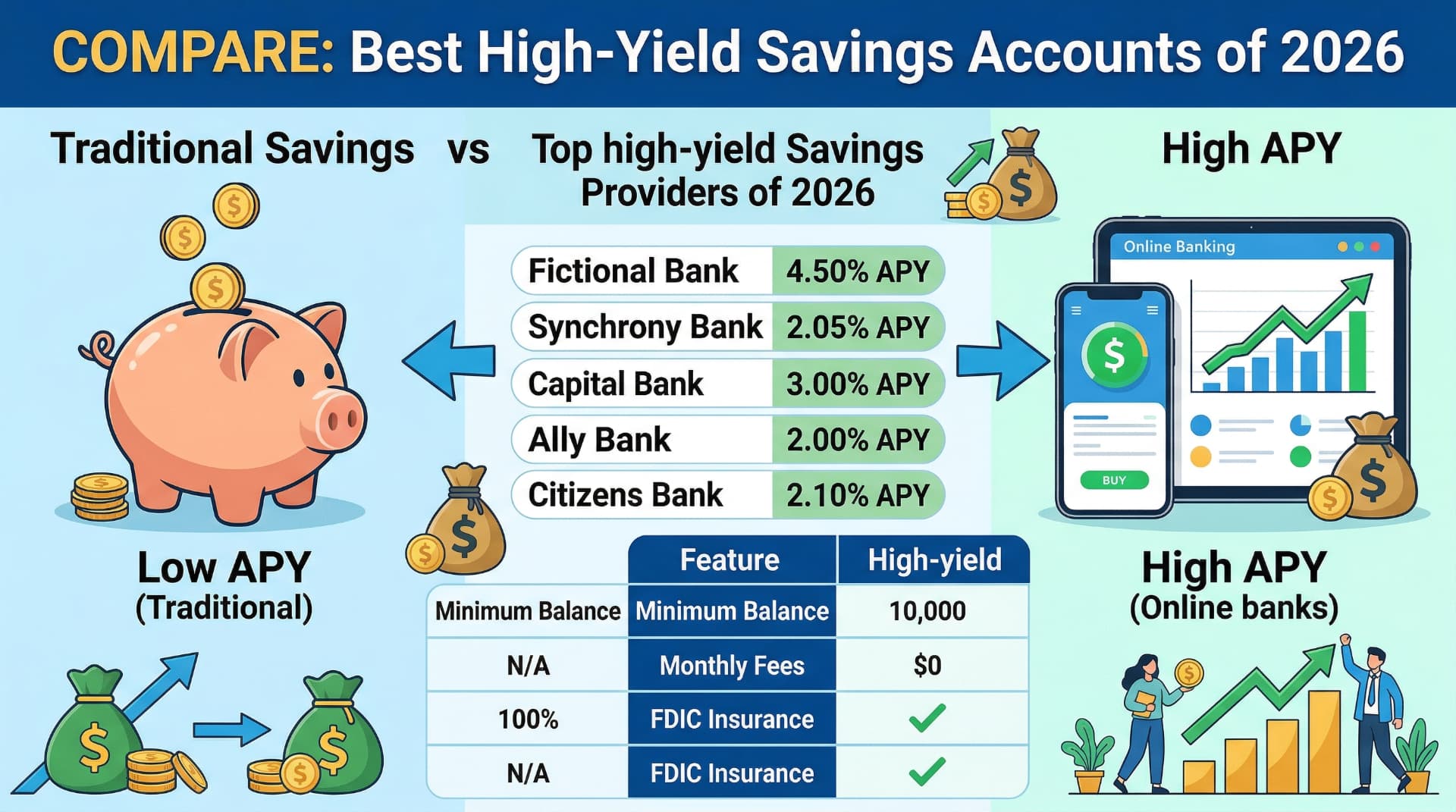
Compare top HYSAs by rate, features, and FDIC coverage.
The Short Answer
The best high-yield savings accounts for 2026 are Marcus by Goldman Sachs, Ally Bank, and Discover — all FDIC-insured, earning 4–5% APY, with no minimums, no fees, and easy online access.
Best High-Yield Savings Accounts for 2026 (Rates Updated March 2026)
By DadAlt Investments | Category: Personal Finance | Last Updated: March 15, 2026
If your emergency fund versus investing or short-term savings are sitting in a traditional bank savings account right now, you are quietly giving money away. The national average savings account rate is 0.39% APY as of February 2026, according to FDIC data — which means the average American earning that rate on a $25,000 emergency fund collects about $97.50 in interest over the full year.1 The best high-yield savings accounts (HYSAs) currently offered by online banks are paying between 3.20% and 4.21% APY, with some promotional rates reaching 5.00% — and they carry the identical FDIC insurance protection as any brick-and-mortar bank account.2 On that same $25,000 balance, a 4.00% APY HYSA earns $1,000 in a year — a difference of more than $900 from the average traditional bank. There is no investment risk, no minimum time commitment, and no reason to leave money in a low-yield account. This guide covers what a high-yield savings account actually is, which accounts stand out in the current rate environment, how HYSAs compare to alternative cash storage tools (money market funds, I-Bonds, CDs), and how to build one intelligently into your family's financial system.
Rate transparency note: HYSA rates are variable and change frequently. All rates cited in this article reflect publicly available data as of March 2026. Verify the current APY directly with each institution before opening an account. The Fed's target rate is currently 3.50–3.75%, and rates may drift lower or higher as monetary policy evolves.
Why a High-Yield Savings Account Is Non-Negotiable in 2026
The Math on What You're Leaving Behind
The difference between a traditional savings account and a HYSA is not incremental — it is substantial. Here is what that gap looks like across common emergency fund balances, comparing the national average (0.39% APY) against a competitive HYSA at 4.00% APY:
| Emergency Fund Balance | National Average (0.39% APY) | HYSA at 4.00% APY | Annual Difference |
|---|---|---|---|
| $10,000 | $39 | $400 | $361 |
| $25,000 | $97.50 | $1,000 | $902.50 |
| $50,000 | $195 | $2,000 | $1,805 |
None of this requires any investment risk. Both accounts are FDIC-insured, both are fully liquid, and both are federally regulated savings products. The only difference is the rate — and the only reason most people still have their emergency fund at a big bank paying 0.39% is inertia.
What a High-Yield Savings Account Is (and Isn't)
A high-yield savings account is a federally insured savings product — structurally identical to a traditional savings account — that pays a significantly higher annual percentage yield (APY). They are offered primarily by online banks that operate with lower overhead than branch-based institutions and use competitive rates to attract deposits.
What a HYSA is:
- FDIC-insured up to $250,000 per depositor, per institution (or NCUA-insured at credit unions) — your money is fully protected by the federal government
- Fully liquid — you can withdraw or transfer funds whenever needed, typically within 1–3 business days
- A savings product, not an investment — your principal does not fluctuate; you simply earn interest
What a HYSA is not:
- An investment — your principal is not at risk and will not grow beyond the stated interest rate
- A checking account — not designed for daily transactions or bill pay (for that, keep a separate checking account)
- A permanent rate — APYs on HYSAs are variable; they can rise or fall when the Federal Reserve adjusts its benchmark rate
Why Now Matters for HYSA Rates
The Federal Reserve cut its benchmark federal funds rate three times in the second half of 2025, bringing the current target range to 3.50–3.75% as of early 2026.3 Competitive HYSA rates have declined somewhat from their 2023–2024 peaks of 5.00–5.50%, but the current 3.20–4.21% range from leading online banks remains dramatically above the national average. Certified financial planners surveyed in early 2026 expect rates to stay relatively stable or drift slightly lower if the Fed makes additional cuts — which is why locking in a competitive account now makes sense for anyone who hasn't already moved their savings.4
Best Use Cases for a HYSA
HYSAs are the right tool for specific jobs. Use them for:
- Emergency fund — 3–6 months of essential expenses; needs to be liquid and safe
- Down payment savings — a house or car purchase within 1–3 years; too short a timeline for stocks
- Upcoming large purchases — home renovation, vacation, appliances, car repairs
- Tax reserves — self-employed individuals holding quarterly estimated tax payments
- Short-term goal savings — any goal with a timeline under 3 years that cannot afford market volatility
HYSAs are not designed to replace long-term investing. Money you won't need for 5+ years belongs in a tax-advantaged retirement account or brokerage account — not sitting in a savings account, even a high-yield one.
Quick Comparison Table
All rates as of March 2026. Verify current APYs directly with each institution before opening an account.
| Bank | Current APY | Min. Balance for APY | Min. to Open | FDIC Insured | Monthly Fees | Best For |
|---|---|---|---|---|---|---|
| Marcus by Goldman Sachs | 3.65% | $0 | $0 | ✅ Yes | $0 | Simple, no-strings HYSA |
| SoFi Checking & Savings | 3.30% (up to 4.00% promo) | $0 for base rate | $0 | ✅ Yes (up to $2M via partners) | $0 | Modern banking with direct deposit APY boost |
| Ally Bank | 3.20% | $0 | $0 | ✅ Yes | $0 | Full online bank with savings buckets |
| LendingClub LevelUp | ~4.00%+ (with $250/mo deposit) | $250/mo deposit requirement | $0 | ✅ Yes | $0 | Competitive yield with easy qualifying criteria |
| EverBank Performance Savings | ~4.05% | $0 | $0 | ✅ Yes | $0 | Highest straightforward rate from major provider |
| Western Alliance Bank | 3.80% | $500 to open | $500 | ✅ Yes | $0 | No balance tiers, consistent yield |
#1 Marcus by Goldman Sachs — Best for Simple, No-Strings HYSA
Current APY: 3.65% (as of March 2026)5 Minimum balance: $0 Monthly fees: None, ever FDIC insured: Yes
Why It Stands Out
Marcus is the consumer banking brand of Goldman Sachs — one of the most recognizable and well-capitalized financial institutions in the world — operating an online savings product with zero complexity and zero fees. There are no minimum balance requirements, no hoops to jump through to earn the stated rate, no tiered structures, and no conditions attached. You deposit money, it earns 3.65% APY, compounded daily. That's it.
For families who want to set up their emergency fund and not think about it again, Marcus is purpose-built for exactly that use case. There is no checking account attached (keeping spending money separate by design), no promotional rate that expires after a few months, and no risk of accidentally falling into a lower tier because your balance dipped in a given month.
Marcus is the right choice if: You want the cleanest, lowest-maintenance HYSA experience — deposit, earn, done — without managing promotional requirements or multi-account relationships.
Limitations: Marcus does not offer a checking account, ATM access, or investment products. It is a pure savings account. If you want a full banking relationship at one institution, look at Ally or SoFi.
#2 SoFi High-Yield Savings — Best for Direct Deposit APY Boost
Current APY: 3.30% base (up to 4.00% promotional for new accounts with eligible direct deposit)6 Minimum balance: $0 Monthly fees: $0 FDIC insured: Yes — up to $2 million through SoFi's partner bank network
Why It Stands Out
SoFi's Checking and Savings account is a full modern banking app with checking, savings, and a strong APY for members who set up qualifying direct deposits. The base savings APY of 3.30% is competitive without any requirements, and SoFi offers a limited-time boost to 4.00% APY for new accounts with eligible direct deposit, plus a cash bonus of $50 or $300 depending on the amount of qualifying direct deposits received.6
Additional benefits that distinguish SoFi:
- Early paycheck access: Direct deposit arrives up to 2 days early, which some families find genuinely useful for cash flow timing
- Extended FDIC coverage: Up to $2 million in FDIC protection through a network of partner banks — far above the standard $250,000, meaningful for households with larger emergency fund or down payment balances
- Savings Vaults: Built-in savings buckets (called Vaults) let you separate your emergency fund, vacation savings, and car repair fund within one account without opening multiple accounts
- Roundups: Small automatic transfers from checking to savings round up purchases to the nearest dollar
- No overdraft fees: SoFi charges no overdraft fees on the checking side
SoFi is the right choice if: You want a complete checking + savings bundle, are a salaried employee who can set up direct deposit, and want to earn a higher boosted APY while keeping your entire banking relationship in one modern app.
Limitations: The 4.00% promotional rate requires qualifying direct deposit; without it, the base rate is 3.30%. Confirm current promotional terms at sofi.com before opening — promotional periods have end dates.
#3 Ally Bank — Best Overall Online Bank with HYSA
Current APY: 3.20% (as of March 2026)5 Minimum balance: $0 Monthly fees: $0 FDIC insured: Yes
Why It Stands Out
Ally Bank has been one of the most consistently trusted online banks for over a decade. While its savings rate (3.20% as of March 2026) is no longer the absolute highest in the market, Ally earns its position through product breadth, feature quality, and long-term reliability that pure rate-chasers can't match.
Ally's standout features for families:
- Savings Buckets: Ally's most distinctive feature. Within one savings account, you can create up to 30 separate "buckets" — labeled sub-accounts for specific goals (Emergency Fund, Car Repair, Vacation, Home Renovation). Each bucket tracks its own running balance and progress toward a goal target. This is ideal for families managing multiple simultaneous savings priorities without the complexity of opening separate accounts at multiple banks.
- Surprise Savings: An automated feature that analyzes your linked Ally checking account and identifies "safe-to-save" amounts — small surpluses — and automatically transfers them to savings. A low-friction way to increase savings without thinking about it.
- Roundups: Rounds up debit card purchases to the nearest dollar and transfers the difference to savings automatically.
- Full banking suite at one institution: Ally offers checking, high-yield savings, money market accounts, CDs (including no-penalty CDs), and IRAs — all at one online bank with one login. For families who want to consolidate their banking, Ally's breadth is unmatched among online banks.
- Consistently competitive over multiple rate cycles: NerdWallet tracked Ally's savings rate at 3.80% in January 2025, declining to 3.20% by March 2026 as the Fed cut rates — consistent movement in line with market conditions, not arbitrary drops.1
Ally is the right choice if: You want a full-service online banking relationship — checking, savings, CDs, and IRA — all under one roof, with best-in-class savings features (Buckets, Surprise Savings) and a historically reliable, competitive APY.
Limitations: Ally's savings APY is not always the highest on the market; rate-focused savers will find marginally better yields elsewhere. No physical branches.
#4 LendingClub LevelUp Savings — Best for Consistently Top-Tier APY
Current APY: ~4.00%+ with $250/month deposit requirement; competitive rate even without requirement7 Minimum balance: $0 Minimum to open: $0 Monthly fees: $0 FDIC insured: Yes
Why It Stands Out
LendingClub's LevelUp Savings account is built around a straightforward value proposition: deposit at least $250 per month into the account and earn one of the most competitive APYs available from a well-known institution. Unlike tiered balance accounts that require large existing balances, LendingClub's requirement is about ongoing deposits — adding $250/month is well within reach for most families actively building their emergency fund.
What makes LendingClub attractive:
- Consistently competitive APY without requiring a large minimum balance
- ATM access via attached checking account — LendingClub also offers a rewards checking account that reimburses unlimited ATM fees, making it one of the only HYSA providers with seamless cash access
- No monthly maintenance fees
- Simple mobile app — consistently rated well for ease of use by Bankrate reviewers7
- Full account management online — easy to open, easy to transfer, easy to link to external accounts
LendingClub is the right choice if: You're actively making monthly contributions to your emergency fund or savings goals — the $250/month deposit threshold is easy to hit in that context — and you want a top-tier APY from a FDIC-insured institution with straightforward terms.
Limitations: The top APY requires meeting the monthly deposit condition. If you miss a month, you earn a lower (but still competitive) rate for that statement period.
HYSA vs. Money Market Fund vs. I-Bonds vs. CDs — When to Use Each
A high-yield savings account is not the only tool for parking short-term cash. Here is an honest comparison of four common alternatives:
High-Yield Savings Account (HYSA)
Best for: Emergency fund, any short-term savings that needs instant or near-instant access
- Fully liquid — no minimum holding period, no early withdrawal penalty
- FDIC-insured — zero principal risk
- Variable rate — fluctuates with Fed policy
- Typical rate range: 3.20–4.21% APY as of March 2026
Use it when: You need the money to be accessible within 1–5 business days at any time, for any reason. This is the right account for your emergency fund.
Money Market Fund (Brokerage Cash)
Best for: Cash held inside a brokerage account, earning yield on uninvested funds
The most common example for U.S. savers: Fidelity, Vanguard, and Schwab's Government Money Market Fund (SPAXX), which is the default "core position" for cash in a Fidelity brokerage account. Vanguard offers VMFXX (Federal Money Market Fund) similarly.
- Not FDIC-insured — money market funds are securities, covered by SIPC (protects against brokerage failure, not market loss), not the FDIC
- Near-zero credit risk — government money market funds hold U.S. Treasury obligations and repurchase agreements
- Historically yield competitive with or slightly above top HYSAs during higher-rate environments
- Highly liquid within the brokerage platform; transfer to checking takes 1–3 business days
Use it when: You have excess cash sitting in a brokerage account between investments. SPAXX and VMFXX are excellent alternatives to leaving cash idle at 0% in a brokerage — but they are not bank accounts and do not carry FDIC insurance.
I-Bonds (U.S. Treasury Series I Savings Bonds)
Best for: inflation protection on a portion of savings you don't need for 12+ months
- Issued by the U.S. Treasury; backed by the full faith and credit of the U.S. government — the safest possible storage of funds
- Rate adjusts every 6 months based on the CPI inflation index
- $10,000 per person, per year maximum — significantly limits how much you can put here
- 12-month minimum holding period — you cannot access the money at all for the first year
- Penalty of 3 months' interest if redeemed within the first 5 years
Use it when: You want guaranteed inflation protection on a portion of your savings that you are certain you won't need for at least 12 months. Not a replacement for your emergency fund — if you need the money in month 11, you cannot get it.
Certificates of Deposit (CDs)
Best for: Locking in a known rate for a specific time period when you don't need liquidity
- FDIC-insured
- Fixed rate for the term (3 months, 6 months, 1 year, 2 years, etc.)
- Early withdrawal penalties — accessing funds before the term ends typically costs 3–12 months of interest
- Rates as of March 2026: top 1-year CDs at approximately 4.10–4.15% APY8
- No-penalty CDs (offered by Ally and others) allow withdrawal after an initial hold period without penalty — a useful middle option
Use it when: You have a defined savings goal with a fixed timeline — a car purchase in 12 months, a home renovation in 6 months — and are confident you won't need the money before the CD matures. CD laddering (splitting funds across 3-, 6-, and 12-month terms so they mature sequentially) provides both yield and rolling liquidity.
Quick Decision Guide
| Situation | Best Tool |
|---|---|
| Emergency fund | HYSA |
| Down payment savings (1–3 year timeline) | HYSA or CD (1–2 year) |
| Cash in brokerage account | Money market fund (SPAXX/VMFXX) |
| Savings you won't touch for 12+ months, inflation concern | I-Bonds (up to $10K/yr) |
| Known expense in exactly 6–12 months | CD or no-penalty CD |
| Cash reserves for self-employed | HYSA (separate account) |
How to Use a HYSA Inside Your Family Financial System
Knowing which HYSA to open is one decision. Knowing how to use it effectively inside your overall financial setup is the more important question.
Tier 1: Emergency Fund — The Non-Negotiable Foundation
Your emergency fund — 3 months of essential expenses for dual-income households, 6 months for single-income or variable-income households — belongs in a HYSA. Not in the stock market (too volatile), not in a CD (too illiquid), not in your checking account (too tempting to spend). The HYSA earns a meaningful return while keeping the money accessible within business days if the furnace breaks in February.
Sizing your emergency fund correctly:
- Essential expenses only: housing payment, utilities, groceries, insurance premiums, minimum debt payments
- Do not include discretionary spending (dining, entertainment, subscriptions) in the essential expense calculation
- A family with $5,000/month in essential expenses needs $15,000–$30,000 in emergency funds
- Keep the emergency fund in a separate account from your day-to-day spending — the psychological separation matters
Tier 2: Tax Reserve (Self-Employed and Freelancers)
If you are self-employed, a freelancer, or have significant 1099 income, the IRS expects quarterly estimated tax payments. Keeping your tax reserve in a separate, dedicated HYSA — not mixed with your personal emergency fund or operating checking account — prevents accidentally spending money that belongs to the IRS.
A practical approach: every time you receive a payment or paycheck, transfer 25–30% of the net amount into the tax reserve HYSA immediately. Earn yield on it until the quarterly payment is due. Never mix tax reserves with personal savings.
Tier 3: Short-Term Goal Buckets
Families with specific near-term goals — a new car in 18 months, a home renovation next spring, a family vacation — should keep that savings in a HYSA (or separate HYSA account), explicitly labeled for each goal.
Ally's Savings Buckets feature is particularly well-designed for this use case: one account, multiple labeled sub-buckets, each tracking progress toward a specific goal amount. You can create buckets for "Car Replacement Fund," "Roof 2027," "Family Beach Trip," and your emergency fund, all within one Ally savings account, with the full APY applied to the combined balance.
The critical rule: Any money you need within the next 3 years should not be in the stock market. Market downturns don't ask for your timeline — they happen when they happen. A HYSA or short-term CD is the appropriate vehicle for money with a defined near-term need.
Everything Above Tiers 1–3 Should Be Invested
A common financial planning mistake families make is accumulating far more cash than their actual near-term needs justify. Once your emergency fund is fully funded, your quarterly tax reserves are set aside, and your near-term goal savings are in place, additional cash sitting in a savings account earns 3–4% when it could be compound interest at historically higher rates in the market over a 5–10+ year horizon.
The question to ask annually: Do I have more cash in savings than I need for the next 3 years? If the answer is yes, consider whether the excess belongs in a Roth IRA, 401(k), or taxable account.
Related Guides
- How Much Cash Should You Keep vs. Invest? — the framework for balancing savings and investments
- Best Budgeting Apps for Families — tools to manage your spending alongside your HYSA
- Best Tools for Tracking Net Worth — see your HYSA alongside all other assets in one dashboard
- Emergency Funds and Investing: How to Balance Both — when your emergency fund is "enough" and it's time to invest
- How to Build a Family Financial Plan — the complete framework where a HYSA fits into your larger strategy
FAQ
Are High-Yield Savings Accounts FDIC Guaranteed?
Yes — any HYSA offered by an FDIC-member bank carries the same federal deposit insurance as any traditional savings account. The FDIC insures deposits up to $250,000 per depositor, per institution, per ownership category.3
This means:
- Individual account: $250,000 insured
- Joint account (two owners): $500,000 insured ($250,000 per owner)
- If you have accounts at multiple FDIC-insured banks, each institution's coverage applies separately
NCUA insurance (for credit unions) provides equivalent coverage. Before opening an account, verify FDIC membership directly — look for the FDIC logo on the bank's website or search the bank by name at FDIC.gov.
Important nuance: Money market funds at brokerages (like Fidelity SPAXX) are NOT FDIC-insured. They are securities covered by SIPC protection, which protects against brokerage failure but not investment losses. Government money market funds have near-zero credit risk in practice, but this is a meaningful legal distinction.
How Quickly Can I Withdraw Funds from a HYSA?
Most HYSA transfers to a linked external checking account complete within 1–3 business days for standard ACH transfers. Some institutions offer same-day or next-day transfer options:
- Wire transfers: Same day, but often carry a fee ($15–$30 per wire)
- ACH transfer (standard): 1–3 business days — the most common method
- Internal transfer (same institution): If your checking and savings are at the same bank (Ally, SoFi), transfers are typically instant or same-day
The practical implication for emergency funds: In most cases, a true emergency — car repair, medical expense, plumbing failure — can be handled with a credit card or existing checking buffer while the HYSA transfer clears. If you pay the credit card within the grace period, no interest is charged. However, if you prefer truly instant access, maintaining a small buffer ($1,000–$2,000) in your regular checking account alongside your HYSA is a reasonable approach.
What Is the FDIC Insurance Limit Per Account?
The FDIC insures $250,000 per depositor, per FDIC-insured institution, per account ownership category. Common ownership categories include:
- Single/individual accounts
- Joint accounts
- Retirement accounts (IRA, Roth IRA)
- Revocable trust accounts (payable-on-death / POD accounts)
A married couple with individual and joint accounts at the same bank can potentially insure significantly more than $250,000 across different ownership categories. For households with larger balances (typically over $250,000 in a single institution), spreading funds across two or more FDIC-insured banks is the simplest solution. SoFi's expanded FDIC coverage of up to $2 million through its partner bank network is a notable alternative for families with larger cash holdings.6
Should My Emergency Fund Be in a HYSA or a Money Market Fund?
For most families: HYSA. Here is the practical reasoning:
Your emergency fund needs to be accessible quickly, from a clearly separate account you don't touch except in genuine emergencies, with zero principal risk and federally guaranteed insurance. A HYSA at a dedicated online bank (separate from your brokerage) checks all of those boxes.
A money market fund held inside a brokerage account introduces two complications:
- Not FDIC-insured — covered by SIPC, which protects against brokerage failure but not fund losses (government money market funds have near-zero loss risk in practice, but this is a distinction worth understanding)
- Psychological proximity to investments — emergency funds kept inside a brokerage account are one click away from stock purchases, which can blur the mental separation between "money I will absolutely not touch" and "investable cash"
When a money market fund makes sense for cash reserves: If you already have significant assets at a brokerage, the convenience of keeping some emergency cash in SPAXX or VMFXX is entirely reasonable — particularly if the yield is competitive. Many sophisticated savers maintain their brokerage cash in a money market fund alongside a standalone HYSA for their core emergency reserve.
Sources and References
Disclaimer: This article is for informational and educational purposes only and does not constitute financial advice. All HYSA rates are variable and subject to change at any time without notice; verify current APYs directly with each institution before opening an account. FDIC insurance limits and terms are set by the FDIC and subject to regulatory changes. DadAlt Investments may earn affiliate commissions from some links in this article at no cost to you.
Recommended Reading
- The Dad's Guide to Emergency Funds & Investing
- How Much Should You Keep in Cash vs. Investments?
- Simple Budget System for Busy Dads
Footnotes
-
NerdWallet. "Best High-Yield Savings Accounts for March 2026." March 13, 2026. https://www.nerdwallet.com/banking/best/high-yield-online-savings-accounts — National average savings rate 0.39% as of March 2026; Ally Bank rate history (3.80% Jan 2025 to 3.30% Nov 2025 to 3.20% March 2026); top rate from Vio Bank 4.03%; best accounts current as of March 13, 2026. ↩ ↩2
-
Fortune. "Top High-Yield Savings Rates: Up to 5.00% on March 13, 2026." https://fortune.com/article/best-savings-account-rates-3-13-2026/ — Top HYSA rates up to 5.00% APY as of March 13, 2026 (Varo Money); Axos Bank 4.21%; national average 0.39% per FDIC. ↩
-
Bankrate. "Best Money Market Account Rates of March 2026." https://www.bankrate.com/banking/money-market/rates/ — Federal funds rate 3.50–3.75% as of March 2026; Fed held steady at January 2026 meeting following three cuts in H2 2025; national average 0.43%; FDIC insurance $250,000 per depositor per institution. ↩ ↩2
-
BestMoney / CFP Surveys. "Savings Account Rates Forecast for 2026." January 2026. https://www.bestmoney.com/financial-advisor/learn-more/savings-account-rates-forecast — Fed funds target range 3.50–3.75% as of January 2026; FDIC national average 0.39% (Dec 2025); CFP Gary Grewal and Charles Petitjean forecast rates stable-to-lower in 2026 pending inflation trajectory. ↩
-
Yahoo Finance / Business Insider. "10 Best High-Yield Savings Accounts for March 2026." https://finance.yahoo.com/personal-finance/banking/article/best-high-yield-savings-account-171334498.html — Marcus by Goldman Sachs 3.65% APY, no minimum deposit, no monthly fees; Ally Bank 3.20% APY, no fees; SoFi up to 4.00% promotional with direct deposit; Western Alliance Bank 3.75% APY on $5,000+ balance. ↩ ↩2
-
CNBC Select. "The Best High-Yield Savings Accounts of March 2026." https://www.cnbc.com/select/best-high-yield-savings-accounts/ — SoFi Checking and Savings: 3.30% base APY with qualifying direct deposit; up to $2 million FDIC coverage via partner banks; $50 or $300 sign-up bonus with qualifying direct deposit; early paycheck access 2 days early; no account or overdraft fees. ↩ ↩2 ↩3
-
Bankrate. "Best High-Yield Savings Accounts of March 2026 — Up to 4.10%." March 10, 2026. https://www.bankrate.com/banking/savings/best-high-yield-interests-savings-accounts/ — LendingClub LevelUp: competitive APY with $250/month deposit requirement; no monthly fees; no minimum opening deposit; app and transfer experience reviewed positively by Bankrate staff. ↩ ↩2
-
Fortune. "Discover the Highest CD Rates for March 13, 2026." https://fortune.com/article/best-savings-account-rates-3-13-2026/ — Top 1-year CD rates approximately 4.10–4.15% APY as of March 2026; CD laddering strategy as complement to HYSA. ↩
Frequently Asked Questions
Are high-yield savings accounts safe?
Yes — they're FDIC-insured up to $250,000 per depositor. Your money is just as safe as a traditional bank savings account, but earning 10–20x more interest. There's no reason to keep cash in a 0.01% account.
Can I lose money in a high-yield savings account?
No — your principal is protected by FDIC insurance. However, if inflation exceeds your interest rate, your purchasing power decreases slightly. HYSAs are still far better than traditional savings accounts.
How quickly can I access money in a high-yield savings account?
Most HYSAs offer next-business-day transfers to your checking account. Some, like Ally, offer same-day transfers. It's liquid enough for emergencies but has a slight delay that discourages impulsive spending.

About the Author
Jared DeValk
Founder, DadAlt Investments
Father, alternative investment researcher, and founder of DadAlt Investments. 14+ years turning hard lessons into honest guidance for dads building real wealth.