
How to Pay Off Debt and Still Invest
Balance debt payoff while investing.
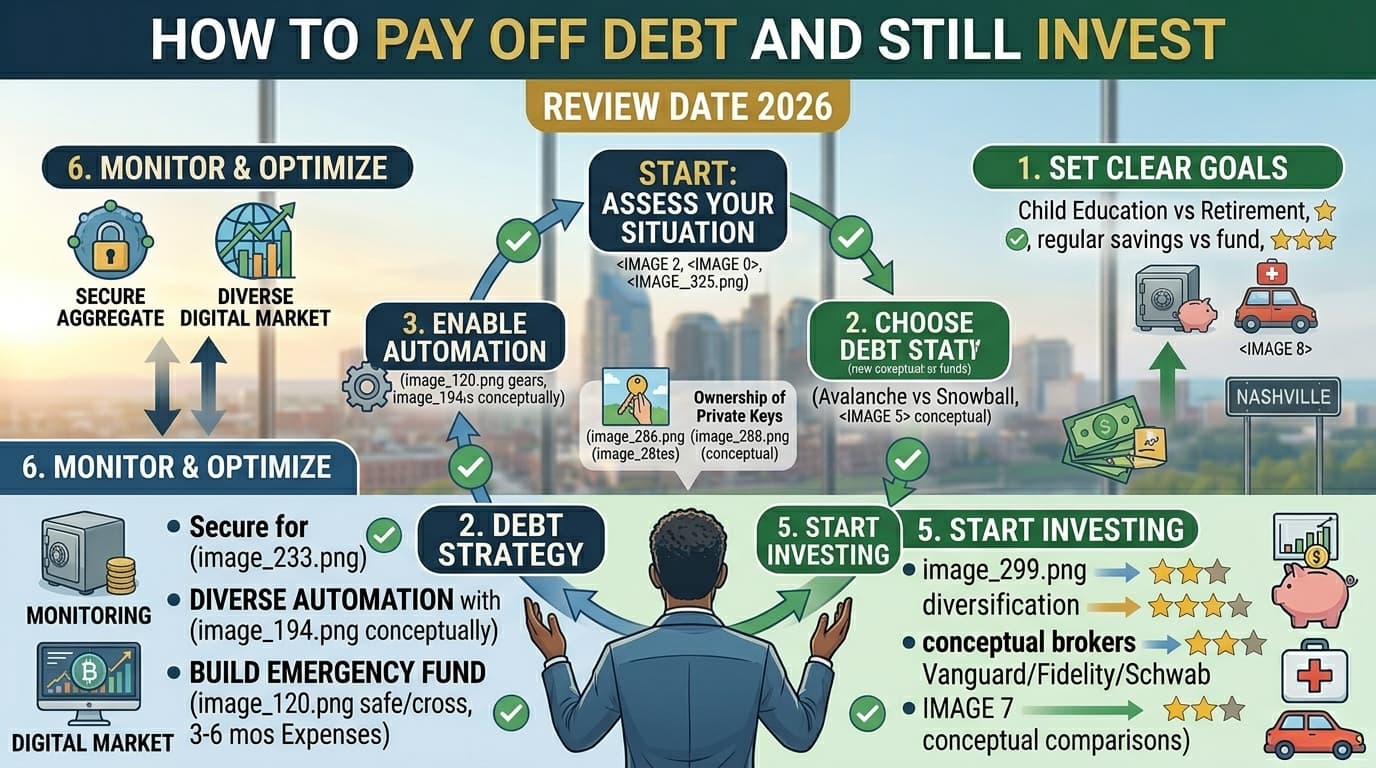
The Short Answer
You can pay off debt and invest simultaneously by eliminating high-interest debt first (above 7%), capturing any employer 401(k) match, and directing remaining funds to low-cost index funds while making steady debt payments.
How to Pay Off Debt and Still Invest
Category: Credit & Loans | Financial Independence | Guides & How-To's Target Keywords: pay off debt, wealth building, debt payoff while investing, how to pay off debt and invest Tags: Credit & Loans · Financial Independence · Guides & How-To's
Disclaimer: This article is for educational and informational purposes only and does not constitute financial, investment, tax, or legal advice. All investing involves risk, including the possible loss of principal. DadAlt Investments may receive affiliate compensation from companies referenced in this article. This never influences our editorial recommendations. Always consult a qualified fee-only financial advisor before making significant financial decisions.
Summary
The number one question from dads who are new to personal finance isn't about which stocks to buy or how to open a Roth IRA providers. It's simpler and more urgent: should I pay off my debt first, or start investing? The real answer — almost always — is to do both at the same time. But the order matters, the strategy matters, and the type of debt you're carrying matters enormously. Americans are carrying a record $1.28 trillion in credit card debt as of Q4 2025, at average interest rates of nearly 21–22%, per LendingTree and the Federal Reserve. Meanwhile, 23% of credit card debtors who delayed investing because of their debt cited investing as the financial decision they most commonly put off, per Bankrate's 2026 Credit Card Debt Report. That delay is costing them years of compound interest growth — and it doesn't have to. This article gives you a clear decision framework for eliminating high-interest debt, investing intelligently at the same time, and using every tool available — including balance transfer cards, debt consolidation, and the right payoff strategy — to build real wealth while you're still getting out of the hole. You don't have to choose between the two. You just need to know the rules.
Introduction: The Guilt Trip Nobody Talks About
Most dads feel it: the quiet guilt of knowing you "should" be investing for your kids' futures and your own retirement, while also staring at credit card statements that make your stomach drop every month.
The financial media doesn't help. One camp says pay off every dollar of debt before investing a single cent. The other says max out your retirement accounts no matter what, even if you're drowning in 24% APR credit card interest. Both are wrong in the extreme. The truth sits in the middle, and it's more practical than either camp admits.
This framework will show you exactly where to draw the line — what to pay off aggressively, what to pay off slowly, and when to invest alongside your debt payoff so you don't lose years of compounding you can never get back.
The Scale of the Problem: Where Most Dads Actually Stand
Before building a strategy, it helps to understand the battlefield.
Credit card debt:
- Total U.S. credit card balances: $1.28 trillion as of Q4 2025 — the highest level since the Federal Reserve Bank of New York began tracking in 1999, per LendingTree's 2026 Credit Card Debt Statistics report
- Average credit card balance per cardholder: $6,523 as of Q3 2025, per TransUnion data cited by Motley Fool
- Average credit card balance among those carrying an unpaid balance: $7,886 as of Q3 2025, per LendingTree
- Average APR on all credit card accounts: 20.97% as of Q4 2025; on cards actively accruing interest: 22.30%, per the Federal Reserve G.19 Consumer Credit Report (February 2026)
- 47% of American credit cardholders are currently carrying a balance, per Bankrate's 2026 Credit Card Debt Report
- 40% of Americans have been in credit card debt for five years or more, per DocuClipper's 2025 credit card debt statistics
The true cost of making only minimum payments: NerdWallet's 2026 Household Debt Study calculated that a person starting with $11,400 in credit card debt at the average 23% APR, making only minimum payments, would pay nearly $18,500 in interest and take 22 years to become debt-free. On just $6,523 (the average balance) at 19% APR, Bankrate calculated the minimum-payment path results in $6,491 in interest over 170 months — more than 14 years. That's not a debt — that's a second mortgage on your future.
Student loan debt:
- Total outstanding student loan debt: $1.84 trillion as of Q4 2025, per LendingTree's student loan statistics report
- Average federal student loan debt per borrower: $39,375 as of Q3 2025, per the U.S. Department of Education via BestColleges
- Average federal undergraduate student loan interest rate (2025–26): 6.39%, down from 6.53% in 2024–25, per Education Data's student loan interest rate analysis
- 42.3 million Americans hold student loan debt, per Motley Fool's student loan debt statistics
The combined picture: The average American dad in his 30s or 40s may be simultaneously managing credit card balances (at 21–22% APR), a car loan (typically 7–9% APR for used cars), student loans (around 6–7%), and a mortgage (currently 6.5–7% for 30-year fixed). Each of these requires a different strategy.
The Cardinal Rule: Not All Debt Is Created Equal
The single biggest mistake in personal finance is treating all debt the same. A 22% APR credit card balance and a 3.5% mortgage are not the same problem. They require completely different solutions.
Here's the framework for categorizing your debt by interest rate:
High-Interest Debt (Above 8–10% APR) — Attack Aggressively
What falls here: Credit cards (typically 18–27%), most personal loans (10–20%), payday loans (200%+), and some private student loans
This is debt that almost certainly costs you more than you can reliably earn by investing. The S&P 500 has averaged approximately 10% annually over its long-run history, per Motley Fool's historical performance analysis. Paying off a 22% APR credit card card delivers a guaranteed 22% return on that dollar. No investment can reliably match that, risk-free. High-interest debt is your first enemy. Eliminate it with maximum aggression before directing significant money toward investing.
Exception: Even while attacking high-interest debt, always capture your full 401(k) employer match. More on this below.
Medium-Interest Debt (5–10% APR) — Balance with Investing
What falls here: Many personal loans, some private student loans, some auto loans, and older mortgages in the 5–7% range
This is the gray zone. The expected long-run stock market return of ~10% is above this interest rate range, but not by a wide enough margin to make investing obviously superior — especially given that investment returns are uncertain while your debt interest rate is guaranteed. The best approach here is a split strategy: put extra money toward both debt payoff and investing simultaneously. A 50/50 split (half to debt, half to investing) is a reasonable default. Adjust based on your risk tolerance and whether your employer offers a retirement match.
Low-Interest Debt (Below 5% APR) — Pay Minimums, Invest the Rest
What falls here: Federal student loans (currently 6.39% for undergraduates, but many older borrowers have rates at 3–5%), 30-year mortgages locked in during 2020–2021 when rates hit record lows, and car loans financed at promotional 0–2.9% rates
When your debt costs less than what you can reasonably expect to earn by investing, you should invest instead of aggressively paying down that debt. A borrower with a 2.75% student loan from 2020 who aggressively makes extra principal payments is essentially choosing a guaranteed 2.75% return over the expected 10% long-run stock market return. That's a poor trade. Make the minimum payment, invest the difference.
Rule of Thumb: If your interest rate is higher than the expected return on your investment (generally use 7–10% for diversified stock best platforms for index fundss), pay off debt first. If it's lower, invest the difference.
The 4-Step Debt + Investment Framework
Follow these four steps in sequence. Don't skip ahead — the order is the strategy.
Step 1: Get Current on All Bills and Minimum Payments
Before you can make progress, you need to stop digging. Missed payments trigger penalty APRs (often 29.99% or higher), destroy your credit score, and generate late fees that accelerate your hole. Get every account current and commit to paying at least the minimum on every debt, every month, on time.
Set up automatic minimum payments for every account. This is non-negotiable. You cannot execute any payoff strategy if accounts are falling behind while you focus elsewhere.
Step 2: Build a $1,000 Starter Emergency Fund vs Investing: What Comes First?
A small cash buffer is the difference between a temporary setback and a debt spiral. Without one, any car repair, medical bill, or unexpected expense goes directly onto a credit card — wiping out weeks or months of debt payoff progress. Before making extra debt payments or investing beyond the 401(k) match, build a $1,000 cash cushion in a separate high-yield savings account. This is your firewall.
Keep this money completely liquid and completely untouched except for genuine emergencies. Top high-yield savings accounts currently offer 3.50–4.20% APY — your emergency fund should earn something while it waits.
Step 3: Capture Your Full 401(k) Employer Match — No Exceptions
If your employer offers a 401(k) match, contributing enough to capture the full match is the single highest-return, zero-risk financial move available to you — period. If your employer matches 50 cents for every dollar you contribute up to 6% of salary, that's an immediate 50% return on those dollars before a single investment gain. If they match dollar-for-dollar up to 3%, that's a 100% guaranteed return. No investment delivers this, and no interest rate on debt surpasses it.
Do this even if you have high-interest credit card debt. The math is unambiguous: a 100% instant return from an employer match outperforms a 22% guaranteed return from paying off a credit card. Contribute enough to maximize the match — not a dollar more, not a dollar less — before redirecting money anywhere else.
Step 4: Attack High-Interest Debt Aggressively
With minimum payments locked in, a $1,000 emergency buffer in place, and your 401(k) match captured, every extra dollar you can find should go toward eliminating high-interest debt. Use either the Avalanche Method or the Snowball Method — both are described in detail below.
Once all high-interest debt (above 8–10%) is eliminated, you graduate to the investing phase. At this point:
- Maximize your Roth IRA contributions ($7,500/year in 2026 for those under 50; $8,600 for 50+)
- Increase your 401(k) contributions toward the $24,500 annual limit
- Begin investing in medium-interest debt repayment alongside investing using a 50/50 split
- Build your emergency fund from $1,000 to 3–6 months of expenses
The Debt Avalanche Method: Maximum Mathematical Efficiency
The Debt Avalanche is the mathematically optimal debt payoff strategy. It consistently saves the most money in interest and typically results in the fastest total payoff time.
How it works:
- List every debt from highest interest rate to lowest
- Make the minimum payment on every debt
- Direct every extra dollar toward the highest-interest debt
- When that debt is eliminated, roll its entire payment toward the next-highest-rate debt
- Repeat until all debts are paid
Example:
| Debt | Balance | APR | Minimum Payment |
|---|---|---|---|
| Credit Card A | $4,500 | 24.99% | $110 |
| Credit Card B | $2,800 | 19.99% | $70 |
| Personal Loan | $8,000 | 13.5% | $190 |
| Car Loan | $12,000 | 7.9% | $280 |
With the Avalanche, you attack Credit Card A first (24.99% APR), while paying minimums on everything else. Once Card A is gone, you roll its $110 payment onto Credit Card B — now paying $180/month toward that balance. Once Card B is cleared, you roll $250/month onto the personal loan. The payments avalanche down the list.
The Avalanche advantage: By killing the highest-rate debt first, you prevent the most expensive interest from compounding. Every dollar you eliminate from a 24.99% balance is a dollar that's no longer generating 24.99% annual charges against you.
The Avalanche drawback: It can take months or longer to eliminate the first debt — especially if it has a large balance. For dads who need visible progress to stay motivated, the lack of early "wins" can make this method hard to sustain.
Best for: Dads who are analytical, patient, and driven by long-term math rather than short-term psychology. If you can stay committed without regular wins, the Avalanche will save you the most money.
The Debt Snowball Method: Momentum and Psychology
The Debt Snowball, popularized by Dave Ramsey, is not the mathematically optimal strategy. But for many people, it's the practically optimal one — because they actually stick with it.
Research consistently shows that the best debt payoff strategy is the one you execute. Behavioral finance studies find that people are more likely to stay on track when they experience early wins, and the Snowball is designed to deliver exactly that.
How it works:
- List every debt from smallest balance to largest (ignore interest rates)
- Make the minimum payment on every debt
- Direct every extra dollar toward the smallest-balance debt
- When that debt is eliminated, roll its payment onto the next-smallest debt
- Repeat until all debts are paid
Example using the same debts as above:
| Debt | Balance | APR | Minimum Payment | Snowball Priority |
|---|---|---|---|---|
| Credit Card B | $2,800 | 19.99% | $70 | 1st |
| Credit Card A | $4,500 | 24.99% | $110 | 2nd |
| Personal Loan | $8,000 | 13.5% | $190 | 3rd |
| Car Loan | $12,000 | 7.9% | $280 | 4th |
With the Snowball, you attack Credit Card B first because it has the smallest balance — even though Credit Card A has the higher interest rate. You pay off Card B in fewer months, bank that psychological win, and roll the $70 minimum onto Card A.
The Snowball advantage: You eliminate accounts faster. Fewer open debt accounts feels like real progress. Multiple studies show that this visible, tangible progress keeps people engaged over the long haul when they might otherwise quit.
The Snowball drawback: By ignoring interest rates, you will pay more total interest than the Avalanche in most scenarios. The difference varies widely — in some scenarios it's a few hundred dollars; in others, it can be several thousand.
Best for: Dads who have struggled to stay on track with past payoff plans, who have multiple small debts they can clear quickly, or who simply need the psychological momentum of regular wins to maintain commitment over a multi-year payoff journey.
The DadAlt Bottom Line on Methods: The Avalanche wins mathematically. The Snowball wins psychologically. The best method is the one you will stick with for 2, 3, or 5 years until the debt is gone. If you've tried the Avalanche before and quit, switch to the Snowball. If you've tried both and quit, the next section is for you.
Debt Consolidation: Is It Worth It?
Before choosing a payoff method, there's a third option worth considering: restructuring your debt to get a lower interest rate. Paying down a 24.99% credit card is the right strategy — but if you can legally reduce that 24.99% to 0% or 7%, you've just made every payoff dollar dramatically more effective.
Option 1: Balance Transfer Credit Cards (0% Intro APR)
Balance transfer cards allow you to move existing high-interest credit card debt to a new card with a 0% introductory APR period. During that window — typically 15 to 21 months — every dollar you pay reduces principal, not interest. This can save hundreds or thousands compared to carrying the same balance at 20%+ APR.
Top balance transfer options available in 2026 (per Bankrate, CNBC Select, and U.S. News):
| Card | 0% Intro APR Period | Balance Transfer Fee | Ongoing APR After Intro |
|---|---|---|---|
| Wells Fargo Reflect® Card | 21 months | 5% ($5 min) | 17.49–28.24% variable |
| Citi® Diamond Preferred® Card | 21 months (BT) / 12 months (purchases) | 5% ($5 min) | 16.49–27.24% variable |
| Citi Simplicity® Card | 21 months | 5% ($5 min) | Similar variable range |
| U.S. Bank Shield™ Visa® Card | 24 months (limited time) | Standard BT fee applies | 16.99–27.99% variable |
| Chase Freedom Unlimited® | 15 months | 3–5% | 18.49–27.99% variable |
| BankAmericard® | 18 billing cycles | 3% (first 60 days) / 4% after | Lower-than-average ongoing APR |
How to use a balance transfer responsibly:
- Calculate whether it makes sense. On a $6,000 balance, a 5% balance transfer fee costs $300 upfront. If you'd pay $1,200+ in interest staying at 22% APR over 18 months, the transfer still saves you $900+.
- Only do this if you will not add new purchases to the card. Adding new charges while a balance transfer is in progress can result in those purchases accruing interest immediately, negating your savings.
- Set up automatic payments to pay off the entire transferred balance before the 0% period ends. When the intro period expires, any remaining balance begins accruing interest at the full variable APR — which is typically 17–28%.
- Stop using the original card for new purchases, but don't close it. Keeping the account open (with a $0 balance) maintains your available credit and improves your credit utilization ratio.
Critical warning: Balance transfer cards work exceptionally well for disciplined borrowers who have a concrete payoff plan. They can backfire badly for borrowers who transfer a balance, continue spending on the old cards, and end up with double the debt. Never use a balance transfer as a solution by itself — use it as a tool to turbocharge a payoff plan you're already committed to.
Option 2: Personal Loan Debt Consolidation
A personal loan consolidation replaces multiple high-interest debts with a single loan at a (hopefully) lower interest rate and a fixed monthly payment. This simplifies your financial life and can reduce total interest paid if you qualify for a rate below your existing credit card APRs.
Best candidates for personal loan consolidation:
- Borrowers with good-to-excellent credit (FICO 680+) who qualify for rates below 12–15%
- Anyone juggling four or more credit cards with different due dates, minimums, and APRs
- Borrowers who have trouble tracking multiple accounts and want simplicity
Caution: Personal loan rates for borrowers with average or below-average credit may not be significantly lower than existing credit card rates. Always compare the consolidated loan's APR and total interest cost against your current path before signing. And critically — once your credit cards are paid off through consolidation, don't immediately run them back up. This is the most common (and financially devastating) consolidation mistake.
Option 3: Home Equity (Use With Extreme Caution)
Homeowners sometimes use a home equity loan or HELOC to pay off unsecured credit card debt at a lower rate. Interest rates on home equity products are typically 6–9%, dramatically lower than credit card rates. However, this converts unsecured debt into debt secured by your home. If you default, you can lose your house. Reserve this strategy for borrowers who have fully exhausted other options, have a concrete payoff plan, and are willing to accept the risk of collateralizing their family's home to pay off consumer debt.
How to Invest While Paying Off Debt
Once you have high-interest debt under control (or being actively attacked), here is exactly how to invest simultaneously without derailing your payoff plan.
Rule 1: Always Capture the Full 401(k) Employer Match
This applies at every stage — even while in high-interest debt. The employer match is a guaranteed, instant return that no interest rate can compete with. It doesn't matter if you have $10,000 in credit card debt. Contribute enough to capture every dollar of match your employer offers, minimum.
Rule 2: Roth IRA After High-Interest Debt Is Eliminated
Once all debt above 8–10% APR is gone, open or maximize a Roth IRA. The 2026 contribution limit is $7,500 per person under age 50 ($8,600 for those 50 and older), per the IRS's November 2025 announcement (Notice 2025-67). On a joint income below $242,000, a married dad can contribute $15,000/year across two Roth IRAs — completely tax-free growth, with no taxes on qualified withdrawals in retirement.
Invest Roth IRA contributions in low-cost index funds: VTI (total U.S. market, 0.03% expense ratio), VXUS (international, 0.07%), or SCHD (dividend growth, 0.06%). Keep it simple.
Rule 3: For Medium-Rate Debt, Use a 50/50 Split
If your remaining debt falls between 5–10% APR — a personal loan, older car loan, or federal student loans — split your extra monthly dollars equally between debt payoff and investing. Put half toward extra principal payments on your medium-rate debt. Put the other half into your investment account.
This approach ensures you're making progress on both fronts. You don't sacrifice compounding time in the market, but you also don't ignore a debt that costs more than what bonds and cash can reliably return.
Rule 4: Low-Rate Debt Gets Minimum Payments — Nothing More
Federal student loans at 6.39% (or even lower for older borrowers), 30-year mortgages locked in at 3–4% during 2020–2021, and car loans at 0–3.9% should receive minimum payments only. Every dollar above the minimum on these debts is voluntarily giving up the return difference between your investment portfolio and your loan rate. Over 20–30 years, that difference compounds into significant wealth lost.
The math is clear: if you're paying 3.5% on a student loan and your Roth IRA earns an average of 10% annually in index funds, every extra dollar toward the loan "earns" 3.5%, while the same dollar in the market "earns" an expected 10%. Invest the difference.
Real Example: The Dad Who Did Both
Let's see how this framework works in a specific scenario.
The situation:
- Dad, age 36, married, household income $90,000
- $30,000 in credit card debt across three cards (average APR: 22%)
- $28,000 in federal student loans at 5.5%
- 30-year mortgage at 6.75% (minimum payment only, no overpaying)
- Monthly surplus after bills and minimum payments: $800
- Employer 401(k) match: 50% of contributions up to 6% of salary
Step 1: Secure the 401(k) match
- 6% of $90,000 = $5,400/year → $450/month
- Employer match: $225/month (free money)
- Monthly commitment: $450 from his paycheck (net after paycheck deduction, approximately $340 less take-home due to pre-tax benefit)
- This leaves him approximately $460/month in true surplus
Step 2: Build the $1,000 emergency buffer
- Month 1: Park $460 in a high-yield savings account. Emergency fund complete.
- From Month 2 onward: All $460/month goes toward credit card debt
Step 3: Avalanche attack on credit card debt
- He lists the three cards by APR: 26.99%, 21.99%, 18.99%
- $460 extra per month goes to the 26.99% card, minimum payments on the others
- At 26.99% APR, a $10,000 card balance with $460/month extra beyond the minimum is paid off in approximately 20–22 months
- As each card falls, the payment rolls to the next
Step 4: Investing expands as debt falls
- By month 24: Two credit cards eliminated; ~$650/month freed up
- He splits: $325 toward the final credit card, $325 toward his Roth IRA
- By month 36: All $30,000 in credit card debt eliminated
- Monthly surplus available: ~$800 again (minimum payments gone on 2 of 3 cards)
- New allocation: $450/month to 401(k) (matching), $350/month to Roth IRA, minimums only on 5.5% student loans
The result at year 5:
- All credit card debt: $0
- Student loans: Still in repayment at minimum (5.5% rate doesn't justify accelerating)
- 401(k) balance: Approximately $38,000+ (contributions + match + market growth)
- Roth IRA: Approximately $12,000+ (started in year 2, growing tax-free)
- Best Tools for Tracking Net Worth: Dramatically higher than a dad who paused all investing to pay off the credit cards first — because he captured years of employer matching and compound growth that can never be recovered
This is not a "pay off everything first" plan. It's a strategic dual-track plan that eliminates the most expensive debt quickly while building a foundation of invested assets simultaneously.
The Biggest Mistakes to Avoid
Learning the framework matters. Avoiding these common pitfalls matters just as much.
-
Stopping all investing while paying off debt. You miss employer match dollars that can never be recovered. Even a single year without capturing a full match is a guaranteed permanent loss.
-
Paying off low-rate mortgage debt aggressively instead of investing. Sending an extra $500/month toward a 3.5% mortgage while your Roth IRA sits unfunded is voluntarily choosing a 3.5% return over a historically expected 10% return. The math is painful over 20+ years.
-
Using a balance transfer and then charging up the original cards again. This is the most common consolidation trap. You now have double the debt and no interest-free period on the original balances.
-
Not building any emergency fund before attacking debt. Without a buffer, the first emergency — a car repair, medical bill, or job disruption — sends you right back to your credit cards.
-
Treating minimum payments as optional. Missing minimum payments triggers penalty APRs (often 29.99%), late fees, and credit score damage. These multiply the cost of debt exponentially. Automate minimum payments on every account before anything else.
-
Waiting until all debt is gone to open a Roth IRA. If you have low-rate student loans, you could be "waiting" for 10–20 years to open an account that should have been growing tax-free the entire time.
Conclusion: Debt and Investing Are Not Mutually Exclusive
The question isn't whether to pay off debt or invest. It's how to do both intelligently, in the right order, with the right tools.
The framework is clear:
- Get current on all minimums
- Build a $1,000 emergency buffer
- Always capture the full 401(k) employer match
- Attack high-interest debt with Avalanche or Snowball
- Open a Roth IRA once high-interest debt is gone
- Make minimum payments on low-rate debt and invest the difference
Credit card debt at 22% is a crisis that demands your full financial attention. Federal student loans at 5.5% are not. A 3% mortgage is actively good debt in a world where index funds have historically returned 10%. Not all debt is equal — and treating it like it is will cost you decades of wealth.
The families that build real financial independence aren't the ones who paid off every debt before investing. They're the ones who eliminated the expensive debt ruthlessly, captured every employer match dollar, and invested consistently for 20–30 years through every economic cycle. That's the path. Start it today — even if the amounts are small.
→ Related: The Ultimate DadAlt Investment Playbook | budget system | The Dad's Guide to Emergency Funds
Sources and References
-
LendingTree — "2026 Credit Card Debt Statistics" (updated February 2026) — Total U.S. credit card balances: $1.277 trillion as of Q4 2025 (Federal Reserve Bank of New York); highest balance since New York Fed began tracking in 1999; up from $1.233 trillion in Q3 2025; national average card debt among cardholders with unpaid balances: $7,886 (Q3 2025); average APR for all accounts Q4 2025: 20.97%; average APR for accounts with finance charges: 22.30%; 30-day delinquency rate: 2.98% in Q3 2025; new card offer average APR: 23.77%. lendingtree.com/credit-cards/study/credit-card-debt-statistics
-
Motley Fool — "Average American Credit Card Debt in 2025" — Average credit card balance: $6,523 as of Q3 2025 (TransUnion); average APR on interest-bearing accounts: 20.97% as of November 2025; total U.S. credit card debt: $1.28 trillion as of Q4 2025; credit card utilization: 29%; average FICO score: 715; credit card debt rose in six of last eight quarters. fool.com/money/research/credit-card-debt-statistics
-
Federal Reserve — G.19 Consumer Credit Report (February 2026) — Consumer credit increased 2.4% in 2025; revolving credit up 3.4%; APR for all credit card accounts: 20.97% (Q4 2025); APR for accounts assessed interest: 22.30% (Q4 2025); interest rates are annual percentage rates as specified by Regulation Z. federalreserve.gov/releases/g19/current
-
Bankrate — "Bankrate's 2026 Credit Card Debt Report" (survey conducted December 2-8, 2025) — 47% of American credit cardholders carry a balance as of December 2025; 41% say primary cause of credit card debt was an emergency expense; 64% of credit card debtors have delayed or avoided financial decisions due to debt; 23% cited investing as most commonly delayed decision; 34% delayed saving for emergencies; on $6,523 average balance at 19% APR with minimum payments only: 170 months in debt, $6,491 in interest. bankrate.com/credit-cards/news/credit-card-debt-report
-
NerdWallet — "2025 Household Credit Card Debt Study: 49% Say Card Debt is Normal" (January 15, 2026) — Starting balance ~$11,400 at average 23% APR (August 2025); minimum-only payments = $18,500 in interest and 22 years to payoff; 26% of Americans with revolving debt only make minimum payments; adding $50 extra monthly cuts interest nearly in half and payoff under 10 years. nerdwallet.com/credit-cards/studies/household-debt-study
-
DocuClipper — "29 Credit Card Debt Statistics For 2025" — 40% of Americans have been in credit card debt for over 5 years; 53% of Americans have reached their credit card limit at some point; 29% max out credit cards monthly; average credit card interest rate 20.97%. docuclipper.com/blog/credit-card-debt-statistics
-
WalletHub — "Credit Card Statistics for 2025" — Q4 2025: ~648 million credit card accounts in the U.S.; total credit card debt $1.28 trillion; average household credit card debt $11,019 (Q3 2025); credit card interest rates increased 71.60% over past decade (Q4 2015 to Q4 2025); credit card balances +$507 billion since Q1 2021 pandemic low. wallethub.com/edu/cc/credit-card-statistics/25581
-
LendingTree — "U.S. Student Loan Debt Statistics" — Total outstanding student loan debt (federal + private): $1.84 trillion as of Q4 2025, up 3.2% from Q4 2024; $140.38 billion in private student loan debt through September 2025; 47% of Class of 2024 bachelor's degree recipients had student loan debt averaging $29,560. lendingtree.com/student/student-loan-debt-statistics
-
Ramsey Solutions — "Average Student Loan Debt: 2025 Statistics" (February 2025) — Total U.S. student loan debt: $1.77 trillion; average student loan debt per borrower: $38,883; average federal undergraduate student loan interest rate (2024–25): 6.53%; student loan debt is second-largest debt category in America behind mortgages; student loan payments have statistically significant negative impact on 401(k) contributions (per cited study). ramseysolutions.com/debt/average-student-loan-debt
-
BestColleges — "Average U.S. Student Loan Debt: 2025 Statistics" (updated August 2025) — Average federal student loan debt per borrower: $39,375 as of Q3 2025 (Federal Student Aid, Department of Education); total federal student debt: $1.67 trillion as of Q3 2025; approximately twice the average student debt of 2008; 42.5 million borrowers have federal student loan debt; 52% of federal borrowers are over age 35; 20% are over 50. bestcolleges.com/research/average-student-loan-debt
-
Education Data — "Average Student Loan Interest Rate (2026)" — Federal undergraduate Direct Loan interest rate 2025–26: 6.39% (down from 6.53% in 2024–25); undergraduate rates declined 2.14% year-over-year; all federal loan interest rates temporarily set to 0% from March 13, 2020 to September 1, 2023; private student loan rates start around 2.84% (as of February 2026). educationdata.org/average-student-loan-interest-rate
-
Motley Fool — "S&P 500 Annual Returns and Historical Performance" (August 2025) — S&P 500 average annual return since 1957: 10.33%; delivered negative returns in only 6 years in past 3 decades; 13 of 30 years saw returns above 20%; considered best investment for most Americans per Warren Buffett. fool.com/investing/stock-market/indexes/sp-500/annual-returns
-
Fidelity, Vanguard, and Schwab — "Debt Snowball vs. Avalanche Methods" (updated January 21, 2026) — Avalanche method generally saves the most on interest payments; snowball may not save as much but is more emotionally satisfying; paying off smaller debts first shows progress; for dads with large amounts of high-interest debt the avalanche is most appropriate; with similar rates, the difference between methods may be minimal; check for prepayment penalties before choosing strategy. fidelity.com/learning-center/personal-finance/avalanche-snowball-debt
-
Experian — "Debt Snowball vs. Debt Avalanche Method" (July 2024) — With the snowball method on a sample debt set: debt-free in 25 months, $2,251 saved in interest; with avalanche: debt-free in 26 months, $2,213 saved in interest — the snowball actually won in this scenario; real differences depend on the specific interest rates and balances; both approaches effective. experian.com/blogs/ask-experian/avalanche-vs-snowball-which-repayment-strategy-is-best
-
CNBC Select — "Debt Snowball vs. Debt Avalanche" (December 2025) — Sample budget with multiple debts: avalanche method saves $153 more in interest vs. snowball; avalanche pays off 1 month sooner (40 vs. 41 months); financial experts often recommend avalanche for maximum interest savings; snowball recommended for those who need quick wins to stay on track. cnbc.com/select/debt-snowball-vs-debt-avalanche
-
Bankrate — "Best Balance Transfer Cards of March 2026" — Balance transfer card market overview; average credit card balance $6,434 (TransUnion, May 2025); average credit card interest rate started 2022 at 16.30%, now just under 20%; Wells Fargo Reflect Card offers 21-month 0% intro APR (5% BT fee); full card comparison table. bankrate.com/credit-cards/balance-transfer/best-balance-transfer-cards
-
CNBC Select — "10 Best 0% APR Credit Cards of March 2026" (updated February 2026) — U.S. Bank Shield Visa: up to 24 months 0% intro APR; Citi Diamond Preferred: 21 months BT / 12 months purchases; Wells Fargo Reflect: 21 months; in 2024, $59.5 billion in credit card debt moved through balance transfers; more than 99% of balance transfers occurred under zero-interest promotions. cnbc.com/select/best-zero-interest-credit-cards
-
Motley Fool Money — "We Compared 100+ Credit Cards — These 3 Offer the Best 0% Intro APR in 2026" (December 17, 2025) — Wells Fargo Reflect: 21 months 0% APR on purchases and balance transfers (17.49–28.24% variable after); Chase Freedom Unlimited: 15 months 0% intro; Discover it Cash Back: 15 months 0% on purchases and balance transfers; balance transfer fee typically 3–5%. fool.com/money/credit-cards/articles/we-compared-100-credit-cards-these-3-offer-the-best-0-intro-apr-in-2026
-
U.S. News — "Best Balance Transfer Credit Cards of February 2026" — Wells Fargo Reflect: 21-month 0% intro APR, 5% BT fee, $0 annual fee; Slate Credit Card from Chase: 21-month 0% intro APR; Citi Diamond Preferred: 21-month BT rate; BankAmericard: 18 billing cycles; BT fee standard 3% during intro, rising to 5% after. money.usnews.com/credit-cards/balance-transfer
-
IRS.gov — "401(k) limit increases to $24,500 for 2026, IRA limit increases to $7,500" (November 13, 2025, IRS Notice 2025-67) — 401(k) employee contribution limit 2026: $24,500; catch-up for age 50+: $8,000 (total $32,500); ages 60–63 super catch-up: $11,250 (total $35,750); combined employee + employer: $72,000; Roth IRA limit 2026: $7,500 (under 50), $8,600 (50+); Roth IRA income phase-out (single) begins $153,000; phase-out (married/joint) begins $242,000. irs.gov/newsroom/401k-limit-increases-to-24500-for-2026-ira-limit-increases-to-7500
Disclaimer: This article is for educational and informational purposes only and does not constitute financial, investment, tax, or legal advice. All investing involves risk, including the possible loss of principal. DadAlt Investments may receive affiliate compensation from balance transfer credit card issuers, brokerage platforms, and other financial companies referenced in this article. This never influences our editorial recommendations. All interest rate figures, debt statistics, and contribution limits are current as of early 2026 and are subject to change. Always consult a qualified fee-only fiduciary financial advisor or CPA before making significant financial decisions.
Recommended Reading
Frequently Asked Questions
Should I pay off debt before investing?
Pay off high-interest debt (credit cards, personal loans above 7%) first. But always capture your employer's 401(k) match — that's free money. For low-interest debt like mortgages, investing alongside payments usually wins.
What's the best order to pay off debt and start investing?
First: employer-matched 401(k). Second: high-interest debt payoff. Third: emergency fund (3–6 months). Fourth: invest in index funds or Roth IRA. This sequence maximizes every dollar.
Can I invest with credit card debt?
Focus on paying off credit card debt first — it typically carries 18–25% interest, which no investment reliably beats. The one exception is capturing a full employer 401(k) match, which is an instant 50–100% return.

About the Author
Jared DeValk
Founder, DadAlt Investments
Father, alternative investment researcher, and founder of DadAlt Investments. 14+ years turning hard lessons into honest guidance for dads building real wealth.