
How Blockchain Will Impact Small Business Ownership
Future of buying businesses with Web3 tools.
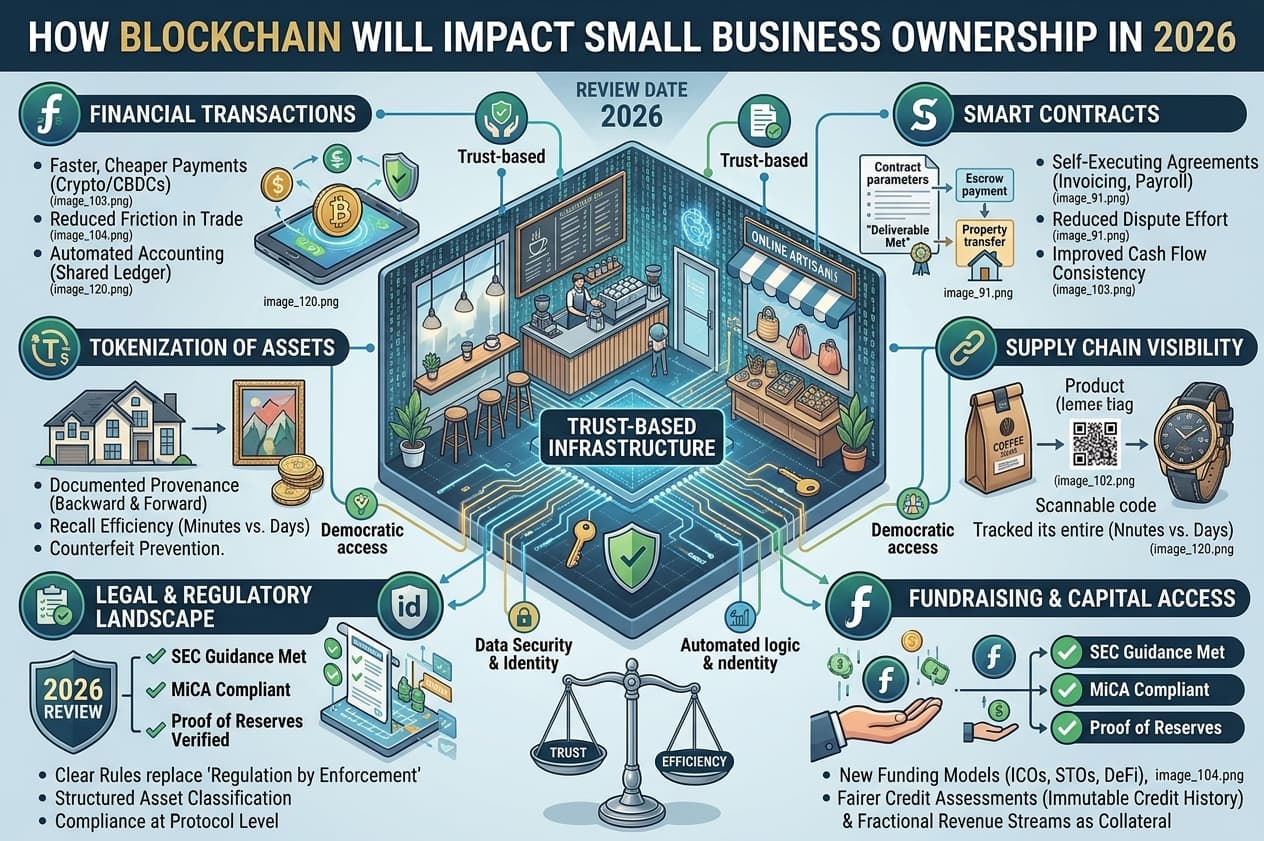
The Short Answer
Blockchain technology is beginning to reshape small business ownership through smart contracts, tokenized equity, transparent supply chains, and decentralized financing — it's still early, but worth watching.
How Blockchain Will Impact Small Business Ownership
Category: Crypto & Digital Assets | Tags: Investment Mindset · Tools & Platforms · Guides & How-To's
Target Keywords: blockchain business, Web3 investing, blockchain small business, tokenized equity, smart contract escrow
Summary
Blockchain is no longer just the infrastructure behind Bitcoin. It is quietly becoming one of the most consequential technologies for how small businesses are bought, sold, operated, and financed in the United States. Whether you are looking to acquire a local service business, build an online operation, or invest in a business without buying it outright, blockchain tools are beginning to reshape the landscape in ways that create real, practical advantages for the independent business owner. The global blockchain market was projected at $31.18 billion in 2025 and is forecast to reach $393.42 billion by 2032, per Fortune Business Insights and Agilie's blockchain trend analysis. Meanwhile, the real-world asset (RWA) tokenization market — the segment most directly relevant to small business ownership — grew 380% in just three years, hitting $24 billion by mid-2025, according to a joint report by RedStone, Gauntlet, and RWA.xyz. For the small business owner or the dad investor who is paying attention, this convergence of crypto, business buying, and Web3 tools represents one of the most interesting early opportunities of the decade. This article breaks down five specific ways blockchain is changing small business ownership right now, and what those changes mean for you.
What Is Blockchain, Really? (A 30-Second Business Owner Explanation)
Before discussing the business implications, it helps to have an honest working definition — not the hype-saturated pitch, but what blockchain actually is and what problem it solves.
A blockchain is a decentralized, tamper-proof digital best hardware wallets that records transactions and stores data across a distributed network of computers rather than in any single centralized location. The key property that makes it useful for business is immutability: once data is written to a blockchain, it cannot be altered, deleted, or manipulated without the consensus of the entire network. There is no single company, server, or administrator that can quietly change the records.
Think of it this way: a regular spreadsheet or database is like a Google Doc — one person controls the edit history, can delete rows, and can change numbers without anyone knowing. A blockchain is like a version of that same document where every participant in the network has their own verified copy, where every change is permanently timestamped, and where no individual party can alter the record without everyone else seeing it.
According to Agilie's 2025 blockchain trend analysis, this core property means blockchain is solving real business problems in three areas:
- Trust without intermediaries — parties can transact with each other directly, without needing a bank, attorney, or escrow company to enforce the agreement
- Transparent, verifiable records — financial data, ownership history, and supply chain information can be verified by any authorized party in real time
- Programmable money and contracts — smart contracts allow business agreements to execute automatically when conditions are met, without manual intervention
Blockchain is not just a cryptocurrency technology. Smart contracts, tokenization, and digital identity tools built on blockchain are now being applied to business ownership, acquisitions, supply chain management, and payments in ways that directly affect small business operators.
#1: Tokenized Business Ownership — A New Way to Buy, Sell, and Invest
One of the most transformative applications of blockchain to small business is tokenized equity — the ability to convert ownership of a business (or a share of one) into digital tokens on a blockchain that can be bought, sold, and held by investors around the world.
How Tokenized Equity Works
When a business is tokenized, its ownership is divided into digital tokens on a blockchain. Each token represents a fractional ownership stake — similar to owning shares of a company, but with the speed, programmability, and accessibility of blockchain-native assets. According to Legal Nodes' 2025 guide to stock tokenization:
- Fractional ownership: Tokens allow even high-priced businesses to be divided into small units. Instead of needing to buy an entire business for $500,000, an investor might purchase tokens representing 2% of a business's revenue stream for $10,000.
- Automated corporate actions: Dividend payments, revenue distributions, and voting rights can be automated via smart contracts — no manual processing, no delays, no intermediary banks.
- Near-instant settlement: Traditional equity transfer can take days involving multiple intermediaries. On-chain settlement can occur within seconds to minutes.
- Cap table automation: Token transfers automatically update ownership records, eliminating manual reconciliations.
Why This Matters for Small Business Buyers
For a dad investor browsing platforms like Empire Flippers or Flippa and Empire Flippers looking to buy a small online business, tokenized equity introduces a new dimension. Rather than acquiring 100% of a business outright — which typically requires a full acquisition, due diligence, SBA loan applications, and legal closing costs — tokenized ownership platforms could allow partial stakes in businesses with transparent, on-chain revenue records.
The RWA market in context: The total value of non-stablecoin tokenized real-world assets grew from roughly $5 billion in 2022 to about $24 billion by mid-2025 — a 380% increase in three years, per Pointsville's RWA market analysis. Boston Consulting Group (BCG) projects the tokenized asset market could reach $16 trillion by 2030.
BlackRock, JPMorgan, Franklin Templeton, and Hamilton Lane are already tokenizing bonds, private credit, and fund shares. As this infrastructure matures, the natural next step is applying it to small and mid-market business equity — the $10M–$200M business segment that currently has the least liquidity, the most friction, and the largest information asymmetry between buyers and sellers.
What Exists Today (Early Stage)
The small business tokenization space is still early. Most current activity involves:
- Security Token Offerings (STOs) — regulated token sales representing equity in private companies, governed by SEC Regulation D or Regulation CF
- Revenue-sharing tokens — tokens that entitle holders to a percentage of monthly or annual business revenue
- Real estate tokenization — fractional ownership of commercial property, which is the most mature sub-category (tokenized real estate could reach $3.2 trillion by 2030, per BCG/ADDX)
- Private credit tokenization — Hamilton Lane, Apollo, and Maple Finance are tokenizing middle-market corporate loans and credit facilities, per XBTO's 2025 tokenization analysis
The honest caveat: Regulatory clarity for tokenized small business equity is still developing. Most tokenized equity offerings are limited to accredited investors under existing securities law. The SEC's Regulation Crowdfunding (Reg CF) allows non-accredited investors to participate in some offerings up to a threshold, but the full vision of anyone buying a token representing cash flow from a local business is still several regulatory cycles away from being routine. Watch this space carefully — it is one of the most interesting early-stage opportunities in the intersection of business buying and crypto.
#2: Smart Contracts for buy a small local business — Faster, Cheaper, More Transparent Deals
If you have ever bought or sold a small business, you know how painful the process can be. Escrow holds, earnout disputes, attorney fees, closing delays, document chasing — a single small business acquisition in the $500,000–$2 million range can cost $30,000–$80,000 in transaction costs and take 90–180 days to close. Smart contracts offer a direct solution to several of these pain points.
What Is a Smart Contract?
A smart contract is a self-executing agreement written in code and deployed on a blockchain. When the predefined conditions of the agreement are met, the contract executes automatically — funds are released, ownership transfers, or milestone payments are triggered without any human intermediary needing to act. As Secured Trust Escrow explains in their analysis of blockchain's role in M&A:
A smart contract releases funds automatically the moment contract conditions are met — no delays, no paperwork, no disputes.
The defining characteristic is the immutability of the code: once deployed, the contract cannot be altered, and terms are visible to all parties, per Debut Infotech's smart contract guide.
Key Applications in Small Business Acquisitions
1. Smart Contract Escrow
Traditional escrow requires an escrow officer to manually review conditions and approve fund releases — a process that typically takes days to weeks. Smart contract escrow automates this entirely:
- Funds are held in a blockchain-based escrow account
- When the predefined conditions are verified (closing documents signed, revenue targets met, licenses transferred), the escrow automatically releases funds to the appropriate party
- No escrow officer required; all parties can track escrow status in real time on the blockchain
According to Standard Chartered's 2025 digital escrow analysis cited by RebelFi, blockchain-based escrow reduces operational costs by 60% while improving settlement speed by 95% compared to traditional methods.
2. Earnout Automation
Earnouts — performance-based payments made to a seller after closing if the business hits certain revenue or profit targets — are one of the most disputed elements of any small business acquisition. They require ongoing financial verification, create conflicts of interest, and often end in litigation. A smart contract can automate this entirely:
- Business financial data is fed into the contract via a trusted data oracle
- When the revenue threshold is hit, the earnout payment is triggered automatically
- No dispute about whether the threshold was reached — the on-chain data is the record
Per Secured Trust Escrow's M&A analysis: "A tech startup acquisition uses smart escrow to release earnout payments the day audited financials confirm revenue targets."
3. Milestone-Based Deal Structures
For acquisitions with seller financing or complex payment structures, smart contracts can replace manual milestone tracking:
- Seller financing payments triggered automatically on schedule
- Performance-based payment adjustments executed programmatically
- Asset transfer conditions enforced without attorney involvement for routine events
4. Reduced Attorney Fees for Straightforward Deals
The XRPL (XRP Ledger) documentation describes smart contracts as useful for "handling payments on large-value items you would otherwise need lawyers for, such as mortgages." For a routine small business acquisition with a standard deal structure, smart contracts can significantly reduce the legal overhead — though legal counsel remains important for structuring the terms and ensuring compliance.
Practical Limitations to Understand
- Regulatory uncertainty: Most U.S. jurisdictions have not fully finalized laws governing blockchain-based escrow. Hybrid models — part traditional, part smart contract — are safer for most deals today.
- Irreversibility: If a smart contract has a bug, funds could be lost or incorrectly disbursed. Third-party code audits are essential.
- Adoption barriers: Many M&A attorneys and business brokers still prefer traditional bank escrow. For deals going through mainstream platforms, you are unlikely to use smart contracts yet — but within five years, this is likely to change.
- Oracle dependency: Earnout automation requires trusted third-party data oracles to verify real-world financial performance — an area that is still developing.
#3: Transparent Financial Verification — Solving the Due Diligence Problem
One of the most frustrating parts of buying a small business is verifying its financial claims. Sellers present P&L statements and revenue figures that may have been adjusted, cherry-picked, or in some cases fabricated. As a buyer, you are trusting PDFs, QuickBooks exports, and a seller's representations — none of which are independently verifiable. Blockchain offers a structurally different solution.
On-Chain Revenue Records
When a business conducts transactions on-chain — whether through crypto payment acceptance, blockchain-native billing, or smart contract-based revenue distribution — those records are:
- Immutable: They cannot be retroactively modified by the seller
- Publicly verifiable: Any authorized party can verify the transaction history
- Real-time: Revenue data is available as it happens, not weeks later via monthly statements
- Tamper-proof: No single party can change the record
For online business buyers in particular — where the primary asset is revenue-generating digital infrastructure — the ability to verify on-chain transaction records during due diligence would eliminate one of the most persistent risks in the acquisition process.
Real-World Precedent: The Supply Chain Model
The proof of concept for blockchain's ability to transform verification already exists in supply chain management. Walmart, in partnership with IBM, built a food traceability system using Hyperledger Fabric that reduced the time required to trace the origin of a food product from 7 days to 2.2 seconds, per the Linux Foundation Decentralized Trust case study on Walmart. The same technology that creates tamper-proof audit trails for mango provenance can create tamper-proof audit trails for business revenue.
Other major supply chain blockchain implementations that illustrate this principle:
- IBM Food Trust — Walmart, Nestlé, Tyson Foods, Dole, and Kroger all participate in a blockchain-based food traceability network
- KPMG, Merck, Walmart, and IBM — a pharmaceutical pilot reduced the time to trace prescription drugs from 16 weeks to two seconds, per IBM Blockchain
- De Beers' Tracr Platform — blockchain-verified diamond provenance tracking
The principle scales down: just as a large retailer can verify the provenance of a food product in seconds using blockchain, a business buyer should eventually be able to verify the provenance of a business's revenue history with the same speed and confidence.
What This Means for Small Business Buyers Today
For most small business acquisitions today, fully on-chain financial verification is not yet available. However, there are practical steps beginning to emerge:
- Blockchain-verified accounting integrations: Some platforms are beginning to integrate blockchain-based audit trails with accounting software
- Smart contract-based payment verification: Businesses that process payments via smart contracts have inherently verifiable revenue records
- DeFi-native businesses: Online businesses built on blockchain protocols often have fully transparent on-chain financials by default — if you are acquiring a DeFi protocol, a blockchain-based SaaS tool, or a Web3 service business, the revenue is on-chain and verifiable
As more small businesses begin accepting crypto payments and operating on blockchain infrastructure, the data will follow. Keep this in mind when evaluating online businesses on acquisition marketplaces — a business with verifiable on-chain revenue data represents a materially lower due diligence risk.
#4: New Revenue Streams for Small Business Owners
Beyond buying and selling businesses, blockchain creates several practical new revenue streams and cost-reduction opportunities for small business operators. Here are the most relevant for the U.S.-based small business owner in 2025:
Accepting Crypto Payments — Lower Fees, Global Customers
The math on crypto payments has shifted dramatically in 2025. Traditional credit card processing fees typically range from 1.5% to 3.5% per transaction, per industry averages cited by Cobo's crypto payment guide. Crypto payment gateway fees typically range from 0.5% to 2%.
The shift that makes this practical for small businesses is stablecoins — dollar-pegged digital currencies like USDC and USDT that eliminate price volatility while delivering the benefits of crypto payment infrastructure. In July 2025, PayPal launched "Pay with Crypto," a service that allows U.S. merchants to accept over 100 cryptocurrencies and convert them automatically to stablecoins or fiat. PayPal reported that the service reduces transaction fees by up to 90% compared to international credit card processing, per their July 28, 2025 press release.
Major platform adoption in 2025:
- PayPal Pay with Crypto — launched July 2025, supports 100+ cryptocurrencies, 0.99% transaction rate until July 2026, available to U.S. merchants
- Shopify + Stripe + USDC — In June 2025, Stripe and Shopify announced that millions of Shopify merchants across 34 countries can accept USDC via Stripe's checkout on Coinbase, Kraken, and Gemini's Base network
- BitPay — a widely-used gateway allowing merchants to accept USDC or USDT with near-zero fees on fast networks like Solana
Key statistics on merchant crypto adoption (2025):
- ~64% of surveyed merchants indicate customer interest in using digital currencies for payments, per CoinLaw's merchant adoption statistics
- 85% of merchants expect crypto payments to become ubiquitous in their industry within five years
- A Deloitte survey found that 85% of merchants see crypto payments as a way to reach new customers, while 77% said they accept crypto because of lower transaction fees
- Independent research by Forrester Consulting on BitPay merchants found crypto buyers spent about twice as much per order as card buyers, with an average 327% ROI for merchants who added crypto, per OpenDue's 2025 analysis
Practical implementation steps for small business owners:
- Sign up for a payment processor that handles crypto-to-fiat conversion automatically (BitPay, Coinbase Commerce, or PayPal Pay with Crypto)
- Add a crypto payment option to your checkout or invoice — most integrations are plug-and-play with Shopify, WooCommerce, and QuickBooks
- Decide whether to hold crypto (for potential appreciation) or convert to fiat immediately (for stability) — most small businesses convert immediately to eliminate volatility
- Track every crypto transaction with the date and USD equivalent at time of receipt for tax purposes
Tax note: The IRS treats crypto payments received as ordinary income at the fair market value on the date of receipt — the same as cash payments. Keep records accordingly, and consult your CPA. (See our related article: crypto staking Explained for Beginners for more on crypto tax treatment.)
NFT-Based Loyalty Programs and Digital Memberships
Non-fungible tokens (NFTs) are commonly associated with speculative digital art, but their underlying technology — unique, verifiable digital ownership records on a blockchain — has genuine practical applications for small business customer loyalty.
How it works for a small business:
- A coffee shop, gym, or local retail store issues NFT-based membership passes or loyalty tokens
- Customers who hold the NFT receive benefits: priority access, discounts, exclusive offers
- Membership can be transferred or sold — giving the customer a stake in the brand's growth
- Engagement and community building around the brand's token can drive repeat business
This is still an early-stage application for most Main Street businesses, but platforms like Shopify, Thirdweb, and Unlock Protocol are beginning to make NFT-based loyalty accessible without requiring technical expertise. Per The Strategy Institute's blockchain business guide, NFT loyalty programs represent an emerging model where "utility tokens with inherent use-case value rather than speculative assets spark true tokenomics."
Access to Tokenized Capital and DeFi Lending
Blockchain-based finance (DeFi) is beginning to offer small businesses access to capital markets that were previously unavailable to them. Platforms like Maple Finance and Credix allow businesses to tokenize receivables and access credit directly from decentralized lenders — bypassing traditional bank underwriting entirely, per BIS Group and XBTO research on RWA tokenization.
This is most relevant for:
- Online businesses with verifiable recurring revenue who want to access working capital without a traditional bank loan
- Service businesses with strong accounts receivable who want to factor invoices at more favorable rates
- Growth-stage businesses that can't qualify for conventional SBA financing but have strong operating metrics
BIS research found that tokenization is helping small and medium-sized enterprises (SMEs) with "little or no access to traditional credit" gain access to capital markets through blockchain-based lending platforms — a direct counterpart to the traditional barriers of high minimums and rigid qualification criteria.
#5: DAOs — A New Model for Community Business Ownership
The most radical — and most speculative — blockchain impact on small business ownership comes from Decentralized Autonomous Organizations, or DAOs.
What Is a DAO?
A Decentralized Autonomous Organization is an organizational structure built on blockchain technology and governed by its members through token-based voting, with rules and financial operations encoded in smart contracts. There is no CEO, no board of directors, no single point of control. Decisions are made collectively, votes are recorded on-chain, and the rules are executed automatically by the code.
As Avast's explanation of DAOs puts it: "DAOs are a new type of organizational structure where all members participate in decision-making, because there is no central authority." Tokens represent both ownership and voting rights — owning more tokens means more say in how the organization operates.
DAOs as a Business Ownership Model
Most DAOs today operate in the crypto-native world: governing DeFi protocols, managing treasuries, or coordinating open-source development communities. But the organizational model is beginning to spill over into real-world businesses:
-
ConstitutionDAO — perhaps the most famous example of a DAO attempting to own a real-world asset. In 2021, thousands of contributors collectively raised millions of dollars to attempt to buy an original copy of the U.S. Constitution at auction. While the bid was ultimately unsuccessful, per Salt Creative's DAO guide for small businesses, it demonstrated that blockchain technology can coordinate large groups of people to raise and deploy capital toward a shared goal with remarkable speed.
-
Investment DAOs — organizations like MetaCartel Ventures operate as for-profit DAOs making venture investments in early-stage decentralized applications. Members collectively vote on investment decisions, per Ross Dawson's analysis of leading DAOs.
-
Community-owned service businesses — the emerging model: a group of customers, employees, or community members collectively own and govern a business through a DAO structure. Revenues are distributed automatically to token holders via smart contracts.
How DAOs Could Impact Small Business Buying and Selling
For the business acquisition-focused investor, DAOs introduce an interesting set of possibilities:
- Collective acquisition: A DAO could pool capital from multiple investors to purchase a small business that none could acquire individually — similar to syndicated real estate, but without the regulatory overhead of a traditional investment fund
- Community governance: After acquisition, a DAO structure allows the customer base or employee base to have a formal governance role — potentially improving alignment and reducing principal-agent problems
- Token-based exit liquidity: Rather than waiting for a traditional business sale, owners could create a market for their business equity by issuing governance tokens, creating liquidity before a formal exit
The honest risks of DAOs:
The DAO model comes with significant limitations that are important to understand before getting excited about the concept:
- Regulatory uncertainty: The legal status of DAOs varies dramatically by state. Wyoming was the first U.S. state to recognize a DAO as a legal business entity. Most other states have not passed equivalent legislation. Without a clear legal wrapper, DAO members may face personal liability for the organization's actions.
- Governance challenges: Token-weighted voting can concentrate power among large holders. Per Wikipedia's entry on DAOs, "DAOs can be subject to coups or hostile takeovers that upend its voting structures especially if the voting power is based upon the number of tokens one owns."
- Smart contract risk: Incorrectly written contracts can be exploited. The original 2016 "The DAO" hack resulted in a loss of over $60 million in ETH due to a code vulnerability.
- Coordination complexity: Managing a distributed group of token holders on operational business decisions can be slow and unwieldy compared to traditional management structures.
Bottom line on DAOs: This is an early-innings innovation with genuine long-term potential for transforming how community-owned businesses operate. For the practical business buyer in 2025, the DAO structure is best understood as a tool to monitor and experiment with cautiously — not something to base a near-term acquisition strategy on.
What This Means for the Dad Investor: A Practical Framework
Blockchain's impact on small business ownership is not a single event. It is a decade-long technology adoption curve. Here is a practical framework for how to think about it in the context of a family investing portfolio:
Short-Term (2025–2027): Practical Tools You Can Use Now
- Accept crypto payments if you own or operate a business. The infrastructure is mature, the fee savings are real, and PayPal's July 2025 launch means the on-ramp is genuinely beginner-friendly.
- Prioritize online businesses with verifiable on-chain revenue when browsing acquisition marketplaces. A business that conducts some portion of its transactions on-chain has inherently more transparent financial records.
- Use stablecoins for international business payments. If your business pays contractors or suppliers overseas, stablecoin transfers via PayPal or Coinbase can dramatically reduce wire transfer costs and delays.
- Stay informed about smart contract escrow developments through the platforms you use for business acquisitions. As mainstream business brokers begin piloting hybrid blockchain escrow solutions, early adopters will see lower transaction costs and faster closings.
Medium-Term (2027–2030): The Convergence to Watch
- Tokenized small business equity — watch for SEC regulatory clarity on Reg CF tokenized equity offerings. When retail investors can legally buy tokens representing cash flows from small businesses on regulated platforms, the acquisition market will be transformed.
- On-chain financial verification becoming standard — as blockchain-native accounting tools mature, expect due diligence processes to increasingly rely on verifiable on-chain data rather than seller-provided PDFs.
- Smart contract escrow mainstream adoption — within three to five years, hybrid blockchain escrow will likely become a standard option on the major business acquisition platforms.
Long-Term (2030+): The Big Picture
The businesses built on blockchain-native infrastructure today are the ones that will have the most liquid, verifiable equity in ten years. Blockchain will change how businesses are bought, sold, and operated over the next decade. The investors who understand it early will have a structural advantage — not by speculating on tokens, but by understanding which tools create real operating leverage and deal transparency.
Common Questions About Blockchain and Small Business
Do I need to understand crypto to benefit from blockchain in my business? Not necessarily. Many blockchain applications for small businesses — particularly crypto payment acceptance via PayPal or BitPay — are abstracted behind familiar interfaces. You don't need to understand how Ethereum works to accept USDC payments via Shopify.
Is accepting crypto payments risky for a small business? The biggest risk is volatility, but this is largely eliminated by converting to fiat or stablecoins at the point of sale. Most payment processors handle this automatically. The risk of a business holding significant crypto on its balance sheet is higher — but routine payment acceptance is straightforward.
What is the legal status of smart contracts in the United States? Several U.S. states have passed legislation recognizing the legal validity of smart contracts, including Arizona, Nevada, Tennessee, and Wyoming. Federal guidance continues to develop. For high-stakes business acquisitions, a traditional legal closing should still accompany any smart contract implementation until federal law is clearer.
Can a small business be tokenized under current U.S. law? Yes, with significant restrictions. Tokenized equity in a private U.S. company must comply with existing securities law — typically Regulation D (accredited investors only) or Regulation CF (up to $5 million annually from non-accredited investors with limits). A securities attorney with blockchain experience is essential for any tokenized equity offering.
Should I invest in DAO-governed businesses? Exercise caution. Most DAOs operating today are crypto-native organizations without clear legal wrappers or investor protections. If investing in a DAO, ensure you understand the governance structure, the legal jurisdiction, and the smart contract audit history before committing capital.
Related Articles on DadAlt Investments
- Crypto Staking Explained for Beginners — If blockchain business tools have you interested in crypto broadly, staking is the most accessible way to earn passive income investments on digital assets you already hold. Includes full U.S. tax treatment.
- How to Buy a Small Local Business for Under $100k Down — The foundational guide to business acquisition for the dad investor. Due diligence, financing, and how to find deals.
- [Top 5 Crypto How to Create Passive Income with ETFss](#) — Want blockchain exposure without direct crypto ownership? Spot Bitcoin ETFs give you indirect exposure to the broader blockchain economy. See our guide to IBIT, FBTC, and the top spot ETF options.
- Should I Buy Crypto? The Case for Crypto in a Family Portfolio — Before staking, paying suppliers, or exploring tokenized equity, start here for a grounded look at whether crypto belongs in a family investing portfolio.
- Flippa vs Empire Flippers: Which Is Better? — The best platforms for finding and buying online businesses — and how blockchain-native businesses are beginning to appear on mainstream acquisition marketplaces.
- Gold vs. Crypto: Which Is the Better Hedge? — For the dad investor weighing how to allocate between traditional stores of value and digital assets, our data-driven comparison of gold vs. Bitcoin.
Sources and References
-
Agilie — "The Future of Blockchain: Trends and Predictions" (October 30, 2025) — Blockchain market projected from $31.18 billion (2025) to $393.42 billion (2032), CAGR 43.65%; tokenized economy benefits including increased liquidity, democratized investment, and programmable smart contracts; how blockchain eliminates middlemen through peer-to-peer transactions; fractional ownership mechanics. agilie.com/blog/the-future-of-blockchain-trends-and-predictions
-
Legal Nodes — "Stock Tokenization in 2025: A Legal Guide for Startup Founders" (November 9, 2025) — Overstock.com issued first blockchain-based stock in a public company in 2016; Harbor $28M seed round in 2018; tokenized equity benefits including enhanced liquidity, fractional ownership, cap table automation; Regulation D and Reg CF compliance requirements; SPV legal wrappers for tokenized equity. legalnodes.com/article/stock-tokenization-in-2025
-
XBTO — "Real-World Asset Tokenization Use Cases in 2025" (October 15, 2025) — Santander $20M bond issued on blockchain in days; Hamilton Lane tokenized middle-market corporate loans; BlackRock BUIDL fund attracted $500M+ signaling institutional demand; rental income automation via smart contracts; global market access through tokenization. xbto.com/resources/real-world-asset-tokenization-use-cases-in-2025
-
Pointsville — "Global RWA Tokenization Industry: Market Analysis and Forecast" — Non-stablecoin tokenized real-world assets grew from ~$5 billion in 2022 to ~$24 billion by mid-2025 (380% increase); ~85% year-on-year expansion; private credit as largest segment; Ethereum as primary settlement rail; institutional adoption by BlackRock, JPMorgan, Franklin Templeton. pointsville.com/global-rwa-tokenization-industry-market-analysis-and-forecast
-
CoinDesk — "Real-World Asset Tokenization Market Has Grown Almost Fivefold to $24B in 3 Years" (June 26, 2025) — RWA tokenization market at $24 billion; quote from RedStone/Gauntlet/RWA.xyz report on asset tokenization transitioning from experimental pilots to scaled institutional adoption in 2024–2025; Standard Chartered projection of $30 trillion by 2034; McKinsey $2 trillion projection. coindesk.com/business/2025/06/26/real-world-asset-tokenization-market-has-grown-almost-fivefold
-
Secured Trust Escrow — "Smart Contract Escrow – The Future of M&A Transactions?" (April 19, 2025) — Smart contract escrow vs. traditional escrow comparison (speed: instant vs. days/weeks; cost: lower vs. higher; transparency: fully auditable vs. limited visibility); earnout automation via smart contracts; tech startup earnout example; elimination of payment delays; challenges including regulatory uncertainty and adoption barriers. securedtrustescrow.com/smart-contract-escrow-the-future-of-ma-transactions
-
M&A Advisor / M&A Alerts — "5 Surprising Ways Blockchain Revolutionizes Finance and Deals" (October 9, 2025) — Blockchain decentralized ledgers reshaping deals; immutable transparency in M&A; smart contracts automate closings; due diligence via shared blockchain data spaces; Microsoft gaming partner royalty payments via blockchain and smart contract technology; Luke Fewel General Manager quote on blockchain finance. maadvisor.com/maalerts/5-surprising-ways-blockchain-revolutionizes-finance-and-deals
-
RebelFi — "Smart Escrow for Marketplaces: Blockchain Payment Solutions & New Revenue Models 2026" (November 26, 2025) — Standard Chartered 2025 analysis: blockchain-based escrow reduces operational costs by 60%, improves settlement speed by 95%; stablecoin market at $246 billion in 2025; GENIUS Act signed July 2025 providing federal regulatory clarity for U.S. stablecoins; Solana processes thousands of transactions per second. rebelfi.io/blog/how-smart-escrow-unlocks-new-business-models
-
Debut Infotech — "Smart Contract Development: Step-by-Step Guide 2025" — Smart contracts deploy to blockchain and execute automatically when predefined conditions are met; immutability prevents fraud; applications in loan agreements, insurance claims, escrow transactions; supply chain payment automation triggered by delivery verification. debutinfotech.com/blog/what-is-smart-contract-development
-
Linux Foundation Decentralized Trust / Hyperledger — "How Walmart Brought Unprecedented Transparency to the Food Supply Chain with Hyperledger Fabric" — Walmart traced mangos from source farm: old method 7 days, with blockchain 2.2 seconds; IBM Food Trust using Hyperledger Fabric; pork certificates of authenticity uploaded to blockchain in China; Walmart now traces 25+ products from 5 suppliers; by 2020, system mandatory for all leafy greens suppliers with 200+ suppliers joined. lfdecentralizedtrust.org/case-studies/walmart-case-study
-
IBM Blockchain — "Blockchain for Supply Chain" — Pilot by KPMG, Merck, Walmart, IBM: blockchain reduced pharmaceutical traceability time from 16 weeks to 2 seconds; supply chain transparency through shared, trusted data; immutable record for vendor details. ibm.com/solutions/blockchain-supply-chain
-
PayPal Press Release — "PayPal Drives Crypto Payments into the Mainstream, Reducing Costs and Expanding Global Commerce" (July 28, 2025) — Pay with Crypto reduces cross-border transaction fees by up to 90%; supports 100+ cryptocurrencies including BTC, ETH, USDT, XRP, SOL, USDC; connects to 650+ million crypto users globally; 0.99% transaction rate until July 31, 2026; available to U.S. merchants; PayPal PYUSD earns 4% rewards held on platform. newsroom.paypal-corp.com/2025-07-28
-
OpenDue — "Crypto Payments in E-commerce 2025: Shopify, Stripe & Due" — PayPal Pay with Crypto 0.99% fee vs. 3%+ international card processing; Shopify + Stripe USDC payments announced June 12, 2025 for 34 countries; Forrester Consulting research on BitPay merchants: crypto buyers spend twice as much per order; 327% average ROI; up to 40% of crypto payers were net-new customers; Triple-A data: 562M crypto holders in 2024. opendue.com/blog/mass-adoption-of-crypto-payments
-
CoinLaw — "Cryptocurrency Payment Adoption by Merchants Statistics 2025" (September 29, 2025) — Bitcoin commands ~42% of merchant crypto transactions; USDT accounts for ~30–35%; ~64% of merchants indicate customer interest in digital currencies; 85% expect crypto payments to become ubiquitous in five years; PayPal "Pay with Crypto" launched H1 2025; Stripe/Shopify USDC announced; crypto gateway market valued $1.69 billion growing to $6 billion by 2035. coinlaw.io/cryptocurrency-payment-adoption-by-merchants-statistics
-
Deloitte — "Cryptocurrency Benefits for Corporations" — 85% of merchants see crypto as way to reach new customers; 77% accepting crypto for lower transaction fees; crypto reduces transaction fees and eliminates float; programmable money enables real-time revenue-sharing; blockchain awareness introduces tokenized investment options. deloitte.com/us/en/services/audit-assurance/articles/corporates-using-crypto.html
-
Cobo — "Crypto Payment Guide 2025: From Basics to Enterprise Security" — Credit card processing fees 1.5%–3.5% vs. crypto payment gateway fees 0.5%–2%; traditional settlement takes 1–3 business days; crypto bypasses intermediary chain; stablecoins on fast networks (Tron, Solana) confirm in seconds; Bitcoin typically 10 minutes to 1 hour depending on network congestion. cobo.com/post/crypto-payments-the-complete-guide
-
Business Model Analyst — "The Future of Cryptocurrency in Small Business Transactions" (October 30, 2025) — Payments in Bitcoin, Ethereum, or stablecoins like USDC settle almost instantly; transaction fees can be 30–70% lower than credit cards; Berlin boutique design studio example: 15% increase in international clients and halved payment processing costs within three months of accepting crypto; plug-and-play crypto payment gateways for Shopify, WooCommerce. businessmodelanalyst.com/the-future-of-cryptocurrency-in-small-business-transactions
-
Salt Creative — "Decentralized Autonomous Organizations (DAOs): A Guide for Small Businesses" (August 18, 2025) — DAOs use blockchain and smart contracts for secure, transparent governance; ConstitutionDAO raised millions attempting to buy U.S. Constitution original; small business DAO use cases including managing freelancer groups, collective brands, transparent treasury governance; benefits: transparency, efficiency, shared ownership. sltcreative.com/decentralized-autonomous-organizations-daos
-
Avast / Gen Digital — "What Is a Decentralized Autonomous Organization (DAO)?" — DAO definition: entity governed by all members through token-based voting with no central authority; smart contracts contain rules and operating conditions; voting recorded on blockchain ensuring transparency; tokens represent ownership and membership; risks including governance concentration and security vulnerabilities. avast.com/c-what-is-dao
-
Changelly — "What Are Decentralized Autonomous Organizations (DAOs) and How Do They Work?" (July 25, 2025) — DAOs operate with no bosses or backroom deals; on-chain proposals replace traditional corporate hierarchy; smart contracts execute automatically; all rules stored publicly on the blockchain; DAO treasury and voting are fully transparent; risks include governance attacks and smart contract exploits. changelly.com/blog/what-is-a-dao-and-how-does-it-work
-
Wikipedia — "Decentralized Autonomous Organization" (Updated February 2026) — DAO history from Bitcoin proto-DAO to Ethereum smart contracts; 2016 "The DAO" hack resulted in $150M crowdfunding followed by major exploit; "DAOs can be subject to coups or hostile takeovers" if voting power based on token ownership; 2022 Build Finance DAO hostile takeover; Wyoming first U.S. state to recognize DAO as legal business entity. en.wikipedia.org/wiki/Decentralized_autonomous_organization
-
World Economic Forum — "Are DAOs the Business Structures of the Future?" (June 2022) — DAO token holders have decision-making and economic rights; Orange DAO, VC3DAO, BessemerDAO examples; Axie Infinity multi-billion engagement via DAO model; entrepreneurs using DAOs to fundraise globally and hand over ownership to communities; without legal form clarity, member liability remains unclear. weforum.org/stories/2022/06/are-dao-the-business-structures-of-the-future
-
Ross Dawson — "The State and Future of Decentralized Autonomous Organizations" (Updated May 2022) — MetaCartel Ventures as for-profit DAO for venture investments in DApps; governed by combination of "code and law"; members perform tasks smart contracts cannot including investment origination and due diligence; MetaCartel LLC legal wrapper required for real-world operations. rossdawson.com/futurist/companies-creating-future/top-decentralized-autonomous-organizations-dao
-
BIS / Consultative Group on Innovation and the Digital Economy — "Leveraging Tokenisation for Payments and Financial Transactions" — AmFi blockchain-based debt issuance platform for SMEs with little or no access to traditional credit; UP Vendas tokenized financial products previously inaccessible to small businesses; Credix tokenized capital markets ecosystem for debt financing and credit; tokenization replaces intermediaries with smart contracts. bis.org/publ/othp92.pdf
-
The Strategy Institute — "Integrating Blockchain for Business Advantage: A Complete Guide" — Smart contracts, tokenization, and DApps enable innovative new business models; NFT loyalty programs with utility value; security tokens for real-world assets; blockchain capabilities for supply chain, capital markets, crowdfunding; phased approach from assessing opportunities to executing blockchain business strategy. thestrategyinstitute.org/insights/integrating-blockchain-for-business-advantage
-
BCG / ADDX Projection (via multiple sources including Ledger Insights and Mintlayer) — Asset tokenization projected to reach $16 trillion by 2030 per BCG/ADDX; represents nearly 10% of global GDP; conservative forecast vs. Standard Chartered's $30 trillion by 2034 projection; Ripple and BCG project $18.9 trillion tokenized asset market by 2033. [Multiple sources confirming BCG projection]
-
Jarsy.com — "How Smart Contracts Work in Tokenized Equity: A Comprehensive Guide" (2025) — Smart contracts are programmable logic automating ownership, transfers, and corporate actions for tokenized equity; ERC-1400 standard for security tokens; near-instant settlement vs. T+1/T+2 in traditional markets; institutions experimenting with tokenized share issuance to fractionalize private assets; compliance hooks integrating KYC/AML into token transfer logic. jarsy.com/learn/smart-contracts
Disclaimer: This article is for educational and informational purposes only and does not constitute financial, investment, legal, or tax advice. Cryptocurrency, blockchain technology, and Web3 investments carry significant risk, including the potential for total loss of principal. Tokenized equity and DAO investments may not be appropriate for all investors and may involve regulatory restrictions. Regulatory frameworks for blockchain-based business transactions in the United States are still evolving — consult qualified legal and financial professionals before making any investment or business decisions. DadAlt Investments may receive compensation from affiliate partners mentioned in this article. See our Affiliate Disclaimer for full details.
Recommended Reading
Frequently Asked Questions
How will blockchain affect small business buying?
Smart contracts could automate escrow, due diligence verification, and ownership transfers — making business acquisitions faster, cheaper, and more transparent than today's traditional process.
Can I use cryptocurrency to buy a business?
Some sellers accept crypto, but it's still uncommon. More practically, blockchain-based platforms are emerging that tokenize business ownership, allowing fractional acquisition and easier financing.
Is blockchain relevant for traditional local businesses?
Not yet for most. But supply chain tracking, customer loyalty tokens, and decentralized payment processing are areas where blockchain could benefit even brick-and-mortar businesses within 5–10 years.

About the Author
Jared DeValk
Founder, DadAlt Investments
Father, alternative investment researcher, and founder of DadAlt Investments. 14+ years turning hard lessons into honest guidance for dads building real wealth.