How Much Money Do You Need to Start Investing in Stocks? (2026 Guide)
The real minimum to start investing and what you can build at every amount.
The Short Answer
You can start investing in stocks with as little as $1 thanks to fractional shares — but $100–$500/month in automatic contributions to an index fund is the sweet spot for building real wealth over time.
How Much Money Do You Need to Start Investing in Stocks? (2026 Guide)
By DadAlt Investments | Category: Stocks & How to Open a Brokerage Accounts | Last Updated: March 2026
The honest answer to "how much do you need to start investing in stocks?" is $1 — and that number is not a gimmick. Fractional share programs at Fidelity, Charles Schwab, and Robinhood allow you to invest any dollar amount into virtually any stock or ETF listed on U.S. exchanges, with no trading commission and no account minimum. But the real insight is not that the financial barrier has been eliminated — it is that it was never the main barrier in the first place. The habit of investing, the account structure you choose, and the tax advantages you take or leave on the table matter far more to your long-term wealth than whether you start with $50 or $5,000. The most expensive investing mistake most Americans make is waiting until they "have enough" to start — while inflation erodes their savings and compounding works for everyone except them. This guide walks through exactly what you can build at every starting amount, which account to open first, and how to automate the whole thing so your future wealth gets funded whether or not you think about it.
The Short Answer: $1 — and Why That Actually Matters
The financial industry spent decades requiring meaningful minimums to invest. Mutual funds at Vanguard historically required $1,000–$3,000 to open a position. Individual stocks required buying whole shares — a single share of Amazon today costs over $200; Berkshire Hathaway Class A trades above $700,000. Ordinary investors were structurally excluded from the most valuable companies in the world unless they had substantial capital.
That era is over. As of 2026:
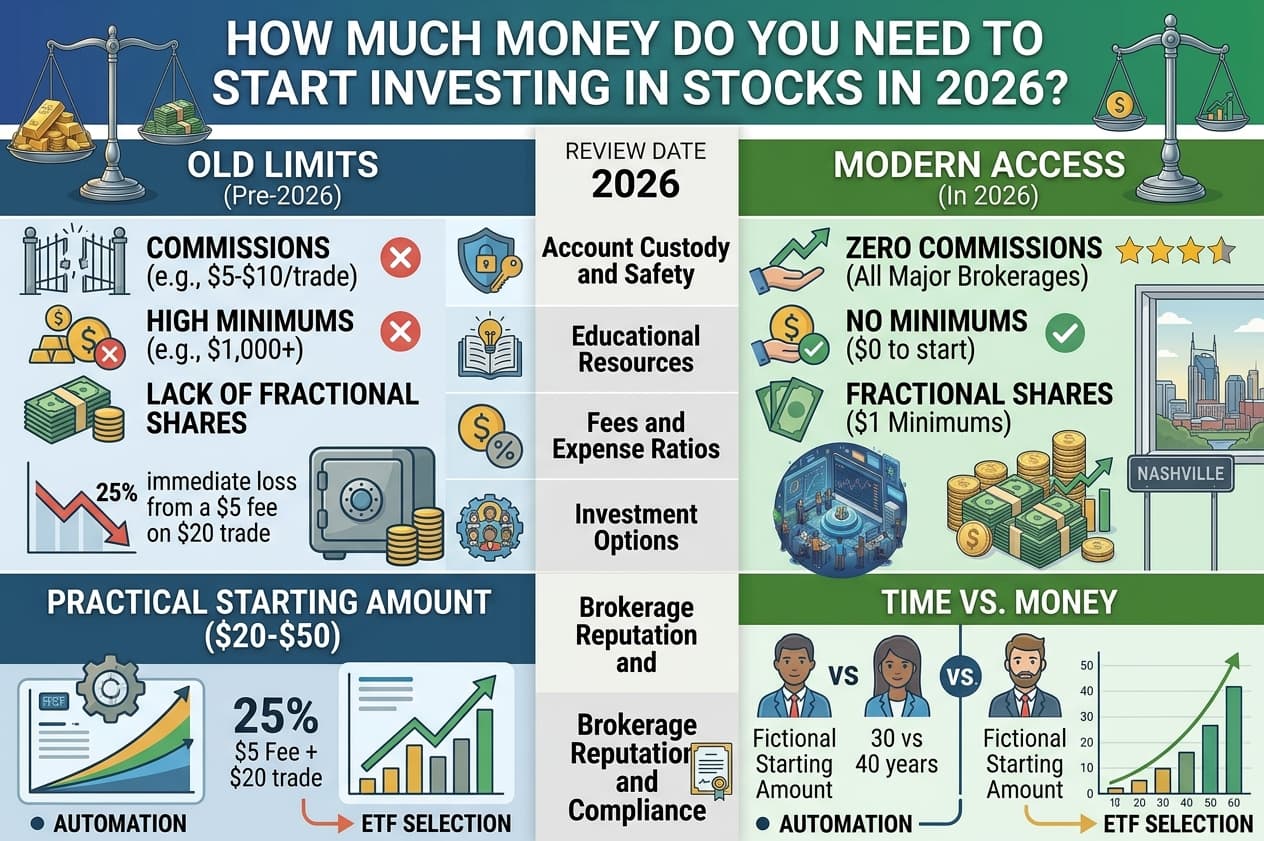
- Fidelity offers fractional shares ("Stocks by the Slice") for $1 minimum on more than 7,000 U.S.-listed stocks and ETFs, with zero trading commissions.1
- Robinhood allows fractional share purchases starting at $1 — including one-millionth of a share of the most expensive stocks — commission-free.1
- Charles Schwab offers "Stock Slices" for $5 minimum on any S&P 500 stock, commission-free, with the ability to buy up to 30 slices in a single transaction.1
- Vanguard allows fractional shares of its own mutual funds and ETFs, though not individual stocks or non-Vanguard ETFs.2
Over 30 million Americans now use fractional share platforms, according to Investopedia's analysis of fractional share adoption in 2025.3
The Real Barrier Is Not Financial — It Is Psychological
The minimum investment question matters less than people think because time is the most powerful variable in long-term investing, not starting amount. Every year you delay is a year of compounding you permanently forfeit — and unlike the amount you invest, forfeited compounding years can never be recovered.
Consider this straightforward comparison at a 7% average annual return (a conservative estimate for a U.S. total stock market Best Platforms to Buy Index Funds over long periods):
- Investor A starts investing $200/month at age 25 and continues until age 65 — 40 years of investing
- Investor B starts investing $200/month at age 35 and continues until age 65 — 30 years of investing
At 65, Investor A has contributed $96,000 and their portfolio has grown to approximately $525,000. Investor B has contributed $72,000 and their portfolio has grown to approximately $243,000. The difference is roughly $282,000 — earned from the same $200/month, with no additional effort required from Investor A beyond starting 10 years earlier.4
That gap — created solely by starting earlier — is the actual cost of waiting until you "have enough."
What You Can Build With Different Starting Amounts
Starting With $50
- Buy a fractional share of VTI (Vanguard Total Stock Market ETF) or FZROX (Fidelity ZERO Total Market Index Fund) — instant exposure to thousands of U.S. companies
- Open a Roth IRA and start the clock — the Roth IRA contribution clock begins the year you make any contribution, no matter how small; years opened matter for the 5-year rule
- Set up automatic monthly contributions so the habit is built before the balance matters
- What this does not do: Generate meaningful income, create a safety net, or significantly impact retirement savings at this level yet — but it starts the habit and the compounding clock
Starting With $500
- Buy full shares of most major ETFs without needing fractional share programs (VTI trades around $240–$270/share; VOO around $500–$530/share; SCHD around $25–$30/share — check current prices)
- Build a simple two-fund portfolio: a U.S. total market ETF plus an international ETF for immediate broad diversification
- Make a meaningful Roth IRA contribution — the 2026 Roth IRA contribution limit is $7,500 (under age 50) or $8,600 (age 50+)5
- Access virtually all ETFs on the market without fractional share assistance
Starting With $1,000
- Build a three-fund portfolio: U.S. total market (VTI or FZROX) + International (VXUS or FZILX) + Bonds (BND) — the most common foundational diversified allocation
- Open and fund a Roth IRA with your first contribution; eligible investors can contribute up to the annual limit in a lump sum
- Hold a full month of meaningful market exposure — enough to begin tracking performance and building the psychological relationship with market fluctuations that long-term investors need to develop
- Access any individual stock with a whole share purchase at most brokerages
Starting With $5,000
- Make a meaningful dent in annual Roth IRA contributions — $5,000 is two-thirds of the 2026 under-50 annual limit of $7,5005
- Begin thinking about asset allocation — the percentage split between stocks, bonds, and other asset classes based on your age and risk tolerance
- Build a genuinely diversified portfolio across multiple positions without fractional share mechanics
- Catch up meaningfully on the compounding curve if you are starting later than you would like — $5,000 invested at 35 at a 7% average return becomes approximately $38,000 by age 65 with no additional contributions
The table below summarizes key characteristics at each starting level:
| Starting Amount | Best First Move | Account to Open | Key Limitation |
|---|---|---|---|
| $50 | Fractional share of VTI/FZROX | Roth IRA | Balance too small for meaningful income |
| $500 | Two-fund portfolio (VTI + VXUS) | Roth IRA | Below some ETF full-share prices |
| $1,000 | Three-fund portfolio | Roth IRA | Below Vanguard mutual fund minimums |
| $5,000 | Max Roth IRA contribution | Roth IRA first, then taxable brokerage | None at this level for most strategies |
Account Type Matters More Than Starting Amount
One of the most consistently expensive mistakes new investors make is opening a taxable brokerage account before maximizing tax-advantaged accounts. The account you invest through can meaningfully change your outcomes over a 30–40 year period — often more than the specific funds you hold or the starting amount you invest.
1. Roth IRA — Open This First, Regardless of Starting Amount
A Roth IRA is the single most powerful account available to most American investors. Contributions are made with after-tax dollars, and everything that grows inside — dividends, capital gains, interest — is permanently tax-free when withdrawn in retirement (age 59½ or later, with the account open at least 5 years).
Key 2026 Roth IRA facts:5
- Contribution limit: $7,500/year under age 50; $8,600/year age 50+
- Income phase-out: Begins at $150,000 (single filers) and $236,000 (married filing jointly) — above these thresholds, eligibility phases out
- Account minimum: $0 at Fidelity, Schwab, and most major brokerages
- Investment options: Stocks, ETFs, mutual funds, bonds — virtually anything a taxable account can hold
Why it matters: On a $100,000 balance at retirement, a Roth IRA saves you potentially $15,000–$37,000 in federal income taxes (at the 15%–37% capital gains rate on a taxable account) — purely from account structure, with no difference in investment.
2. 401(k) — Especially Valuable If Your Employer Matches
If your employer offers a 401(k) with a matching contribution, always contribute enough to capture the full match before investing elsewhere. An employer match is a guaranteed 50%–100% immediate return on your contribution — no investment in any brokerage account can compete with that.
The most common 401(k) match structure in 2026 is 50 cents for every dollar you contribute, up to 6% of your salary. If you earn $60,000 and your employer offers this match, contributing $3,600/year (6%) earns you an additional $1,800 in employer contributions — free money that immediately doubles your return before any market gains.
The 2026 401(k) employee contribution limit is $23,500 (under age 50), with catch-up contributions of $7,500 available to those 50 and older, and a "super catch-up" of $11,250 for ages 60–63.5
3. Taxable Brokerage — For Investing Beyond Tax-Advantaged Limits
A taxable brokerage account at Fidelity, Schwab, or Vanguard has no contribution limits and no restrictions on withdrawals — but capital gains and dividends are taxed in the year they are realized. Use this account after you have maximized contributions to your Roth IRA and 401(k).
The right order of operations:
- Contribute enough to your 401(k) to capture the full employer match
- Max out your Roth IRA ($7,500 in 2026 for most investors)
- If you still have money to invest, return to the 401(k) up to the annual limit
- Overflow into a taxable brokerage account
Many beginners skip steps 1–3 and open a taxable brokerage account first — typically because it is marketed more aggressively, requires no income documentation, and has no annual limits. This is a mistake that costs real money in taxes over decades.
The Real Costs of Starting Small (and the Real Cost of Not Starting)
Transaction Fees: Effectively $0
The cost argument against starting small used to have merit. In 2000, a $7–$10 commission on a $50 investment represented a 14%–20% fee before any market return. That era is gone. As of 2026:
- Fidelity: $0 commissions on all online U.S. stock and ETF trades; $0 account minimum; $1 minimum fractional share
- Charles Schwab: $0 commissions on all online U.S. stock and ETF trades; $0 account minimum; $5 minimum Stock Slices
- Robinhood: $0 commissions on stock, ETF, and crypto trades; $0 account minimum; $1 minimum fractional
- Vanguard: $0 commissions on online stock and ETF trades; $0 account minimum for brokerage accounts
The cost barrier to starting with a small amount is genuinely zero at these platforms.1 2
The Real Cost: What You Lose by Waiting
The compounding math of delay is the actual number investors should understand:
Scenario: $50/month invested starting at age 25 vs. 35, at 7% average annual return
- Starting at 25 (40 years): ~$131,000 at retirement
- Starting at 35 (30 years): ~$61,000 at retirement
- Difference: ~$70,000 from the same $50/month
Scenario: $200/month invested starting at 25 vs. 35
- Starting at 25 (40 years): ~$525,000
- Starting at 35 (30 years): ~$243,000
- Difference: ~$282,000 — more than the total contributions made by either investor combined4
A 2026 Fidelity projection cited by financial advisors estimates that investors who begin with just $50/month at age 25 can accumulate over $150,000 by age 55, assuming average market returns.3 The stock market has historically delivered approximately 7% real returns after inflation on a diversified U.S. equity portfolio over long periods — with the S&P 500 returning approximately 13.99% annually (nominal, including dividends) between 2010 and 2026.6
Minimum Amounts for Different Brokerages and Fund Types
Fidelity
- Account minimum: $0
- Fractional shares: $1 minimum; 7,000+ eligible stocks and ETFs
- Fidelity ZERO funds (FZROX, FZILX): $0 minimum investment; 0.00% expense ratio — the lowest-cost index funds available anywhere
- Commission: $0 on all online U.S. stock and ETF trades
- Best for: Beginners who want the lowest possible costs and a Roth IRA with strong research tools; NerdWallet's 2026 Best-of Award winner for best online broker for beginning investors2
Charles Schwab
- Account minimum: $0
- Fractional shares: $5 minimum via "Stock Slices" for any S&P 500 stock; up to 30 slices per transaction
- ETF fractional shares: Not available via Stock Slices (Schwab Stock Slices covers only S&P 500 stocks)
- Commission: $0 on all online U.S. stock and ETF trades
- Best for: Investors who want the industry's most comprehensive platform (including the professional-grade thinkorswim trading platform inherited from TD Ameritrade); StockBrokers.com #1 Overall broker in 20262
Robinhood
- Account minimum: $0
- Fractional shares: $1 minimum; eligible for stocks over $1/share with market cap above $25 million; ETFs included
- Commission: $0 on stocks, ETFs, and options; Robinhood Gold subscription ($5/month) may apply for margin and premium features
- Best for: Mobile-first investors who want the simplest interface; note that Robinhood does not offer mutual funds or individual bonds
Vanguard
- Account minimum: $0 for brokerage accounts
- Fractional shares: Available for Vanguard's own mutual funds and ETFs only — not individual stocks or non-Vanguard ETFs
- Mutual fund minimums: Many Vanguard mutual funds require $1,000–$3,000 minimum investment; Vanguard ETFs (VTI, VOO, VXUS, BND) require only the cost of one full share
- Commission: $0 on online stock and ETF trades
- Best for: Long-term investors who specifically want Vanguard's fund lineup and mutual funds; less friendly for beginners wanting fractional shares of individual stocks2
ETF Share Price Reference
Most ETFs require the cost of one full share unless you use a fractional share program. Some approximate 2026 price ranges (verify current prices before investing):
- VTI (Vanguard Total Stock Market): Approximately $240–$280/share
- VOO (Vanguard S&P 500): Approximately $500–$540/share
- SCHD (Schwab U.S. Dividend Equity): Approximately $25–$30/share
- FZROX (Fidelity ZERO Total Market): $0 minimum, any dollar amount
- BND (Vanguard Total Bond Market): Approximately $72–$78/share
For investors with under $500, Fidelity's FZROX ($0 minimum, 0.00% expense ratio) or fractional VTI at Fidelity or Robinhood is the most practical starting point.
Dollar-Cost Averaging: The Strategy That Removes the "When to Start" Problem
Dollar-cost averaging (DCA) is investing a fixed dollar amount on a fixed schedule — every month, every two weeks, or every week — regardless of whether the market is up, down, or sideways. It is arguably the most important strategy for investors who are starting small, building the habit, and trying to sidestep the psychological trap of "waiting for a good time to invest."
How DCA Works
When you invest $200 every month regardless of price:
- When the market is down, your $200 buys more shares at the lower price
- When the market is up, your $200 buys fewer shares at the higher price
- Over time, your average cost per share is lower than the average price during the investment period
This is not just theoretical. A Charles Schwab study found that even an investor who consistently bought at the market peak (worst possible timing) each year still significantly outperformed an investor who held cash waiting for the "right time." Being invested — even at bad timing — beats not investing.4
The Mathematical Reality of Consistent Small Contributions
- $100/month for 30 years at 7%: Approximately $121,000 total ($36,000 in contributions, $85,000 in growth)
- $200/month for 30 years at 7%: Approximately $243,000 total ($72,000 in contributions, $171,000 in growth)
- $500/month for 30 years at 7%: Approximately $608,000 total ($180,000 in contributions, $428,000 in growth)4
The growth component in each scenario dwarfs the actual money contributed — this is compounding doing the work that you cannot do manually.
How to Implement DCA in Practice
- Open a Roth IRA at Fidelity or Schwab ($0 to open)
- Select your investment: FZROX at Fidelity (0.00% expense ratio, $0 minimum) or VTI as a fractional share is the simplest starting point
- Enable automatic investment: Fidelity, Schwab, and Vanguard all support recurring automatic investment purchases on a schedule you define
- Set the date: The day after your paycheck hits is the optimal timing — the money moves before you can spend it
- Do not adjust for market conditions: DCA works because you ignore market noise, not because you react to it
Fidelity's "Basket Portfolios" feature allows you to automate a recurring investment across multiple positions simultaneously, making DCA across a multi-fund portfolio as frictionless as a single-fund purchase.2
When You Have More: Moving From $1,000 to $10,000+
At $1,000: Establish Your Foundation
- Priority 1: Fund a Roth IRA with your full $1,000 contribution — you can always add to it throughout the year up to the annual limit
- Fund selection: One broad U.S. total market index ETF or fund is sufficient at this stage (FZROX at Fidelity, VTI at Schwab/Vanguard/Robinhood, or VOO for S&P 500 exposure)
- What to skip: Do not complicate your portfolio with sector ETFs, individual stocks, or themed funds until your core index position is established
- Set up a recurring monthly contribution, even if it is only $50 — the automation habit is worth more than the dollar amount
At $5,000: Build the Three-Fund Portfolio
The three-fund portfolio is the most widely recommended foundational investment strategy among evidence-based personal finance communities (Bogleheads, JL Collins, Rick Ferri):
- U.S. Total Market: VTI (0.03% expense ratio) or FZROX (0.00%)
- International Stocks: VXUS (0.07% expense ratio) or FZILX (0.00%)
- U.S. Bonds: BND (0.03% expense ratio) for stability — especially important for investors within 10 years of needing the money
At $5,000, a reasonable starting allocation for a long-term investor in their 30s might be 70% VTI, 20% VXUS, and 10% BND — adjust the bond percentage upward as you approach retirement.
Begin reviewing your asset allocation — the percentage balance between stocks and bonds — relative to your age, risk tolerance, and time horizon.
At $10,000+: Maximize the System
- Maximize all tax-advantaged accounts first: Roth IRA ($7,500 in 2026) and 401(k) up to the full employer match, then beyond
- Overflow into a taxable brokerage account for any investments beyond tax-advantaged limits
- Review expense ratios across all holdings — every 0.10% in expense ratio costs approximately $1,000 per $100,000 invested per year, compounding over time
- Consider tax-loss harvesting in your taxable account — selling positions at a loss to offset capital gains elsewhere
- Revisit your asset allocation annually and after major life changes (job change, new child, home purchase)
FAQ
What Is the Minimum to Open a Roth IRA?
At Fidelity, Charles Schwab, and most major brokerages, there is $0 minimum to open a Roth IRA. You can open the account with nothing, then fund it at any time during the tax year (up until the tax filing deadline, typically April 15 of the following year). The 2026 contribution limit is $7,500 for investors under age 50 and $8,600 for those 50 and older — but you can contribute any amount up to those limits. There is no minimum annual contribution requirement.5
The income eligibility phase-out for Roth IRA contributions begins at $150,000 for single filers and $236,000 for married filing jointly in 2026. Investors above these thresholds may need to explore a backdoor Roth IRA strategy.
Should I Invest $500 or Save It in a High-Yield Savings Account?
It depends on the purpose of the money:
- If this is emergency savings: Keep it in a high-yield savings account (HYSA). Top HYSA rates in early 2026 are in the 4%–5% APY range — a meaningful real return with no market risk. Emergency funds should be in savings, not stocks.
- If this is truly long-term money (10+ years away): Invest it. Historically, a broad U.S. stock market index fund has outperformed even the best HYSA rates over periods of 10 years or more. The S&P 500 returned approximately 80% in the three years from 2023 to 2026 alone.6
- The rule of thumb: Keep 3–6 months of expenses in a HYSA as your emergency fund. Invest everything beyond that (within tax-advantaged accounts first) if your time horizon is 10+ years.
Can I Buy Partial Shares of Expensive Stocks Like Amazon or NVIDIA?
Yes — at Fidelity, Robinhood, and most major brokerages that support fractional share programs. Amazon trades at over $200/share; NVIDIA at several hundred dollars per share. Neither requires a full share purchase.
At Fidelity, you can buy $1 worth of Amazon or NVIDIA, receiving a fractional share proportional to your dollar investment. Dividends, if any, are paid proportionally. The fractional shares appear in your holdings as decimal quantities and are sold the same way as whole shares.1 3
One important caveat: Fractional shares at most brokerages execute as market orders at a set time (often at market close) rather than in real-time like whole share trades. For long-term investors using DCA, this distinction rarely matters in practice.
Is It Worth Investing $100 a Month?
Yes — unambiguously, and the math is clear. $100/month invested in a broad U.S. index fund at a 7% average annual return:
- After 10 years: ~$17,000 (on $12,000 contributed)
- After 20 years: ~$52,000 (on $24,000 contributed)
- After 30 years: ~$121,000 (on $36,000 contributed)
- After 40 years: ~$263,000 (on $48,000 contributed)
At 40 years, you have contributed $48,000 and compounding has added $215,000 — more than four times your total contributions, from $100/month. That is not a hypothetical scenario — it is arithmetic applied to historical market return averages.4
The counterargument — "it's only $100, it doesn't matter" — is mathematically backward. $100/month at 25 matters more than $1,000/month at 55, because time is the irreplaceable ingredient.
Sources and References
Disclaimer: This article is for informational and educational purposes only and does not constitute financial, tax, or investment advice. Investment minimums, contribution limits, and expense ratios are subject to change. Verify all figures at the relevant institution before making investment decisions. DadAlt Investments may earn affiliate commissions from some links in this article at no cost to you.
Recommended Reading
- How to Open a Brokerage Account
- The Ultimate Beginner's Guide to Investing
- Best Platforms to Buy Index Funds
Footnotes
-
Bankrate / StockBrokers.com. "Best Brokers for Buying Fractional Shares." January 23, 2026. https://www.bankrate.com/investing/best-brokers-fractional-share-investing/ and https://www.stockbrokers.com/guides/fractional-shares-brokers — Fidelity: $1 minimum, 7,000+ stocks and ETFs, $0 commissions; Schwab Stock Slices: $5 minimum, S&P 500 stocks only, up to 30 slices per transaction, $0 commissions; Robinhood: $1 minimum fractional shares, $0 commissions, eligible for stocks over $1/share with market cap above $25 million, ETFs included; Vanguard: fractional shares for Vanguard's own funds only, not individual stocks or non-Vanguard ETFs. ↩ ↩2 ↩3 ↩4 ↩5
-
NerdWallet. "11 Best Brokers for Trading Fractional Shares in 2026." March 2026. https://www.nerdwallet.com/investing/best/best-brokers-for-fractional-shares — Fidelity 2026 Best-of Award winner for best online broker for beginning investors; Schwab #1 Overall at StockBrokers.com in 2026; Vanguard allows fractional shares of ETFs but not stocks; Fidelity Basket Portfolios feature for automated recurring multi-position investments; $0 account minimums at Fidelity, Schwab, and Robinhood. ↩ ↩2 ↩3 ↩4 ↩5 ↩6
-
Millions Pro / Investopedia via Millions Pro. "Fractional Shares Investing Guide for Small Budgets." March 2026. https://www.millionspro.com/blog/fractional-shares-investing-guide-for-small-budgets — Over 30 million Americans use fractional share platforms as of 2025; Fidelity projects investors beginning with $50/month at age 25 can accumulate over $150,000 by age 55 at average market returns; fractional orders settle one business day after trade, same as whole shares; fractional positions appear as decimal quantities in portfolio. ↩ ↩2 ↩3
-
Richify Insights / Finance Digs. "Dollar-Cost Averaging Guide 2026." March 2026. https://blog.richify.ai/investing/dollar-cost-averaging-guide-2026/ and https://www.financedigs.com/2026/03/start-investing-stocks-little-money.html — $500/month for 30 years grows $180,000 in contributions to over $1.1 million at compound average returns; $50/month starting at 25 at 7% return grows to $260,000 over 40 years; Schwab study finding worst-timing investor still significantly outperformed cash-holding investor; $200/month comparison at 7%: 40 years ~$525K vs. 30 years ~$243K. ↩ ↩2 ↩3 ↩4 ↩5
-
DadAlt Investments internal data / IRS Notice 2025-67. 2026 IRS contribution limits: Roth IRA $7,500/year under age 50; $8,600/year age 50+; income phase-out begins at $150,000 (single) and $236,000 (married filing jointly). 401(k) employee contribution limit $23,500; catch-up age 50+ $7,500; super catch-up ages 60–63 $11,250. ↩ ↩2 ↩3 ↩4 ↩5
-
OfficialData.org. "S&P 500 Returns since 2010 and 2023." https://www.officialdata.org/us/stocks/s-p-500/2010 — $100 invested in S&P 500 in 2010 grew to $812.35 by 2026, a 712% return at 13.99% annually (nominal, including dividends). $100 invested in S&P 500 in 2023 grew to $180.47 by 2026, an 80.47% return in three years. Historical returns are not a guarantee of future performance. ↩ ↩2
Frequently Asked Questions
Is $100 enough to start investing?
Yes — $100 invested monthly in an index fund at 10% average returns grows to over $75,000 in 20 years. Fractional shares mean there's no minimum to buy into quality companies and funds.
What should I invest in with $500?
Put it all into a total stock market index fund (VTI or FZROX). One fund gives you exposure to thousands of companies with nearly zero fees. Don't overcomplicate your first investment.
How much should I invest each month?
Aim for 15–20% of your take-home pay. If that's not possible yet, start with whatever you can — even $50/month. The habit of consistent investing matters more than the dollar amount.
About the Author
Jared DeValk
Founder, DadAlt Investments
Father, alternative investment researcher, and founder of DadAlt Investments. 14+ years turning hard lessons into honest guidance for dads building real wealth.