
Gold vs. Bitcoin: Which Is the Better Hedge? (2026 Guide)
Data-driven comparison of gold and Bitcoin as inflation and crisis hedges.
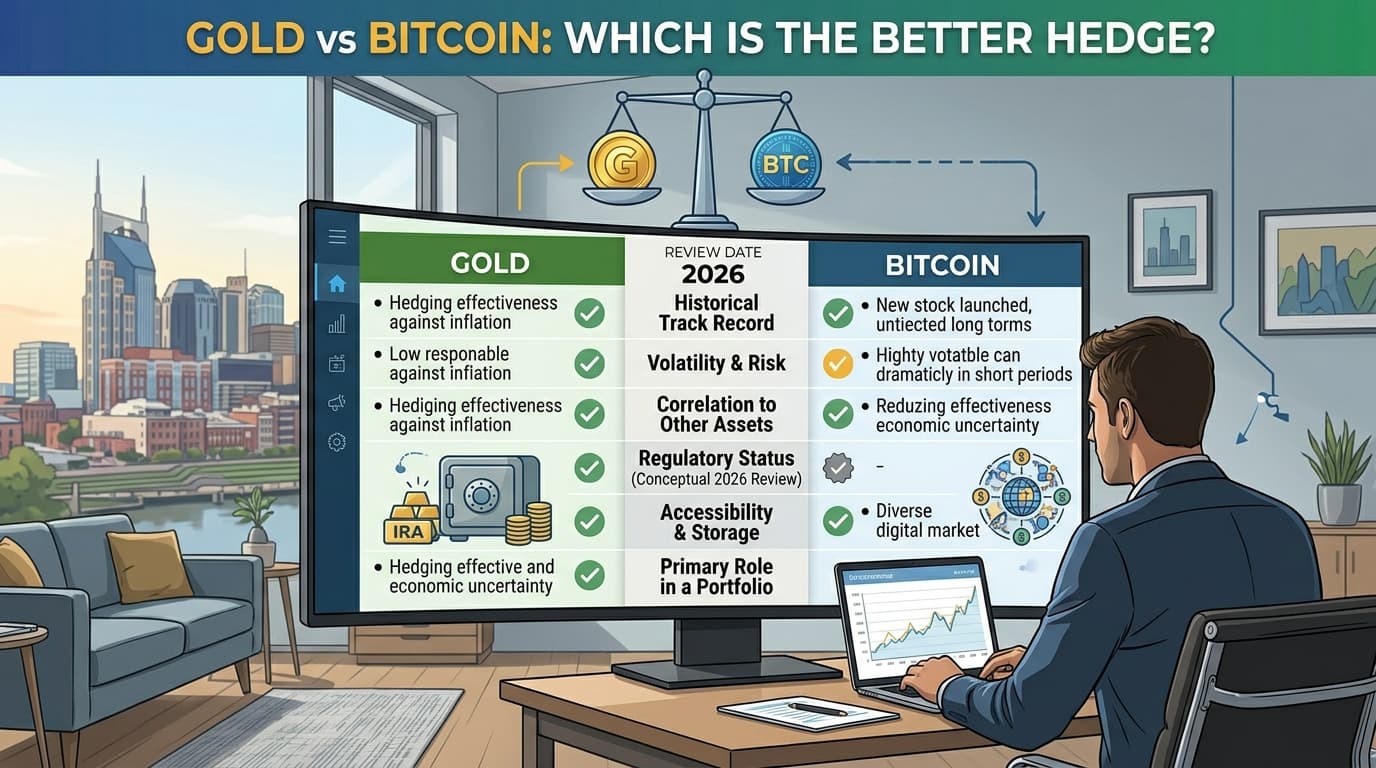
The Short Answer
Gold is the more reliable crisis hedge with a proven 5,000-year track record, while Bitcoin offers higher potential returns with significantly more volatility — data suggests holding both in small allocations is the optimal strategy for dads.
Gold vs. How to Buy Bitcoin Safely: Which Is the Better Hedge? (2026 Guide)
By DadAlt Investments | Category: Gold / Crypto | Last Updated: March 2026
Gold and Bitcoin are the two most discussed alternatives to stocks and bonds for investors seeking protection against inflation, dollar debasement, and portfolio volatility — yet they are fundamentally different assets serving different roles. Gold crossed $3,000 per ounce in early 2026 and pushed significantly higher, continuing a multi-year run fueled by central bank demand, geopolitical risk, and persistent inflation concerns. Bitcoin, meanwhile, established itself as a legitimate institutional asset class following the January 2024 approval of spot Bitcoin ETFs in the U.S., with BlackRock's IBIT reaching $70 billion in AUM faster than any ETF in history. The honest comparison: gold is the better hedge for inflation, currency crises, and equity market drawdowns — it has decades of crisis performance data supporting that claim. Bitcoin is a higher-volatility, higher-return asymmetric bet on digital scarcity and the future of censorship-resistant money, with a track record too short and too volatile to qualify as a reliable crisis hedge by any rigorous standard. Neither is risk-free. Neither belongs at the center of a long-term investor's portfolio. And for most investors, a small allocation to a gold ETF plus consistent equity index investing is the lower-risk path to both inflation protection and wealth accumulation.
What "Hedge" Actually Means — and Why It Matters
The word "hedge" gets applied loosely in investing discussions. A hedge in its strict sense is an asset that holds value or appreciates when your other portfolio assets decline — specifically, when they decline in the conditions you fear most.
Different investors fear different things:
- Inflation — your dollars buy less over time; a hedge against inflation should maintain purchasing power as the CPI rises
- Equity market crashes — a portfolio-level crash; a hedge should be uncorrelated or negatively correlated with stocks
- Dollar debasement — the purchasing power of fiat currency falls versus hard assets; a hedge should appreciate as the dollar weakens
- Sovereign default or systemic collapse — the most extreme scenario; a hedge should retain value when governments or financial institutions fail
Gold and Bitcoin answer these scenarios differently. The question is not which is "better" in the abstract — it is which is better for the specific risk you are hedging against, in your specific investment timeframe, at your specific risk tolerance.
Critical framing that most comparisons skip: Both gold and Bitcoin are speculative positions relative to a diversified equity portfolio. A portfolio of index funds (VTI, VT, FZROX) provides the best long-term risk-adjusted returns for most investors. Gold and Bitcoin are portfolio supplements — their role is risk modification, not core wealth generation. This distinction matters when sizing allocations.
Gold: The Historical Inflation and Crisis Hedge
5,000 Years of Monetary History
Gold has served as a store of value, medium of exchange, and monetary reserve for as long as recorded civilization. This is not merely historical trivia — it creates a self-reinforcing legitimacy. Gold is held by central banks in every major economy. The U.S., China, Germany, Italy, France, and Russia maintain significant gold reserves. The IMF holds gold. This institutional embedding means gold's role as a reserve asset is not dependent on any single government's policy, technology platform, or regulatory framework remaining intact.1
Gold's Crisis Performance Record
The 2008–2009 Financial Crisis: The S&P 500 fell approximately 57% from peak to trough between October 2007 and March 2009. Gold rose roughly 25% over the same period. This is the textbook example of gold performing its intended crisis hedge function — appreciating while equities collapsed during systemic financial stress.
The 1970s Inflation Decade: The most cited inflation test. Gold rose from approximately $35/oz in 1971 (when Nixon ended the gold standard) to approximately $850/oz in January 1980 — an approximately 24x price increase over the decade when U.S. inflation averaged above 7% annually. This remains gold's strongest empirical case as an inflation hedge.
The 2022 Inflation Spike: Gold outperformed most asset classes in 2022 as the S&P 500 fell approximately 18%. While gold's performance was not spectacular (it ended 2022 down modestly), it dramatically outperformed equities, bonds, and most alternative assets during a period of 40-year-high inflation — functioning as intended.
2025: Gold surged approximately 65% in 2025, reaching record highs above $5,500/oz in late January 2026 before correcting, and trading in the $5,000–$5,500 range through early 2026. This exceptional performance was driven by central bank gold-buying acceleration (central banks globally doubled their gold purchases in recent years), geopolitical risk, tariff-driven uncertainty, and continued de-dollarization concerns.2
Gold's Structural Properties
- Annual supply inflation: Approximately 1.75% in 2024 (annual mine production divided by total above-ground stock) — meaningfully less than fiat currency inflation in most periods, and far below Bitcoin's historical supply inflation (though Bitcoin's inflation rate has also declined significantly)
- Market capitalization: Approximately $12–14 trillion — approximately 8–11x the size of Bitcoin's market cap
- Correlation to equities: Low to negative — gold has historically maintained near-zero to negative correlation with U.S. equities, making it a genuine portfolio diversifier
- Correlation to dollar: Negative — gold typically appreciates when the U.S. dollar weakens against other currencies and declines in real terms
Gold's Weaknesses
Gold is not without limitations for the modern investor:
- Zero yield: Gold generates no dividends, interest, or cash flow. A dollar held in gold is a dollar not compounding in the market. Over 20–30 year periods, this matters substantially.
- Storage and insurance costs: Physical gold requires secure storage and insurance — typically 0.3%–1% annually for allocated vault storage. ETFs eliminate this friction but add expense ratios.
- Short-term volatility: Despite its long-term stability reputation, gold can be highly volatile over months-long periods. It fell from $1,900/oz to $1,050/oz between 2011 and 2015 — a 45% peak-to-trough decline — before recovering. Investors who bought at the 2011 peak waited years for breakeven.
- Does not hedge all crisis types: During the COVID-19 crash of March 2020, gold initially fell alongside everything else (liquidity crisis behavior) before recovering strongly — demonstrating that even gold does not reliably hedge during forced-selling, liquidity-driven market crashes.
Bitcoin: The Digital Scarcity Thesis
The Supply Cap and What It Implies
Bitcoin's foundational investment thesis is mathematical: there will only ever be 21 million Bitcoin in existence. This is hardcoded into the protocol and has been maintained since 2009. As of early 2026, approximately 19.8 million Bitcoin have been mined — roughly 94% of the total supply. The remaining ~1.2 million will be released over approximately the next 120 years through the halving schedule (the Bitcoin reward per block is halved approximately every 4 years, with the most recent halving occurring in April 2024).3
The annual new supply inflation rate for Bitcoin in 2024 was approximately 1.1% — below gold's 1.75% annual supply growth, and continuing to decline with each halving. The "digital scarcity" argument follows: if Bitcoin achieves sustained adoption as a store of value, its fixed supply should cause purchasing power to increase over time relative to inflating fiat currencies — the same theoretical mechanism that makes gold valuable, but with absolute rather than relative scarcity.
Bitcoin's Performance and Institutional Legitimacy
Long-term returns: Bitcoin has returned approximately 26,900% over the past decade, dramatically outperforming gold (approximately 7% over the same period) and every other major asset class. This extraordinary return comes with extraordinary volatility — multiple drawdowns of 65–85% from peak to trough during the same period.
The 2024 ETF milestone: In January 2024, the SEC approved spot Bitcoin ETFs in the United States for the first time. BlackRock's iShares Bitcoin Trust (IBIT) became the fastest ETF in history to reach $10 billion in AUM (in approximately 39 trading days — a milestone that took the first gold ETF, GLD, over two years to achieve). IBIT subsequently hit $70 billion in AUM in just 341 trading days — five times faster than GLD's record for the same milestone.4
Fidelity's spot Bitcoin ETF (FBTC) is a distant second to IBIT with approximately $31 billion in AUM. Together, U.S. spot Bitcoin ETFs represent an unprecedented wave of institutional capital flowing into what was previously an entirely retail-driven asset.
Bitcoin inflation rate decline: Bitcoin's inflation rate fell from approximately 15% in 2013 to just 1.1% in 2024, following the most recent halving. Morningstar's analysis noted that "Bitcoin's inflation rate has been declining steadily" toward a trajectory that will eventually reach zero — a feature gold does not have.3
Bitcoin's Weaknesses as a Hedge
Bitcoin's empirical track record as a crisis hedge is mixed at best:
2022 — The most important test case: During 2022, when U.S. inflation reached 40-year highs and the Federal Reserve aggressively raised interest rates, Bitcoin fell approximately 65% peak to trough — the same period during which gold modestly outperformed equities. Bitcoin's worst performance occurred precisely during the inflation shock it was theoretically designed to hedge. This is the most significant single data point against Bitcoin's inflation hedge claim.
Correlation with risk assets: Research from Morningstar (Cam Harvey's September 2025 paper "Gold and Bitcoin") and market data from 2026 show Bitcoin increasingly correlating with technology stocks rather than behaving as an independent store of value. Data from February 2026 shows Bitcoin's correlation with the Nasdaq-100 swinging from -0.68 to +0.72 within a two-week period — and Bitcoin demonstrated an 85% correlation with the Nasdaq-100 ETF during oil price spikes in 2026. During risk-off episodes, Bitcoin behaves more like a high-beta tech asset than a safe haven.1
Volatility profile: Bitcoin's volatility (annual standard deviation) is approximately 60–80% — roughly 4–8x higher than gold's typical volatility. A research note from Morningstar described this disparity with a useful market impact comparison: a $11.8 billion sale of Bitcoin (100,000 BTC) could cause a 25% price drop, while the equivalent sale of gold would represent about 5% of daily gold turnover and cause perhaps a 2% impact.
Existential risks gold does not face: Bitcoin faces technological risks absent from gold, including the theoretical risk of a "51% attack" (gaining majority control of the network's hash rate), regulatory prohibition, and long-term quantum computing threats to private key cryptography. Harvey's paper acknowledges that quantum-resistant technologies should be available before quantum computers can reverse-engineer private keys — but these risks do not apply to gold.
Head-to-Head: Six Comparison Dimensions
1. Volatility
Gold's annual standard deviation typically runs in the 15%–20% range, consistent with a traditional alternative asset. Bitcoin's annual standard deviation of 60%–80% is 4–8x higher. Multiple drawdowns of 65%–85% from all-time high have occurred in Bitcoin's history.
Winner: Gold — by a large margin for anyone prioritizing capital preservation
2. Correlation to Equities
Gold has maintained near-zero to negative correlation with U.S. equities over decades — its defining characteristic as a portfolio diversifier. On average, gold has shown positive performance when the S&P 500 drops by more than 2% in a single day; Bitcoin has averaged approximately -2.6% on the same days.2
Bitcoin's equity correlation has been rising, with 2026 data showing increasingly tight tracking to the Nasdaq-100. Gold and Bitcoin "moved in tight correlation from 2022 to 2024, but that relationship broke down early in 2025," with gold reasserting its traditional safe-haven role while Bitcoin behaved more like a tech asset.
Winner: Gold — meaningfully lower equity correlation, better portfolio diversification effect
3. Inflation Protection
Gold: Stronger empirical record. Outperformed during the 1970s inflation decade, 2022 inflation spike, and continues to post record prices in 2025–2026 as inflationary concerns persist. Gold's supply inflation (1.75%/year) consistently below fiat money supply growth creates structural inflation-hedging properties.
Bitcoin: Compelling theoretical case (fixed supply, declining inflation rate), but the 2022 real-world test failed. Bitcoin fell 65% during the worst U.S. inflation in 40 years — precisely when the inflation hedge was needed most.
Winner: Gold — for investors specifically seeking inflation protection, gold has the stronger empirical track record
4. Crisis Behavior
Gold: Consistent. Rose 25% during the 2008–2009 financial crisis while equities fell 57%. Positive performance on most high-stress equity days. Held value during the Russia-Ukraine conflict in 2022.
Bitcoin: Inconsistent. Sometimes rose (initial spike during Russia-Ukraine conflict), sometimes fell sharply (2022 crypto bear market during high inflation). During the 2026 episodes of geopolitical stress, Bitcoin demonstrated more correlation to risk sentiment than safe-haven behavior.
Winner: Gold — demonstrably more reliable crisis behavior
5. Liquidity
Gold: Deep market. Approximately $12–14 trillion in total above-ground gold. Daily trading volume across all markets (spot, futures, ETFs) exceeds $200 billion. A $11.8 billion sale causes approximately a 2% price impact.
Bitcoin: Liquid relative to other cryptocurrencies but smaller than gold. Daily trading volume approximately $50 billion. The same $11.8 billion sale causes approximately a 25% price impact. Available for trading 24/7/365 — gold markets have hours-based constraints.
Winner: Gold for large transactions and price stability. Bitcoin for 24/7 availability.
6. Long-Term Return Potential
Gold: Slow, steady appreciation with strong stability. Rose from approximately $1,400/oz to $3,000–$5,500/oz between 2017 and 2026. Approximately 7% gains over the past decade — comparable to bonds, below equities.
Bitcoin: Extraordinary long-term returns at extraordinary volatility. Approximately 26,900% over the past decade. Severely negative in multiple individual years.
Winner: Bitcoin on pure return — but the volatility profile means many investors who "own" Bitcoin never actually capture the long-term return because they sell during one of the 65%–85% drawdowns.
Portfolio Allocation: What the Data Suggests
Gold: 5%–10% Allocation for Inflation Hedging
Most mainstream portfolio models — from Morningstar to Ray Dalio's All Weather Portfolio to institutional wealth management frameworks — suggest 5%–10% of a diversified portfolio in gold for investors seeking inflation protection and equity crash diversification.
This allocation provides meaningful portfolio protection during crises without excessive drag on long-term returns from gold's zero yield. On a $100,000 portfolio, a 5% gold position is $5,000 — large enough to meaningfully offset a major equity drawdown, small enough to limit the opportunity cost of not being fully invested in equities.
Bitcoin: 1%–5% Maximum Allocation for Growth/Diversification
Most financial advisors and institutional frameworks treat Bitcoin as a satellite position — if owned at all — with a maximum of 1%–5% of portfolio. BlackRock's model portfolio guidance (per their digital asset research team) has suggested that Bitcoin's role is not as a portfolio stabilizer but as a potential return enhancer with asymmetric upside, sized small enough that the full volatility exposure does not compromise overall portfolio risk targets.
The practical allocation rule: do not allocate more than you could afford to see fall 50% without panic-selling and making the loss permanent. Bitcoin has fallen 65%–85% from prior all-time highs multiple times. A 3% allocation to Bitcoin that falls 70% becomes a 0.9% allocation — painful, but survivable. A 15% allocation that falls 70% becomes a 4.5% allocation — a catastrophic portfolio event.
The Combined Approach
Some portfolios hold small positions in both — using gold for the defensive/crisis-hedge role and Bitcoin for the speculative upside exposure. Bitwise Europe's analysis suggests these assets can complement each other: gold for the "defensive diversifier" role and Bitcoin for the "high-risk satellite" role, each at their appropriate size for the investor's risk tolerance.2
A practical combined allocation for a moderate-risk investor: 5% gold ETF (IAU or GLD) + 2% Bitcoin (IBIT ETF) + 93% diversified equity/bond core. This provides meaningful inflation protection from gold, some digital scarcity exposure from Bitcoin, and preserves the compounding engine of the core equity portfolio.
How to Access Each Asset
Gold: Three Options
1. Gold ETFs (lowest friction, most practical)
- GLD (SPDR Gold Shares): $102 billion AUM; tracks gold price directly; 0.40% expense ratio; available at all major brokerages. Largest physically backed gold ETF in the world.
- IAU (iShares Gold Trust): $48 billion AUM; 0.25% expense ratio — lower cost than GLD; nearly identical performance. Most cost-efficient option for long-term holders.
- GLDM (SPDR Gold MiniShares): Expense ratio of 0.10% — the lowest-cost gold ETF available; newer and smaller than GLD/IAU but growing.4
For most investors, IAU or GLDM in a standard brokerage account is the recommended gold access method — no storage logistics, no insurance costs, FDIC-equivalent protection via SIPC on brokerage holdings.
2. Physical gold bullion
- American Gold Eagle coins (IRS-approved for gold IRAs; government-minted)
- Canadian Maple Leaf coins, Australian Kangaroo coins (99.99% pure)
- Gold bars from COMEX/NYMEX-approved refiners
- Physical ownership provides the most direct crisis-proof access but requires secure storage and insurance
3. Gold IRA (tax-advantaged)
- Holds IRS-approved physical gold within a Traditional or Roth IRA
- Gold must be 99.5%+ pure; stored at an IRS-approved depository
- Suitable for investors specifically wanting tax-advantaged precious metals exposure
Bitcoin: Three Options
1. Bitcoin ETFs (most accessible, recommended for most investors)
- IBIT (iShares Bitcoin Trust, BlackRock): The dominant U.S. spot Bitcoin ETF with the most liquidity; expense ratio 0.25%. Buy in any standard brokerage account the same way you buy a stock. No wallet, no private keys, no custody concerns.
- FBTC (Fidelity Wise Origin Bitcoin Fund): Second-largest spot Bitcoin ETF; Fidelity-custodied; 0.25% expense ratio. Best option if you hold other Fidelity accounts and want integration.
- For tax-advantaged accounts: IBIT or FBTC can be held in a Roth IRA at Fidelity or Schwab — providing permanently tax-free Bitcoin price exposure without the custodial complexity of directly owning Bitcoin
2. Directly on an exchange (Coinbase or Kraken)
- Coinbase: Most regulated U.S. exchange; simplest interface; publicly traded (NASDAQ: COIN)
- Kraken: Strong security track record; lower fees than Coinbase; available in most U.S. states
- Appropriate for investors who want direct Bitcoin ownership or plan to hold larger amounts self-custody
3. Self-custody (hardware wallet)
- Ledger Nano X ($149) or Trezor Model One (~$59–$69)
- Your Bitcoin exists in your custody — no exchange failure can affect it
- Requires secure seed phrase management; recommended for holdings above $1,000–$5,000
- "Not your keys, not your coins" — the core argument for self-custody over exchange custody4
The Honest Conclusion: It Depends on What You're Hedging Against
If you're hedging against inflation and dollar decline: Gold
Gold has 50+ years of modern fiat-era performance data demonstrating its inflation-hedging properties. The 1970s, 2022, and 2025 all support the empirical case. Central banks globally continue to accumulate gold as a dollar diversification strategy. The combination of institutional legitimacy, verified crisis behavior, and manageable volatility makes gold the more appropriate tool for investors whose primary concern is inflation and currency purchasing power.
If you're hedging against sovereign default or systemic collapse: Bitcoin (uniquely)
Bitcoin possesses one property that gold does not: censorship resistance. A government that decides to confiscate physical gold (as the U.S. did in 1933 under Executive Order 6102) can do so. A government that decides to sanction a financial institution holding gold ETFs can do so. Bitcoin held in self-custody, with the private keys accessible only to you, cannot be confiscated without your cooperation. For investors in countries with authoritarian governments, hyperinflation, or capital controls, Bitcoin's borderlessness and censorship resistance provide a unique property no other asset offers.
For U.S.-based investors in a functioning institutional system, this specific use case is a lower-probability scenario — but for investors thinking about portfolio robustness against truly extreme outcomes, Bitcoin's unique self-sovereignty properties are worth acknowledging.
For most investors: Gold ETF + equity index funds
The evidence-based recommendation for most investors building long-term wealth through index fund investing:
- Core portfolio: Low-cost index ETFs (VTI, VXUS, or equivalents) — the best long-term risk-adjusted return available
- Inflation hedge: 5%–10% IAU or GLDM — gold ETF at minimal cost, in a standard brokerage account or Roth IRA
- Bitcoin (optional): 0%–3% IBIT in a Roth IRA for maximum tax efficiency — sized only as large as you can emotionally tolerate seeing drop 70% without selling
The speculative case for a larger Bitcoin position exists if you have a long time horizon, high risk tolerance, and deep conviction in Bitcoin's role in the future financial system. That is a separate decision from using Bitcoin as a "hedge" — because Bitcoin's current behavior, driven by equity correlation and risk sentiment, means it functions more as a growth asset than a defensive one.
FAQ
Has Bitcoin Ever Acted as a Safe Haven Like Gold?
Occasionally — but inconsistently and unreliably. Bitcoin showed brief safe-haven behavior during the initial stages of the Russia-Ukraine conflict in February 2022, rising as geopolitical tensions escalated. But within weeks, it reversed sharply as the broader crypto market declined. In March 2020 during the COVID crash, Bitcoin initially fell alongside everything else before recovering strongly.
The 2025 Morningstar research paper (Cam Harvey's "Gold and Bitcoin") concluded that gold maintains a more stable and reliable role during crisis periods. Bitcoin's correlation to equity markets during stress has increased — not decreased — as institutional adoption has grown, making it behave more like a high-beta tech stock than a safe haven during the events that most test a safe-haven asset.3
Should I Own Both Gold and Bitcoin in My Portfolio?
Potentially yes, but they serve different purposes — not interchangeable ones. Owning both makes sense if:
- You want gold's proven defensive/crisis-hedge role (5%–10% in IAU/GLD)
- You want Bitcoin's asymmetric growth potential and digital scarcity exposure (1%–3% in IBIT)
- Your total alternative asset allocation stays within a manageable 5%–15% of portfolio
Owning both makes less sense if you are treating them as equivalent inflation hedges with the same risk profile — they are not equivalent. Gold is a proven crisis hedge with moderate volatility. Bitcoin is an emerging asset class with exceptional return potential and exceptional risk. Size them accordingly.
Does the Bitcoin ETF (IBIT) Remove the Need to Own Bitcoin Directly?
For most investors, yes. IBIT offers:
- Direct Bitcoin price exposure without wallets, seed phrases, or custody complexity
- Available in standard brokerage accounts — buy like a stock at Fidelity, Schwab, Robinhood
- Holdable in a Roth IRA — providing permanently tax-free Bitcoin appreciation
- BlackRock custody and institutional-grade security for the underlying Bitcoin
The primary reason to own Bitcoin directly (versus IBIT) is self-custody — the censorship resistance argument. If you believe the value of Bitcoin lies partially in its uncensorable nature, then holding it via a BlackRock fund means you own exposure to Bitcoin's price but not Bitcoin's censorship-resistant properties. If your goal is portfolio exposure to Bitcoin price appreciation in a tax-efficient wrapper, IBIT accomplishes that more efficiently than direct ownership for most investors.4
What Percentage of My Portfolio Should Be in Alternative Assets?
Most mainstream financial planning frameworks suggest 10%–20% maximum in all alternative assets combined (gold, Bitcoin, real estate investment trusts, commodities). Within that:
- Gold (or all precious metals): 5%–10% for investors who specifically want inflation hedging and portfolio diversification
- Bitcoin: 0%–5% maximum for most investors; sized at the level where a 70% drawdown would be painful but not portfolio-threatening
- Total alternatives: Not more than your risk tolerance and time horizon support — every dollar in alternatives is a dollar not compounding in equities
The rule used by many portfolio managers for speculative positions: do not own more than you could afford to see drop to zero without fundamentally changing your financial situation. Bitcoin has never gone to zero, but it has fallen 85% from peak — effectively "going to zero" emotionally for many investors who sold at the bottom.
Sources and References
Disclaimer: This article is for informational and educational purposes only and does not constitute financial, tax, or investment advice. Gold and Bitcoin prices are highly volatile and subject to rapid change; figures cited reflect early 2026 market data. Investing in alternative assets including gold and cryptocurrency involves significant risk including potential loss of principal. Past performance, including crisis-period behavior, does not guarantee future results. DadAlt Investments may earn affiliate commissions from some links in this article at no cost to you.
Recommended Reading
Footnotes
-
Morgan Spencer / Mudrex. "Bitcoin vs. Gold: Inflation Hedge Guide 2026." January 2026. https://morgan-spencer.co.uk/news/bitcoin-vs-gold-inflation-hedge-guide-2026/ and https://mudrex.com/learn/oil-gold-bitcoin-correlation-2026/ — Gold as "bunker" asset during geopolitical stress: surged 65% in 2025 vs. Bitcoin's 6% decline; gold reached record highs above $5,500/oz in late January 2026; trades around $5,000–$5,100; central banks doubled gold purchases; gold market cap $12–14 trillion vs. Bitcoin $1.74 trillion. Bitcoin's 85% correlation with Nasdaq-100 ETF during oil price spikes in February 2026; correlation swings from -0.68 to +0.72 within two weeks; behaves more like high-beta tech asset than commodity-linked safe haven. ↩ ↩2
-
Morningstar / Bitwise. "Gold vs. Bitcoin: Why the Safe-Haven Debate Is Shifting in 2025." November 2025. https://www.morningstar.com/alternative-investments/gold-vs-bitcoin-why-safe-haven-debate-is-shifting-2025 and Bitwise Europe https://bitwiseinvestments.eu/blog/crypto-research/bitcoin-vs-gold-the-ultimate-hedge-against-inflation-and-sovereign-debt/ — Cam Harvey September 2025 paper "Gold and Bitcoin": gold maintains more stable role during crisis; Bitcoin 4x+ more volatile; $11.8B Bitcoin sale causes 25% price drop vs. 2% for equivalent gold sale; gold-bitcoin correlation broke down early 2025. Gold positive performance (+0.1%) on average when S&P 500 drops >2% single day; Bitcoin averages -2.6% on same days. Bitcoin often shows negative performance during adverse market environments. Gold annual supply inflation 1.75% (2024); Bitcoin supply inflation 1.1% (2024). Bitcoin inflation rate declined from 15% (2013) to 1.1% (2024). ↩ ↩2 ↩3
-
CoinLedger / Gate.com. "Bitcoin vs. Gold 2026 Analysis." https://coinledger.io/learn/bitcoin-vs-gold — Bitcoin 21 million supply cap; ~19.8 million mined as of early 2026; circulating supply ~94% of total. Bitcoin supply grows 0.82% annually vs. gold 1.5–2%. Bitcoin fell 65% in 2022 during worst U.S. inflation in 40 years — empirical test against inflation hedge narrative. Bitcoin rose 26,931% over past decade; gold gained 7% same period. Morningstar (Harvey): Bitcoin faces existential risks absent from gold — 51% attack, quantum computing, regulatory prohibition. Bitcoin shows "negative performance (-2.6%)" vs. gold "+0.1%" on high-stress equity days. ↩ ↩2 ↩3
-
The Block / Wall Street Horizon / iShares. "IBIT AUM Milestones and ETF Structure." https://www.theblock.co/post/357465/blackrocks-spot-bitcoin-etf-becomes-fastest-to-hit-70-billion-crushing-golds-previous-record and https://www.wallstreethorizon.com/blog/Gold-and-Bitcoin-Shining-in-2025-as-ETFs-Drive-Diversification — BlackRock IBIT: hit $70 billion AUM in 341 days — 5x faster than GLD's previous record of 1,691 days. IBIT reached $10 billion in AUM in ~39 trading days; GLD took 2+ years. Fidelity FBTC: ~$31 billion AUM. Grayscale GBTC: ~$22 billion AUM. GLD: ~$100–$102 billion AUM; 0.40% expense ratio. IAU: ~$48 billion AUM; 0.25% expense ratio. GLDM: 0.10% expense ratio. SEC document (January 2026): gold prices up 20% YTD in January 2026; gold pushed past $5,100/oz; gold ETFs top-performing strategies in 2025. iShares: gold in military-grade vaults; Bitcoin custody operationally challenging requiring private key management or institutional-grade custodian. ↩ ↩2 ↩3 ↩4
Frequently Asked Questions
Has Bitcoin outperformed gold historically?
In total returns since 2009, Bitcoin has dramatically outperformed gold. But Bitcoin has also had 50–80% drawdowns, while gold rarely drops more than 20%. Performance depends entirely on your time horizon and risk tolerance.
Is gold or Bitcoin better during a recession?
Gold has proven recession performance — it rose during 2008, 2020, and most major downturns. Bitcoin is too young to have a clear recession track record, though it performed well during COVID-era stimulus.
How much gold and Bitcoin should I own?
A conservative allocation is 5–10% gold and 2–5% Bitcoin. Gold provides stability and proven crisis protection. Bitcoin adds asymmetric upside. Together they hedge against both inflation and currency debasement.

About the Author
Jared DeValk
Founder, DadAlt Investments
Father, alternative investment researcher, and founder of DadAlt Investments. 14+ years turning hard lessons into honest guidance for dads building real wealth.