
How to Build a Dividend Portfolio With $1,000 (2026 Guide)
Step-by-step guide to building a dividend portfolio starting with $1,000.
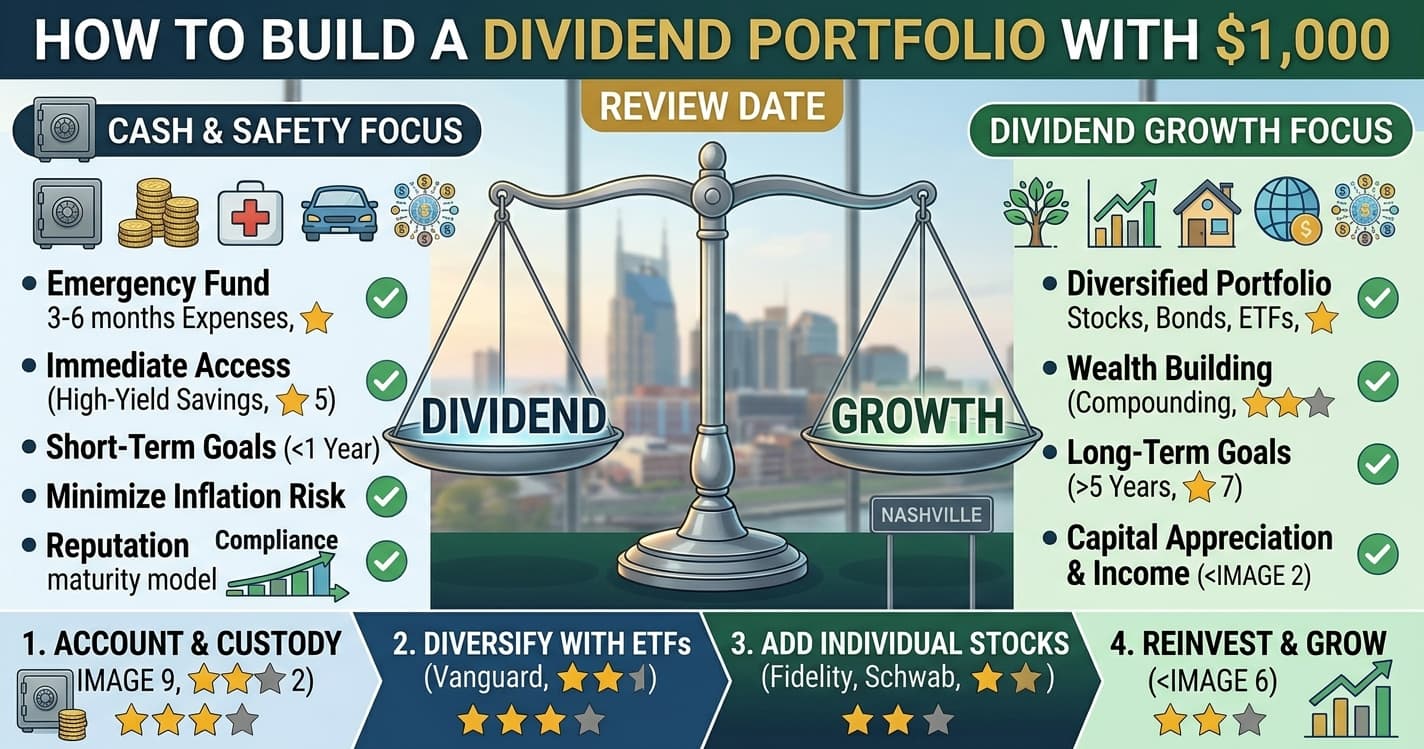
The Short Answer
Build a dividend portfolio with $1,000 by investing in 2–3 dividend ETFs like SCHD and VYM through a zero-commission brokerage, enabling DRIP, and adding $100–$200/month to grow your passive income stream over time.
How to Build a our full Dividend Portfolio Guide Portfolio With $1,000 (2026 Guide)
By DadAlt Investments | Category: Stocks & Best Brokerages for Dividend Investorss | Last Updated: March 2026
Building a dividend portfolio with $1,000 is both entirely possible and — if done right — one of the best financial habits you can start. The realistic first thing to understand: $1,000 at a 3.5% average dividend yield generates roughly $35 per year, or less than $3 per month. That number is not the point yet. The point is building the foundation — the accounts, the ETFs, the reinvestment automation, and the compounding flywheel — so that when you add $100 or $200 per month over the next five years, you are not starting from scratch. You are adding to a machine that already works. This guide covers exactly which dividend ETFs belong in a $1,000 starter portfolio (SCHD, VYM, and JEPI), why account type changes your after-tax returns as much as the ETFs you pick, how dividend reinvestment (DRIP) transforms $1,000 into a compounding engine, and when it actually makes sense to graduate from ETFs to individual dividend stocks. This is not a get-rich-quick article. It is a framework for the investor who wants passive income that actually grows — and is willing to be patient enough to let compounding do its job.
What a Dividend Portfolio Is — and What It Isn't
A dividend portfolio is a collection of stocks or ETFs that pay regular cash distributions to shareholders — typically quarterly or monthly — as a share of the company's earnings or income strategy. Dividend investing has a dedicated following among income-focused investors because it creates a tangible, recurring cash flow that does not require selling assets.
But framing matters. Here is what a dividend portfolio with $1,000 is not:
- It is not a replacement for a broad market index fund. A total market ETF like VTI gives you exposure to every sector of the U.S. economy including high-growth tech companies that pay little or no dividends. A dividend portfolio deliberately tilts toward mature, cash-generative companies and away from growth. You are making a trade-off.
- It is not passive income yet at $1,000. The income generated is a rounding error in your monthly budget. The value at this stage is the habit, the account structure, the compounding mechanism, and the foundation.
- It is not a substitute for an emergency fund. Market-traded assets can fall 20%–30% in a recession. Keep 3–6 months of expenses in a high-yield savings account before investing any amount in equities — dividend or otherwise.
Here is what it is:
- A tax-advantaged income stream (if held in the right account) that grows through both dividend reinvestment and share price appreciation
- A system that rewards patience — dividends paid on reinvested dividends, compounding year over year
- An accessible entry point for any investor willing to open a Roth IRA, contribute $1,000, and automate monthly additions
At $1,000 with a blended 4% yield, your annual dividend income is $40. That is honest. The goal of this guide is to show you how to grow that $40 into $400, then $2,000, then meaningful passive income — and how long each step realistically takes.
The Case for Starting With ETFs, Not Individual Dividend Stocks
The instinct for many new dividend investors is to research individual stocks — companies like Coca-Cola, Johnson & Johnson, or Realty Income — because dividends feel more concrete when they come from a recognizable company. That instinct, while understandable, is backwards at $1,000.
Here is why ETFs are the right starting point:
1. Instant diversification at the cost of one share
SCHD (Schwab U.S. Dividend Equity ETF) holds approximately 100 carefully screened dividend stocks. Buying one share of SCHD (approximately $25–$27) gives you proportional ownership in all 100 — in the same way that one share of VTI gives you a tiny piece of thousands of U.S. companies. At $1,000, you cannot meaningfully diversify across 15–20 individual dividend stocks without impractically small positions.
2. No single-company dividend cut destroys your income stream
The biggest risk in an individual dividend stock is a dividend cut — when a company reduces or eliminates its payout due to declining earnings, debt problems, or a strategic pivot. AT&T cut its dividend in 2022. GE slashed its dividend multiple times. Walgreens eliminated its dividend entirely in 2024. In an ETF like SCHD or VYM, one company cutting its dividend causes a fractional decline in total portfolio income — the other 99 or 450+ companies are still paying.
3. The ETF does the research and screening for you
SCHD tracks the Dow Jones U.S. Dividend 100 Index, which screens for companies with at least 10 consecutive years of dividend payments and ranks them on cash flow to debt, return on equity, dividend yield, and five-year dividend growth rate. VYM tracks the FTSE High Dividend Yield Index — a broad, rules-based screen for high-yielding U.S. equities. Neither requires you to read annual reports, evaluate payout ratios, or monitor quarterly earnings. The index methodology handles that continuously.
4. Automatic rebalancing
Index-based ETFs reconstitute periodically — removing companies that no longer qualify and adding new ones that do. Your portfolio stays current without any action on your part.
The individual dividend stock discussion is worth having once your portfolio exceeds $10,000 and your ETF core is established. At $1,000, ETFs are both more practical and more defensible.
The Core $1,000 Dividend ETF Portfolio
The following three-ETF allocation is a practical starting point for a $1,000 dividend portfolio, using the most widely held and analyzed dividend ETFs available in 2026:
| ETF | Allocation | Amount | Yield | Expense Ratio | Pay Schedule | Strategy |
|---|---|---|---|---|---|---|
| SCHD | 60% | $600 | ~3.5% | 0.06% | Quarterly | Dividend quality/growth |
| VYM | 25% | $250 | ~2.4% | 0.06% | Quarterly | Broad diversification |
| JEPI | 15% | $150 | ~7.5–8% | 0.35% | Monthly | Income + options overlay |
Blended portfolio yield: Approximately 4%–4.5% weighted average Annual income at $1,000: Approximately $40–$45 Monthly income cadence: Monthly income from JEPI; quarterly income from SCHD and VYM (paid in March/June/September/December)
SCHD — The Core (60% / $600)
SCHD is the consensus pick as the best all-around dividend ETF for long-term investors in 2026. It tracks the Dow Jones U.S. Dividend 100 Index, screening for 100 companies with 10+ consecutive years of dividend payments, filtered by quality metrics including cash flow-to-debt ratio, return on equity, and five-year dividend growth rate.1
Key metrics:
- Yield: ~3.5% (trailing twelve months as of early 2026)
- Expense ratio: 0.06% — extremely low for an actively screened dividend index
- 10-year annualized return: Approximately 12.21% (total return including dividends)
- Payment: Quarterly (March, June, September, December)
- Holdings: ~100 companies; concentrated in Financials, Healthcare, Consumer Staples, Industrials
- Inception: October 2011 — established 15-year track record2
SCHD's competitive advantage is its combination of above-average current yield (higher than VYM, much higher than VIG), quality screening (only financially strong companies qualify), and demonstrated dividend growth. It is the "do everything reasonably well" dividend ETF.
What SCHD is not: SCHD has minimal exposure to technology stocks because most tech companies either pay very low dividends or none at all. In a strong tech rally, SCHD will underperform the S&P 500 — this is the core trade-off of dividend investing.
VYM — The Diversifier (25% / $250)
VYM (Vanguard High Dividend Yield ETF) tracks the FTSE High Dividend Yield Index and holds 500+ dividend-paying U.S. stocks at a very low 0.06% expense ratio.1 Where SCHD holds ~100 quality-screened stocks, VYM holds ~500, prioritizing maximum diversification across dividend payers.
Key metrics:
- Yield: ~2.4% (lower than SCHD but still above average)
- Expense ratio: 0.06%
- 5-year annualized return: ~13.09%
- 10-year annualized return: ~11.03%
- Payment: Quarterly
- Holdings: 500+ companies — much broader diversification than SCHD3
VYM's role in the $1,000 portfolio is to reduce single-stock and sector concentration risk that comes with SCHD's more concentrated 100-stock approach. The two funds have a 0.95 correlation — they move together most of the time — but VYM's broader holding set provides meaningful diversification during SCHD-specific sector drawdowns.
SCHD vs. VYM for most investors: SCHD generally offers a higher yield (~3.5% vs. ~2.4%) and has outperformed VYM over 10 years (12.21% vs. 11.03% annualized). VYM is the better choice if maximum diversification is your priority or if you want broader market representation across dividend payers.2
JEPI — The Monthly Income Layer (15% / $150)
JEPI (JPMorgan Equity Premium Income ETF) is a fundamentally different kind of dividend ETF. It is actively managed by JPMorgan, holds approximately 124 large-cap U.S. stocks with a low-volatility tilt, and generates additional income by selling equity-linked notes (ELNs) tied to S&P 500 call options — an options overlay strategy that produces premium income on top of regular dividends.4
Key metrics:
- Yield: ~7.5%–8.34% (trailing twelve months) — more than double SCHD's yield
- Expense ratio: 0.35% — nearly six times SCHD's cost
- Payment: Monthly — 12 income payments per year
- 3-year cumulative return: ~30.89% (lower than SCHD's ~54% five-year total return — reflecting the upside cap from the options overlay)
- Maximum drawdown since inception: -13.71% — smaller than SCHD's -33.37% maximum drawdown, reflecting JEPI's lower-volatility defensive approach4
The critical JEPI trade-off: JEPI's ~7.5%+ yield is not free money. The options overlay strategy caps JEPI's upside during strong bull market rallies — when the market surges, JEPI's call options are exercised and it misses the top end of gains. In years like 2023 when the S&P 500 rose 26%, JEPI meaningfully underperformed. Over full market cycles including volatile periods (where option premiums are higher), JEPI's total return is more competitive.
Why 15% JEPI and not more: Keeping JEPI at 15% of the portfolio uses its high monthly income as a cash flow supplement without over-weighting the strategy's capped-upside limitation. At $150, JEPI generates approximately $11–$12 per year in income at its current yield — monthly payments of roughly $1. The value of that monthly income grows meaningfully as the portfolio scales.
Critical tax note: Hold JEPI in a Roth IRA or tax-advantaged account whenever possible. JEPI's distributions are a mix of qualified dividends, non-qualified dividends (from the options strategy), short-term capital gains, and return of capital — much of it taxed as ordinary income (20%–37% rate in a taxable account). In a Roth IRA, that distribution is permanently tax-free. More on this in Section 4.
Why Account Type Changes Everything
The same three ETFs held in different account types can produce meaningfully different after-tax returns over a 20–30 year period. Getting this right at $1,000 costs nothing and can save tens of thousands of dollars in taxes over a lifetime.
Roth IRA — Best for JEPI and High-Yield Positions
Inside a Roth IRA, all income — dividends, capital gains, option premiums — compounds and withdraws permanently tax-free (after age 59½, with the account open at least five years). This makes a Roth IRA the ideal location for the highest-yielding positions in your portfolio, specifically JEPI.
The math: $150 in JEPI generating 8% annually inside a Roth IRA for 30 years at 7% total return grows to approximately $1,140 — and every dollar of that $1,140 is withdrawn tax-free. The same $150 in JEPI in a taxable account loses a portion of each year's distributions to ordinary income tax (up to 37% for high earners) — significantly reducing the compounding base over time.
2026 Roth IRA contribution limit: $7,500 (under age 50) / $8,600 (age 50+)5 Account minimum: $0 at Fidelity, Schwab, Vanguard Income eligibility phase-out: Begins at $150,000 (single) / $236,000 (married filing jointly) in 2026
Taxable Brokerage — More Efficient for SCHD and VYM
SCHD and VYM pay predominantly qualified dividends — dividends from stocks held for more than 60 days that qualify for the lower long-term capital gains tax rate (0%, 15%, or 20% depending on your income). For most middle-income investors, qualified dividends are taxed at 15% — significantly lower than ordinary income rates.
If your Roth IRA capacity is limited and you need to hold some dividend ETFs in a taxable account, prioritize SCHD and VYM there and keep JEPI in the Roth IRA.
The Wrong Order: What Many Beginners Do
The most common account structure mistake is opening a taxable brokerage account (Robinhood, etc.) before opening a Roth IRA, because taxable accounts are marketed more aggressively and have no income documentation requirements. This costs real money in taxes on every dividend paid, every year, for as long as you hold the position.
The right order:
- Open a Roth IRA at Fidelity or Schwab ($0 to open)
- Invest the $1,000 across SCHD/VYM/JEPI inside the Roth IRA
- Set up automatic monthly contributions to the Roth IRA (up to the $7,500 annual limit)
- Overflow into a taxable brokerage only after the Roth IRA is maxed for the year
Building to $10,000: The Compounding Path
The $1,000 starting point matters less than what happens in the following 24–60 months. The compounding path from $1,000 to $10,000 is where the dividend investing habit is either established or abandoned.
Adding $100/Month: What the Numbers Look Like
At $100/month added to the $1,000 foundation, at a blended 7% total return (approximately 4% yield + 3% share price appreciation):
- After 1 year: ~$2,280 — generating ~$91/year in dividends
- After 2 years: ~$3,660 — generating ~$146/year in dividends
- After 3 years: ~$5,150 — generating ~$206/year in dividends
- After 5 years: ~$8,540 — generating ~$342/year in dividends ($28.50/month)
- After 7 years: ~$12,900 — generating ~$516/year in dividends ($43/month)
By year five at $100/month, you have crossed $8,000 and your dividend income has grown from $40 to over $340 per year — nearly a 10x increase in annual income from consistent, automated investing.1
Enable DRIP — Dividend Reinvestment Plan
A DRIP automatically uses each dividend payment to purchase additional shares of the same ETF rather than depositing the cash to your account. This is available at Fidelity, Schwab, and Vanguard at no additional cost.
Why DRIP matters at small portfolio sizes: At $1,000, your quarterly dividend from SCHD is approximately $5.25. That $5.25 buys a fractional share of SCHD. That fractional share generates its own dividend next quarter — a smaller amount, but added to the existing fractional. Over years, DRIP meaningfully accelerates portfolio growth because dividends are continuously reinvested at whatever price is available, including during market downturns when shares are cheaper.
The rule to fight: The temptation to turn off DRIP and take dividends as cash "because you've earned it" is real — and costly early in the compounding period. A $40 annual dividend spent in Year 1 rather than reinvested loses not just $40, but all future compounding growth on that $40. Resist spending dividends in the first five to seven years.
Scale Your Monthly Contribution With Income Growth
A practical approach:
- Month 1–12: $100/month — build the habit, ignore the small balance
- Year 2: Increase to $150/month as income grows or expenses decrease
- Year 3+: Target $200/month — each additional dollar invested at this stage has the longest compounding runway ahead of it
Most investors who successfully build dividend portfolios attribute the outcome not to stock picking or ETF selection but to automation — the recurring investment happening on the day after each paycheck regardless of market conditions, financial news, or short-term motivation.
Individual Dividend Stock Considerations
The case for individual dividend stocks is compelling once your portfolio is large enough to use them responsibly. At $1,000, you are not there yet. But knowing when and how to graduate from ETFs to individual stocks is worth understanding now.
When Individual Stocks Make Sense
The threshold most experienced dividend investors recommend: after your portfolio exceeds $10,000 with an established ETF core. At that level, you have enough capital to build a diversified individual stock position (15–25 stocks across 5+ sectors) without any single company representing a dangerous concentration.
At $10,000, adding $500–$1,000 in a single individual dividend stock represents 5%–10% of the portfolio — meaningful, but not catastrophic if that company cuts its dividend.
Dividend Aristocrats: The Safest Starting Point for Individual Stocks
Dividend Aristocrats are S&P 500 companies that have increased their dividend payments for 25 or more consecutive years. As of January 2026, there are 69 Dividend Aristocrats across 10 sectors. They must be members of the S&P 500, meeting minimum size and liquidity requirements.6
A tier above: Dividend Kings are companies that have raised their dividends for 50 or more consecutive years — currently 57 companies as of early 2026. Not all are S&P 500 members, but all have a multi-decade track record of consistent payouts through recessions, rate cycles, and industry disruptions.6
Notable current Dividend Aristocrats and Kings with updated 2026 data:
- Johnson & Johnson (JNJ): 63 consecutive years of dividend increases; $1.30/share quarterly payment; ~2.3% yield; AAA credit rating (one of only two U.S. companies); 2026 revenue guidance ~$100.5B7
- Procter & Gamble (PG): 65+ consecutive years of increases — the longest streak on the Aristocrats list; ~2.4% yield; $1.0568 quarterly dividend7
- Coca-Cola (KO): 63 consecutive years of increases; most recent quarterly dividend $0.53; ~3.0% yield; 5% organic revenue growth in Q4 2025; Warren Buffett's most famous income holding7
- McDonald's (MCD): 49 consecutive years of increases; global comp sales hit +5.7% in Q4 20257
Key Metrics to Evaluate Before Buying an Individual Dividend Stock
- Dividend yield: Current annual dividend divided by share price — target 2%–5% for sustainability; yields above 7% often signal elevated payout risk
- Payout ratio: Dividends paid as a percentage of earnings — under 60% is generally sustainable for most sectors; above 80% suggests the dividend is stretching the company's cash flow
- Consecutive years of dividend increases: 10+ years indicates a demonstrated commitment; 25+ (Aristocrat status) is the gold standard
- Dividend growth rate: The average annual percentage increase in the dividend — a 6%–8% growth rate means your income doubles roughly every 9–12 years without adding new capital
- Debt levels and free cash flow: Dividends are paid from free cash flow; high debt relative to cash flow is the most common precursor to a dividend cut
Concentration limit for individual stocks at this portfolio size: No single dividend stock should exceed 5% of your portfolio. A 5% position in a company that cuts its dividend is painful; a 15% position is a portfolio event.
What Your Dividend Portfolio Looks Like at Scale
Most investors starting with $1,000 want a realistic picture of what dividend income looks like as the portfolio grows. Here is what a blended 4% yield generates at different portfolio sizes:
| Portfolio Size | Annual Dividend Income | Monthly Income | Real-World Equivalent |
|---|---|---|---|
| $1,000 | $40/year | $3.33/month | A coffee |
| $10,000 | $400/year | $33/month | A utility bill |
| $50,000 | $2,000/year | $167/month | A car payment |
| $100,000 | $4,000/year | $333/month | A nice vacation per year |
| $250,000 | $10,000/year | $833/month | A meaningful income supplement |
| $500,000 | $20,000/year | $1,667/month | Substantial passive income stream |
These numbers assume a static 4% yield with no portfolio growth — in reality, a dividend growth strategy (SCHD-weighted) increases the yield-on-cost over time as dividends grow. An investor who bought SCHD in 2015 at a 3% yield is now receiving a higher yield-on-cost because SCHD's dividend per share has grown substantially in the decade since.
The Timeline to Meaningful Passive Income
At $200/month added to a $1,000 base, with a 7% total return and DRIP enabled:
- 5 years: ~$17,000 portfolio → ~$680/year in income ($57/month)
- 10 years: ~$36,000 portfolio → ~$1,440/year in income ($120/month)
- 15 years: ~$65,000 portfolio → ~$2,600/year in income ($217/month)
- 20 years: ~$108,000 portfolio → ~$4,320/year in income ($360/month)
Patience is the primary factor separating investors who build meaningful dividend income from those who do not. The math is not complicated — the execution requires staying invested through the years when $40 per year in dividends feels too small to matter.
FAQ
How Long Before Dividend Income Becomes Meaningful?
"Meaningful" depends on your definition, but a useful benchmark is $100/month in dividend income — roughly the level at which dividends begin to cover a real expense rather than feeling like a footnote.
At $200/month contributed with DRIP enabled and a 4.5% blended yield:
- To $33/month ($400/year): Approximately 5 years (portfolio ~$10,000)
- To $100/month ($1,200/year): Approximately 11–12 years (portfolio ~$30,000)
- To $500/month ($6,000/year): Approximately 22–25 years (portfolio ~$150,000)
The honest answer is that dividend income becomes practically meaningful in the $30,000–$50,000 portfolio range — a benchmark that, at $200/month plus DRIP, most investors can reach in 10–15 years starting from $1,000.
Should I Prioritize Dividend Yield or Dividend Growth?
For most long-term investors: dividend growth over raw yield. Here is why.
A company paying a 2.5% yield that grows its dividend 8% per year will be paying you significantly more money in 15 years than a company paying a static 5% yield with no growth. At year 15, the 2.5% starter at 8% growth is paying a 7.9% yield-on-your-original-cost — while the 5% static payer is still paying 5%.
The practical application: SCHD (quality-screened dividend growers) is more valuable than a high-yield fund with no dividend growth for a 20-year time horizon. JEPI (high-yield, minimal growth due to options cap) makes more sense in a retirement income context where you need cash flow now. Both have their place — the mix depends on your time horizon.3 4
Is a High Dividend Yield Always Better?
No — and this is one of the most important concepts in dividend investing. A very high yield (above 7%–8% on individual stocks or funds outside of options-based strategies like JEPI) is frequently a yield trap — a signal that the market has priced the dividend as likely to be cut.
A stock yielding 10% usually yields 10% because its share price has fallen significantly — often because investors expect a dividend cut. When the cut happens, the share price falls further and the yield resets lower. Investors who chased the 10% yield end up with both lower income and lower portfolio value.
The sweet spot for individual dividend stocks: 2%–5% yield with a payout ratio under 60%, 10+ consecutive years of increases, and a dividend growth rate above inflation. That combination produces sustainable income that grows over time, not a temporary high yield that evaporates.1
What Is a DRIP and Should I Always Enable It?
A DRIP (Dividend Reinvestment Plan) is a feature that automatically reinvests dividend payments into additional shares of the same security rather than depositing the cash into your account. It is available at no extra cost at Fidelity, Schwab, Vanguard, and most major brokerages.
Should you always enable it? For investors in the accumulation phase (building the portfolio, 10+ years from needing income), yes — virtually always. The compounding effect of reinvested dividends is one of the most mathematically powerful forces in long-term investing.
When to turn it off: Once you reach the income distribution phase — typically near or in retirement, when you want dividend income to cover living expenses — you turn off DRIP and let dividends flow to your brokerage cash account as spendable income. That transition is the "moment" the portfolio was built for.
Tax note on DRIP: Even when dividends are automatically reinvested through DRIP in a taxable brokerage account, they are still taxable in the year they are paid — the reinvestment is treated as a new purchase. This is another reason the Roth IRA is the preferred home for dividend ETFs: in a Roth IRA, reinvested dividends are never taxable at any point.
Sources and References
Disclaimer: This article is for informational and educational purposes only and does not constitute financial, tax, or investment advice. ETF yields, share prices, and dividend schedules are subject to change; all figures reflect early 2026 market data. Past dividend payments do not guarantee future distributions. Individual dividend stocks carry specific company risk including potential dividend cuts. DadAlt Investments may earn affiliate commissions from some links in this article at no cost to you.
Recommended Reading
- How to Build a Dividend Portfolio as a Beginner Dad
- Best Brokerages for Dividend Investors
- How to Create Passive Income with ETFs
Footnotes
-
DividendPro.io / MoneyNestLab. "Best Dividend ETFs for Passive Income in 2026." March 2026. https://www.dividendpro.io/blog/best-dividend-etfs-passive-income-2026 and https://www.moneynestlab.com/en/dividend-etf-calculators/guide/best-2026 — SCHD: 3.5% yield, 0.06% expense ratio, 100 holdings, tracks Dow Jones U.S. Dividend 100 Index, 10+ year dividend payment screen; VYM: 2.44% yield, 0.06% expense ratio, 500+ holdings; JEPI: ~7.5% yield, highest-yield ETF on list, 0.35% expense ratio, monthly distributions; SCHD widely considered best all-around dividend ETF for 2026. At $200/month with $100K at 7% total return: ~$400/year to ~$10,500/year income at scale. ↩ ↩2 ↩3 ↩4
-
PortfoliosLab. "SCHD vs. VYM ETF Comparison." https://portfolioslab.com/tools/stock-comparison/SCHD/VYM — SCHD 10-year annualized return 12.21% vs. VYM 11.03%; SCHD yield ~3.45% vs. VYM ~2.41%; both 0.06% expense ratio; SCHD launched October 2011; VYM launched November 2006; correlation between SCHD and VYM is 0.95 (high); SCHD maximum drawdown -33.37%, VYM maximum drawdown -56.98%. ↩ ↩2
-
BullishFlow / Yahoo Finance. "Dividend ETFs for Reliable Income in 2026." January 2026. https://bullishflow.com/best-dividend-etfs-for-2026-complete-analysis-and-rankings/ and https://finance.yahoo.com/news/3-dividend-etfs-better-schd-171755801.html — SCHD yield 3.82%, 0.06% ER; VYM yield 2.44%, 5-year return 13.09%; JEPI yield 8.21%–8.25%, monthly distributions, 3-year cumulative return 30.89%, 5-year cumulative return 60.32%; VYM 5-year annualized return 12% and 10-year annualized return 11.28%; SCHD gained 0.73% in 2025 due to low tech exposure. ↩ ↩2
-
REWD / Mezzi / PortfoliosLab. "SCHD vs. JEPI Complete Comparison — 2026 Guide." February 2026. https://retireearlywithdividends.com/blog/schd-vs-jepi-complete-comparison — JEPI yields ~7.5%, SCHD ~3.5%; JEPI expense ratio 0.35% vs. SCHD 0.06%; JEPI maximum drawdown since inception -13.71% vs. SCHD -33.37%; JEPI distributions mix of qualified dividends, non-qualified dividends, short-term capital gains, return of capital — most taxed as ordinary income in taxable accounts; JEPI's call options strategy caps upside during bull markets; hold JEPI in IRA to avoid ordinary income tax treatment; JEPI trailing twelve months yield ~8.34%; JEPI holds 124 stocks; sector diversification across Technology (19.3%), Healthcare (14.7%), Financial Services (13.1%), Industrials (13%). ↩ ↩2 ↩3
-
IRS Notice 2025-67 / DadAlt Investments internal data. 2026 Roth IRA contribution limit: $7,500 (under age 50); $8,600 (age 50+). Income phase-out begins at $150,000 (single) and $236,000 (married filing jointly). Account minimum $0 at Fidelity, Schwab, Vanguard. Qualified dividends (SCHD, VYM) taxed at 0%, 15%, or 20% long-term capital gains rate; JEPI distributions partially taxed as ordinary income 20%–37%. ↩
-
Sure Dividend / MoneynestLab. "2026 Dividend Aristocrats List: All 69 Ranked." https://www.suredividend.com/dividend-aristocrats-list/ and https://www.moneynestlab.com/en/dividend-etf-calculators/guide/dividend-aristocrats — 69 Dividend Aristocrats as of January 2026; three additions in 2025 (FactSet, Erie Indemnity, Eversource Energy); Dividend Aristocrats = S&P 500 members with 25+ consecutive years of dividend increases; Dividend Kings = 50+ consecutive years (57 Dividend Kings as of March 2026); Industrials lead with 16 companies; Consumer Staples 15 companies; 40%+ of Aristocrats index in Consumer Staples and Industrials vs. less than 20% in S&P 500; Aristocrats have historically delivered similar total returns to S&P 500 with lower volatility. ↩ ↩2
-
24/7 Wall St. / DividendPro. "Dividend Aristocrats in a Shaky Market: KO, PG, JNJ, and 2 Others Built to Last." March 2026. https://247wallst.com/investing/2026/03/06/dividend-aristocrats-in-a-shaky-market-ko-pg-jnj-and-2-others-built-to-last/ — JNJ: 63 consecutive years of increases; quarterly payment $1.30/share; ~2.3% yield; 2026 revenue guidance ~$100.5B; AAA credit rating (one of only two U.S. companies). PG: 65+ consecutive years; $1.0568 quarterly dividend; ~2.4% yield; faces $400M after-tax tariff headwind. KO: 63 consecutive years; quarterly dividend $0.53; ~3.0% yield; 5% organic revenue growth Q4 2025. MCD: 49 consecutive years; global comp sales +5.7% Q4 2025. ↩ ↩2 ↩3 ↩4
Frequently Asked Questions
Can I start a dividend portfolio with just $1,000?
Absolutely. With fractional shares and zero-commission brokerages, $1,000 buys you meaningful positions in multiple dividend ETFs. The key is consistency — adding money monthly matters more than your starting amount.
What dividend ETFs should I buy with $1,000?
Split between SCHD (dividend growth focus, ~3.5% yield) and VYM (broad high yield, ~3% yield) for a simple, diversified starting portfolio. Both have low expense ratios and strong track records.
How long until $1,000 in dividends becomes meaningful?
$1,000 at a 3.5% yield earns about $35/year in dividends. But if you add $200/month and reinvest dividends, you could reach $500+/month in passive dividend income within 12–15 years thanks to compounding.

About the Author
Jared DeValk
Founder, DadAlt Investments
Father, alternative investment researcher, and founder of DadAlt Investments. 14+ years turning hard lessons into honest guidance for dads building real wealth.