
Best Businesses You Can Buy for Under $50K (2026 Guide)
Guide to the best business categories available under $50K.
The Short Answer
The best businesses to buy under $50K include vending routes, cleaning services, content websites, lawn care companies, and mobile car detailing — all offer immediate cash flow with manageable learning curves for first-time buyers.
Best Businesses You Can Buy for Under $50K (2026 Guide)
By DadAlt Investments | Category: Buying Businesses | Last Updated: March 2026
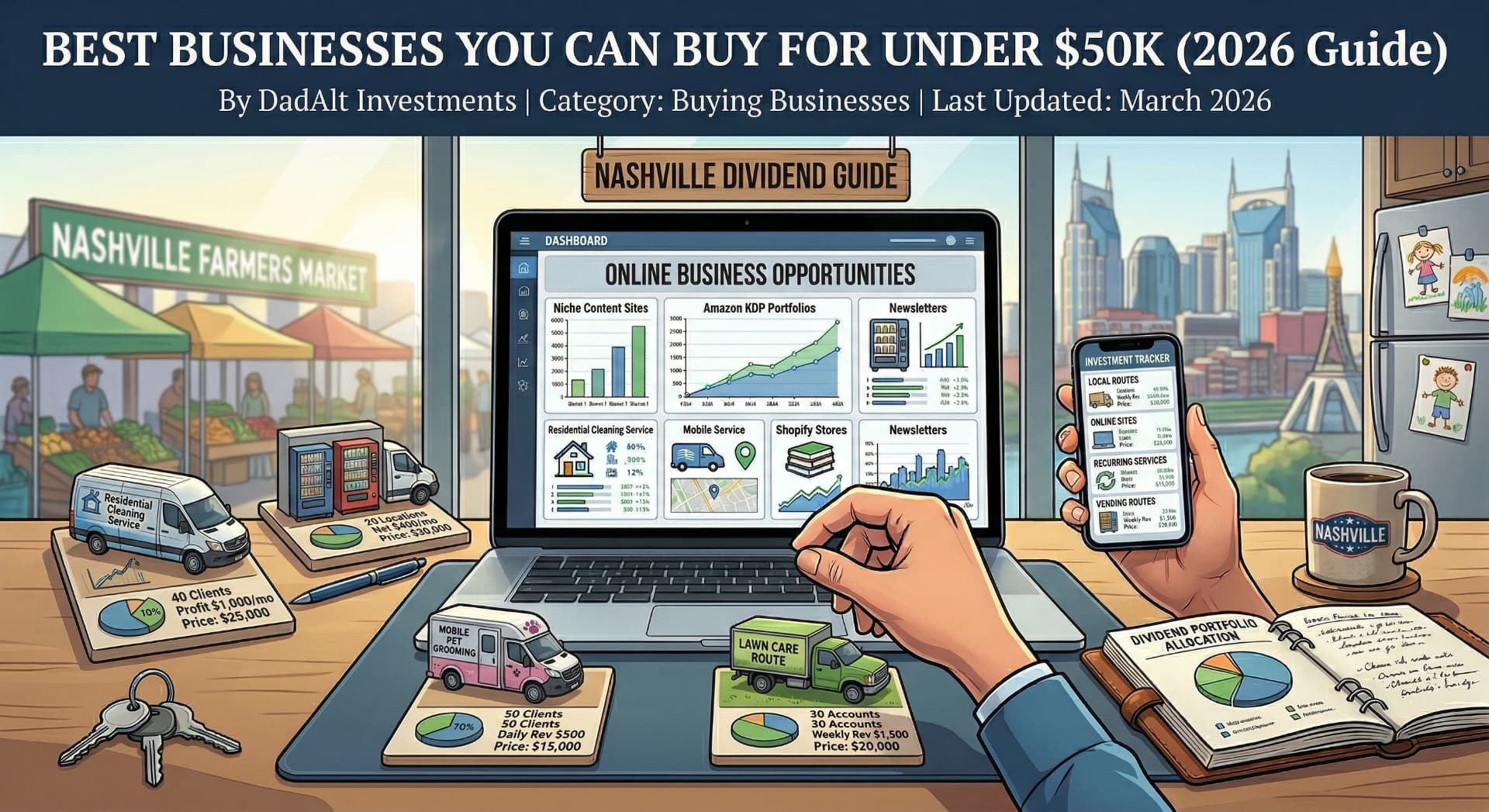
You don't need hundreds of thousands of dollars, an MBA, or a business broker to buy a profitable, cash-flowing business. The under-$50K acquisition market is one of the most overlooked opportunities in personal finance — a range where motivated sellers, realistic valuations, and self-financeable deals intersect to give ordinary investors genuine access to business ownership without catastrophic downside risk. A $30,000 content website generating $1,000/month in profit pays itself back in 30 months. A $25,000 residential cleaning business with 40 established clients generates predictable monthly revenue from day one. A vending machine route with 20 locations earning $400/month net can be bought for under $30,000 and scaled incrementally with zero technical skill. The 2026 market is particularly favorable for buyers in this range: content site multiples have compressed following Google algorithm volatility (creating value opportunities), the Baby Boomer retirement wave is flooding BizBuySell with motivated local service business sellers, and Flippa and Empire Flippers's under-$50K listings are at their deepest inventory in years.1 This guide covers the best business categories available under $50K, what they actually earn, where to find them, what to look for, and what red flags to avoid — everything a first-time buyer needs to make a smart, data-backed acquisition decision.
Why Under $50K Is the Smart Entry Point for First-Time Buyers
Lower Financial Risk While You Learn
Your first acquisition is a learning experience, no matter how well-prepared you are. At under $50K, the stakes are high enough to keep you focused but low enough that a suboptimal outcome — a business that earns less than expected, requires more time than projected, or needs to be sold at a loss — doesn't derail your financial life. First-time buyers who start small build pattern recognition, negotiation skills, and operational confidence that makes their second acquisition significantly better.
Self-Financeable Without Banks or Investors
SBA loans require 650+ credit scores, two-plus years of documented business profitability, and processing timelines of 30–90 days. Under-$50K deals skip all of that. You can use personal savings, a HELOC, a 401(k) loan, or negotiate financing a business purchase directly. Most sellers of small businesses are open to carrying a note — especially in the online business market where financing a business purchase is increasingly common. The absence of institutional financing means faster closes, fewer third parties, and more flexible deal structures.
Wide Enough Selection to Be Selective
BizBuySell lists thousands of businesses under $50K at any given time. Flippa's active inventory includes hundreds of content sites, e-commerce stores, and online businesses in the $5K–$50K range. You have the luxury of walking away from anything that doesn't feel right without missing a once-in-a-decade opportunity. For a full platform comparison, see buying businesses online.
The Math on Upside Potential
A business bought at a 3x earnings multiple — the rough standard for many small service and online businesses — has clear, simple return math:
| Purchase Price | Monthly Earnings | Payback Period | Annual Return on Investment |
|---|---|---|---|
| $15,000 | $500/month | 30 months | ~40% |
| $25,000 | $1,000/month | 25 months | ~48% |
| $40,000 | $1,500/month | 27 months | ~45% |
This ignores the terminal value — the resale value — of the business after you've improved it. Buy a $30,000 business, improve monthly profit from $800 to $1,500 through better marketing, and you've doubled the exit value to approximately $54,000 at the same multiple. The under-$50K market is where operational improvement creates the most leverage.
Online Businesses Under $50K
Online businesses are the most liquid, most geographically flexible, and most scalable category in the sub-$50K range. They require no physical space, no in-person employees to manage daily, and can often be operated in 5–15 hours per week by an active owner.
Niche Content Sites and Blogs: $10K–$40K
A niche content website is a blog or informational site that generates revenue through affiliate commissions, display advertising, or sponsored content — focused on a specific topic like personal finance, outdoor gear, home improvement tools, pet care, or DIY hobbies.
How they're valued in 2026: Content sites currently trade at 30x–40x monthly net profit (approximately 2.5x–3.5x annual profit) on the major marketplaces, according to data from Flippa and AcquireYet.2 At the lower end of that range — where much of the under-$50K inventory lives — a site earning $1,000/month in profit sells for roughly $30,000–$40,000.
What realistic earnings look like:
- Entry-level content site ($10K–$20K): $300–$700/month net profit
- Mid-range content site ($20K–$40K): $600–$1,200/month net profit
- Payback period at 35x monthly multiple: approximately 35 months
Key evaluating a business for content sites:
- Verify traffic through direct Google Analytics access — not screenshots
- Check the traffic trend over the past 24 months; any significant drop may correlate with a Google algorithm update
- Diversified traffic sources (organic search + email list + social) are worth more than pure SEO sites
- Diversified revenue (affiliate + display ads + email revenue) is more stable than a single monetization channel
Where to find them: Flippa (widest selection, all sizes), Motion Invest (pre-vetted smaller content sites), Quiet Light Brokerage (higher-quality curated listings $50K+)
Important 2026 context: Google's 2024 Helpful Content and March 2024 Core updates significantly affected many content sites. This has compressed multiples and created genuine value opportunities — but it has also produced many sites whose traffic has structurally declined. Verify traffic stability over the past 18 months before buying any content site.
Amazon KDP / Self-Publishing Portfolios: $5K–$30K
Amazon Kindle Direct Publishing portfolios — collections of published books earning royalties on Amazon — are one of the most underrated acquisition targets in the online space. A portfolio of 10–30 non-fiction books or children's books generating consistent royalty income can be acquired for low multiples because most buyers don't know this market exists.
What to look for:
- Royalty income verified through KDP dashboard access
- Non-fiction evergreen topics (personal finance, health, pets, business) have more durable demand than trend-based titles
- Low author name recognition — if royalties depend on the seller's personal brand, they may not transfer fully
Typical range: $5K–$30K for portfolios generating $200–$800/month in passive royalties
Where to find them: Flippa, Publish0x marketplace, direct seller outreach through KDP communities
Small Shopify and E-Commerce Stores: $10K–$50K
Established Shopify stores with a supplier relationship, brand assets, and documented sales history are available throughout the under-$50K range. The key distinction: you want a store with real sales history from real customers, not a dropshipping store with minimal traffic and optimistic projections.
E-commerce valuation in 2026: Small owner-operated e-commerce stores typically sell at 2.5x–4x annual SDE depending on brand strength, growth trend, and supplier exclusivity.3
Operational reality: Small e-commerce stores are not passive — they require active customer service, inventory management, and marketing attention. Budget 10–20 hours/week, especially in the first 6 months.
Where to find them: Flippa, Exchange Marketplace (Shopify's native marketplace)
Newsletter and Email List Businesses: Emerging Under-$50K Market
Email newsletters with 5,000–30,000 engaged subscribers focused on a specific niche are an emerging acquisition category. While still early-stage as an asset class, newsletters with documented open rates (25%+), consistent sponsorship revenue, and a defined content calendar are increasingly transacting in the $10K–$40K range.
The email list advantage: Unlike SEO-dependent content sites, email audiences are owned and are not subject to algorithm changes.
Where to find them: Flippa, Twitter/X acquisition communities, direct outreach to newsletter operators
Service Businesses Under $50K
Local service businesses are the most traditional and most accessible acquisition for first-time buyers who want a business with physical customer relationships, recurring revenue, and low technological complexity. These businesses often come with equipment, established routes or client lists, and immediate cash flow from day one of ownership.
Residential Cleaning Services: $10K–$40K
A residential cleaning service with 30–60 established recurring clients is one of the cleanest (no pun intended) acquisition targets in this price range. Clients on weekly or biweekly schedules generate predictable monthly revenue. The business doesn't depend on the seller's personal expertise — the service is delivered by cleaners, not the owner.
What a typical deal looks like:
- 40 clients generating $150–$200/visit, weekly or biweekly = $2,500–$4,000/month revenue
- After labor, supplies, and insurance: $800–$1,500/month net profit to the owner
- Acquisition price with equipment: $15,000–$35,000
Critical due diligence question: Are the client relationships tied to the individual cleaner or to the business? If clients hired the business (not the specific cleaner), relationships transfer. If they hired the person, they may not.
Where to find them: BizBuySell (search "cleaning" + your state/metro), local business brokers, Facebook Marketplace, Craigslist business listings
Lawn Care and Landscaping Routes: $5K–$30K
A residential lawn care route — a defined set of properties serviced on a weekly or biweekly schedule during the growing season — is one of the most straightforward acquisitions in any price range. You're buying a client list, equipment, and recurring appointments.
The business model:
- 25–50 weekly lawn accounts at $40–$60 per visit = $1,000–$3,000/week during peak season
- Owner-operated in the $5K–$15K range; routes with helpers in the $15K–$30K range
Seasonal revenue reality: Lawn care is seasonal in most U.S. markets (April–November in northern states, year-round in the Sun Belt). Model your annualized earnings accordingly before paying a full-year multiple.
Scalability: Adding accounts incrementally is straightforward — buy a route, operate it yourself initially, hire a helper once cash flow allows, and grow.
Where to find them: BizBuySell, Craigslist, local Facebook groups for landscaping businesses, direct outreach to solo operators signaling retirement
Pressure Washing Businesses: $5K–$20K
Pressure washing is a low-skill, high-demand service with minimal recurring overhead and strong margins. A small owner-operated pressure washing business — one trailer, one machine, a client list, and basic insurance — can generate $3,000–$6,000/month in revenue during peak season with strong net margins.
Why pressure washing transacts cheap: Many owners are solo operators who price their own business poorly. An established route with equipment and customer reviews has meaningful value that an inexperienced seller often underprices.
What you're buying:
- Pressure washer equipment (commercial grade): $3,000–$8,000 replacement cost
- A trailer or truck mount setup: $3,000–$10,000
- Established Google reviews and customer list: $2,000–$5,000 value to a buyer
Total acquisition range: $5,000–$20,000 for a one-man operation with established clientele
Where to find them: Facebook Marketplace, BizBuySell, Craigslist, local operator outreach
Mobile Pet Grooming: $15K–$40K
Mobile pet grooming — a fully equipped grooming van that visits clients at their homes — combines recurring revenue (pets get groomed every 4–8 weeks), a growing market (U.S. pet spending exceeded $147 billion in 2023 and continues rising), and geographic flexibility. Established mobile groomers with a full appointment book are genuinely difficult to find; when they come to market, they typically sell quickly.
What you're buying:
- A converted van with grooming equipment ($20,000–$40,000 replacement cost)
- An established appointment book of 50–100+ recurring clients
- Supplier relationships (shampoos, tools)
Revenue model: 5–8 appointments/day at $75–$125/appointment = $375–$1,000/day revenue. Even 4 days/week generates meaningful income.
Acquisition price: $15,000–$40,000 for an established operation with book of clients
Where to find them: BizBuySell, local pet groomer Facebook groups, direct outreach to established mobile groomers
Vending Machine Route Businesses: $25K–$50K
Vending machine routes are among the most dad-friendly acquisitions in this guide: semi-passive income investments, flexible hours, no employees to manage, no customer service beyond restocking, and a business model simple enough to explain to your kids.
How a Vending Route Works
You own a collection of machines placed in high-traffic locations (offices, gyms, laundromats, schools, warehouses, medical offices). The locations provide the space at no cost in exchange for the vending service. You service the machines weekly or biweekly — restocking product and collecting cash or mobile payment receipts.
The income model:
- Machine average gross: $150–$400/month per machine
- After product cost (food/drink cost of goods: typically 35–50% of gross): $75–$200/month net per machine
- 20 machines at $100/month net average: $2,000/month
What a $25K–$50K Route Looks Like
A typical established route acquisition at this price point includes:
- 15–30 machines — combination of snack machines, drink machines, and combo units
- Established location contracts — office buildings, gyms, factories, schools with existing permission
- Equipment (often 5–10 years old, still functional)
- Route logistics — which locations to service, on what schedule, with which products
Acquisition price math:
- 20 machines at $1,000–$2,000 each replacement cost = $20,000–$40,000 in equipment value
- Established route adds a premium for the location relationships and existing income
- Total typical acquisition price: $25,000–$50,000 for a generating route
Why Vending Is Ideal for First-Time Buyers
- Truly semi-passive — 5–15 hours/week of physical route servicing once established
- All cash or mobile payments — simple accounting, minimal accounts receivable
- Scalable — add machines one at a time as cash flow allows; no step-change capital needed
- Tangible assets — machines have real replacement value; worst-case, you can sell the equipment
- No employees — most routes are owner-operated without staff
Where to find them: BizBuySell (search "vending"), BizQuest, Craigslist, local classified ads, direct outreach to existing vending operators
What to Look for in a Sub-$50K Business
These four criteria apply across every category — online and offline.
1. Positive, Documented Cash Flow
The business should generate at least break-even cash flow — ideally $1,500–$3,000/month in net profit. Anything below $1,000/month at a $30,000+ acquisition price is a challenging investment; the payback period extends to 3+ years with no margin for operational disruption.
Verify cash flow through:
- Bank statements (actual deposits, not P&L summaries)
- For online businesses: payment processor records (Stripe, PayPal, Amazon Seller Central)
- Tax returns (Schedule C or business return) for the past 2–3 years
2. Transferable Customer Relationships
The clients, accounts, or traffic must transfer to a new owner without requiring the seller's ongoing personal involvement. Ask specifically: Why would a customer or advertiser continue after you leave?
- Content site: Are readers coming for the topic or for the specific author's voice?
- Cleaning business: Do clients call the company number or the owner's personal cell?
- Vending route: Are location contracts with the business entity or with the individual?
3. Documented Systems and Operating Procedures
A business that only the current owner can run is a job, not an acquisition. Look for:
- Written standard operating procedures (SOPs) for recurring tasks
- Supplier contacts, account numbers, and purchasing history documented
- Equipment inventory and maintenance records
- For online businesses: content calendar, monetization accounts, publishing workflow
4. A Clear, Credible Reason for Sale
Sellers don't give away profitable businesses without a reason. The most common legitimate reasons in the under-$50K market:
- Retirement or health (common in local service businesses)
- Pivot to a different business or career (common in online businesses)
- Lifestyle change (moving, having children, reducing workload)
Treat with skepticism:
- "I just don't have time for it anymore" — often code for "the business is declining and I'm exhausted"
- "I want to pursue my passion" — sometimes true; sometimes the business financials tell a different story
- Any reason that feels scripted or rehearsed without specific detail
Ask the seller directly: What have been the three biggest challenges in this business? A seller who can answer that honestly is usually a seller you can trust.
Red Flags in Cheap Business Listings
1. High Claimed Revenue Without Verifiable Documentation
A listing showing $5,000/month revenue with no bank statements, no payment processor records, and no tax returns to corroborate is a listing to walk away from. In the sub-$50K market, sellers who won't verify their numbers are not sellers operating in good faith. Revenue screenshots can be fabricated; bank deposit records cannot.
2. Businesses in Structurally Declining Industries
Some industries face headwinds that no operator can overcome:
- Print publishing businesses (unless niche and defensible)
- Businesses whose primary revenue depends on a platform algorithm that has already begun to penalize them
- Brick-and-mortar retail in categories structurally displaced by e-commerce
- Any business whose primary customer is shrinking as a demographic
3. Single-Customer Revenue Concentration
If more than 30% of the business's revenue comes from one customer, one platform, or one client, you are buying fragility. A single customer leaving post-acquisition — which happens more often than sellers predict — can cut the business's revenue by a third overnight. Some concentration is acceptable; majority concentration is a dealbreaker at the under-$50K level where there is no financial cushion to absorb it.
4. A Seller Who Refuses to Provide Financial Records
This is the clearest red flag of all. Any seller unwilling to provide at minimum:
- 2–3 years of P&L statements or tax returns
- 12 months of bank statements
- Access to payment processor dashboards (for online businesses)
- Equipment inventory and condition report (for physical businesses)
...is a seller hiding something. Full stop. There is no legitimate reason a seller of a small business cannot provide these documents if the business is healthy and the financials are real.
FAQ
Can a business under $50K actually generate meaningful monthly income?
Yes — and in many cases, sooner than you'd expect. A $25,000 residential cleaning business with 40 clients can generate $1,200–$1,800/month in net profit from the first month of ownership. A $35,000 content site with verified traffic generating $1,000/month in affiliate and display revenue pays itself back in under 3 years while you own an appreciating asset. The income is rarely transformative in isolation at this price range, but it is genuinely meaningful — especially as a second income stream or as a proof-of-concept for your first acquisition before you buy something larger.2
What are the best online businesses to buy for under $50K?
In 2026, the strongest online business acquisitions under $50K are:
- Established affiliate content sites in evergreen niches (personal finance, health, tools/home improvement) with diversified traffic sources, verified revenue, and a track record of 18+ months
- Email newsletter businesses with 10,000+ engaged subscribers in a defined niche — owned audience, algorithm-proof
- Small Shopify stores with a proven product and existing customer reviews, in a niche with repeat purchase potential
- Amazon KDP portfolios in non-fiction evergreen topics with consistent royalty history
Avoid: content sites that dropped significantly in the Google March 2024 or later core updates unless you understand SEO recovery and are pricing accordingly.
How long until a small acquisition pays itself back?
At standard market multiples in 2026, payback periods for different categories:
| Business Type | Typical Multiple | Payback Period |
|---|---|---|
| Niche content site | 30–40x monthly profit | 30–40 months |
| Local service business | 1.5–2.5x annual SDE | 18–30 months |
| Vending machine route | 18–24x monthly net | 18–24 months |
| Small e-commerce store | 2.5–3.5x annual SDE | 30–42 months |
The payback period calculation assumes the business continues to perform at its historical rate. Businesses that improve under new ownership pay back faster; those that decline, slower. Local service businesses with physical recurring clients typically carry lower risk of decline than algorithm-dependent content sites.
Should I buy a small local business or start one from scratch under $50K?
For most investors, buying beats starting in this price range — with an important caveat.
Buy when:
- You want immediate cash flow (an established business earns from day one; a startup does not)
- You're acquiring skills in a new industry and want an existing framework to learn within
- You have the capital available and are willing to pay a multiple for reduced startup risk
- The specific business type has a proven model with documented performance
Start when:
- The type of business you want is highly personal-skill-dependent (the seller's competitive advantage is their unique ability, which you don't share)
- You can build the core asset yourself at a fraction of the acquisition price (a new content site, a new e-commerce store with a unique product idea)
- The available acquisition inventory in your target category is overpriced relative to the risk
The financial case for buying over starting: at $25,000 invested in an established business, you have immediate cash flow and a proven model. At $25,000 invested starting from scratch, you have equipment, marketing spend, and 12–24 months of break-even uncertainty. For first-time buyers who can tolerate the acquisition process, buying a small, proven business is almost always the faster path to actual income.
Sources and References
Disclaimer: This article is for informational and educational purposes only and does not constitute financial, legal, or business acquisition advice. Buying a business involves significant risk including the risk of total loss. Past performance of similar businesses does not guarantee future results. Always conduct thorough independent due diligence and consult qualified legal and accounting professionals before completing any business acquisition. DadAlt Investments may earn affiliate commissions from some links in this article at no cost to you.
Recommended Reading
- How to Buy a Small Local Business for Under $100k Down
- How to Finance a Business Purchase Without Savings
- 5 Side Business Ideas You Can Start This Weekend
Footnotes
-
BizBuySell. "Insight Report — 2026 Outlook and Market Trends." https://www.bizbuysell.com/insight-report/ — Baby Boomer retirement wave; 80% of brokers forecast higher deal volume; market conditions. ↩
-
AcquireYet. "How Much Is My Website Worth? The Complete 2026 Valuation Guide for Blogs and Online Businesses." https://www.acquireyet.com/knowledgebase/how-much-is-my-website-worth-the-complete-2026-val/ — Content sites 30–40x monthly profit; 2.5–3.5x annual; 35-month payback at midpoint multiple. ↩ ↩2
-
FE International. "How Much Is Your Business Really Worth? What Most Owners Get Wrong About Valuation." January 2026. https://www.feinternational.com/blog/how-much-business-worth-valuation-2025 — Amazon FBA/e-commerce 2.5x–4x SDE; Empire Flippers content/affiliate sites 25–34x monthly; valuation methodology. ↩
Frequently Asked Questions
Can I really buy a profitable business for under $50K?
Yes — many service-based and online businesses sell for $20K–$50K with immediate positive cash flow. Vending routes, cleaning businesses, and small content websites are commonly available in this range.
What's the ROI on a $50K business investment?
Well-chosen small businesses typically return 30–100% on invested capital annually. A $50K cleaning business generating $50K/year in owner earnings is a 100% ROI — far better than any stock market return.
Where do I find businesses for sale under $50K?
BizBuySell, Flippa, Facebook Marketplace, and local business brokers all list sub-$50K businesses. Craigslist occasionally has good deals too. Networking with local CPAs and attorneys can surface off-market opportunities.

About the Author
Jared DeValk
Founder, DadAlt Investments
Father, alternative investment researcher, and founder of DadAlt Investments. 14+ years turning hard lessons into honest guidance for dads building real wealth.